Facebook
 Google
 GitHub
 Linkedin
Bosch Intros MEMS-Based Bluetooth Tire Pressure Sensors
The new SMP290 sensor integrates Bluetooth Low Energy to simplify vehicle electronics and extend sensor lifespan.
At Sensors Converge 2025 this week, Bosch announced the launch of the SMP290, a compact tire pressure monitoring system (TPMS) sensor that integrates Bluetooth Low Energy (BLE). Recent years have seen tire pressure monitoring systems become mandatory in major markets like Europe, the U.S., and China.
.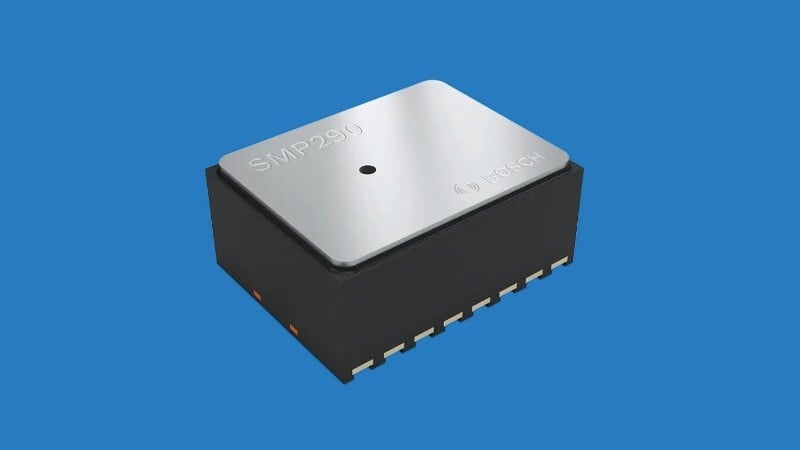
In a tiny package, the SMP290 embeds an MCU, a pressure sensor, a 2-axis accelerometer, a temperature sensor, a battery voltage sensor and a BLE interface. Image used courtesy of Bosch.
The first fully integrated MEMS-based TPMS solution on the market with BLE functionality, the SMP290 aims to relieve the electronic and architectural burden on designers by consolidating sensing and communication functions into a single, low-power device.
A Closer Look at the SMP290
The SMP290 combines several sensing and processing elements within a 4.5 mm x 3.5 mm DFN package. The design is based around an energy-efficient 32-bit ARC EM6 microcontroller supported by 256 KB of flash and 64 KB of RAM.
Meanwhile, the sensor array includes a MEMS pressure sensor, a temperature sensor, a two-axis accelerometer, and a battery voltage monitor. These components are integrated together with a BLE 5.3 interface, allowing the SMP290 to communicate directly with vehicle systems or external devices like smartphones.
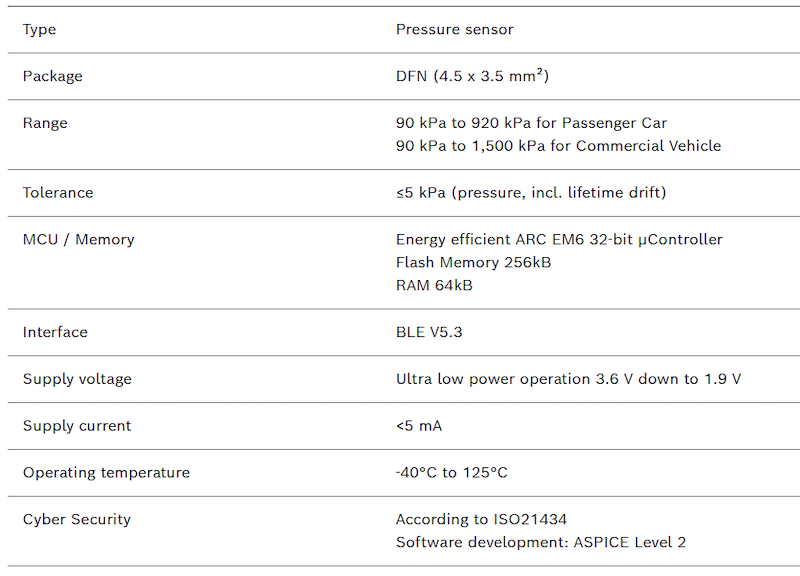
The SMP290’s operating specs. Image used courtesy of Bosch.
Engineered for both valve-mounted and in-tire configurations, the pressure sensor covers a measurement range of 90 kPa to 920 kPa for passenger vehicles and up to 1,500 kPa for commercial applications. Bosch specifies a pressure tolerance of ≤5 kPa across the sensor’s operational life, which spans a temperature range from -40°C to 125°C.
Electrically, the SMP290 operates at voltages from 1.9 V to 3.6 V and draws less than 5 mA. According to Bosch, such efficiency can unlock battery lifespans of up to ten years. The system is also compliant with ISO 21434 for cybersecurity and development aligned to ASPICE Level 2.
Why Bluetooth in Tire Pressure Monitoring?
Traditionally, TPMS solutions have relied on proprietary radio frequency (RF) links that communicate through a centralized vehicle control unit. In contrast, BLE-enabled sensors like the SMP290 can interact directly with both vehicle systems and consumer devices, thereby creating new vectors for diagnostics, monitoring, and software updates.
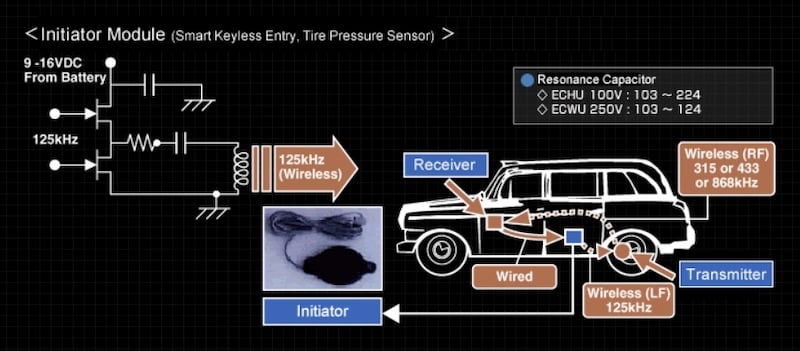
A TPMS architecture. Image used courtesy of Panasonic.
For starters, BLE 5.3 brings several advantages over earlier wireless protocols with respect to energy efficiency, connection latency, and throughput. BLE also supports bidirectional communication, which enables features such as over-the-air firmware updates and real-time diagnostics, which were previously restricted to more complex and costly system architectures.
Moreover, BLE’s compatibility with smartphones and tablets allows for user-facing applications such as mobile tire pressure checks or early warning alerts without requiring an intermediary vehicle gateway.
From an engineering standpoint, embedding BLE in TPMS sensors reduces wiring, simplifies the electronic/electrical (E/E) architecture, and enhances modularity. Designers can eliminate dedicated RF modules and consolidate communication across a shared BLE infrastructure, potentially including other systems like keyless entry or infotainment. The technology, therefore, reduces material and integration costs while improving system flexibility.
A New TPMS Approach
Bosch’s SMP290 shows how MEMS innovation and BLE integration can drive down complexity while expanding functionality in vehicles. As OEMs push toward centralized and software-defined vehicle architectures, components like the SMP290 can support the migration by offering multifunctionality, long service life, and wireless interoperability. The SMP290 is currently available for sampling.