Facebook
 Google
 GitHub
 Linkedin
Broadcom Claims ‘World’s First’ Quantum-Safe Gen 8 128G SAN Switch
Announced today, Broadcom’s Gen 8 128G Fibre Channel switch portfolio is claimed as the first quantum-safe, SAN architecture with 128G speed, AI-powered SAN management, and quantum-safe cryptography.
Today, Broadcom introduced the “industry’s first” 128G Fibre Channel switching platforms with the debut of the Brocade X8 Directors and the G820 56-port switch. The launch pairs new hardware with Fabric OS v10.x and expanded SANnav capabilities, leading Broadcom to claim its Gen 8 portfolio as the highest-performance and most secure SAN architecture available.
All About Circuits spoke with Scott Shimomura, Director of SAN Product Marketing for Brocade (a Broadcom company), to hear more about the launch.
Fibre Channel as a Purpose-Built Storage Network
Fibre Channel has persisted for three decades because it is still the only transport protocol engineered specifically for storage workloads. Even as Ethernet has advanced, it is a general-purpose transport. Fibre Channel, on the other hand, is a uniquely isolated, lossless fabric with purpose-built hardware and a tightly controlled software stack.
One of the protocol’s most notable features is a credit-based flow-control mechanism that guarantees deterministic delivery by matching buffer availability at every hop. Functionally, it eliminates packet drops and retransmission penalties that can disrupt latency-sensitive I/O.
“When we ask our customers why they continue to deploy Fibre Channel, the first response is almost always reliability,” said Shimomura. “The expectation on network reliability is 6/9s reliability, where the downtime experience is measured in seconds, not minutes or hours.”
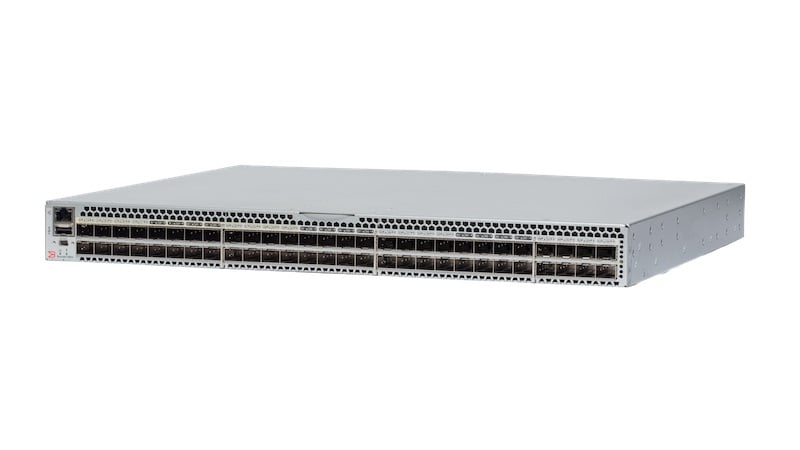
The Brocade Gen 8 G820 Fibre Channel switch
To this end, Broadcom’s Gen 8 switch reduces local switching latency to 580 ns using dual FEC, an improvement over Gen 7’s 460 ns single-FEC architecture, while doubling maximum supported speed from 64G to 128G. The fabric architecture also scales cleanly, with up to 384 128G ports on the X8 Director and support for 128 UltraScale inter-chassis links to maintain bandwidth headroom during network expansion.
Architecture for Enterprise AI and High-Density Storage
As organizations begin to apply AI inference to production datasets rather than historical training sets, the storage network is expected to deliver high throughput and minimal latency with strict performance isolation. As Shimomura notes, “We believe the AI infrastructure will move to the data center because customers want to apply AI to the data that runs their most important applications, and they don’t want to move that data off-prem.”
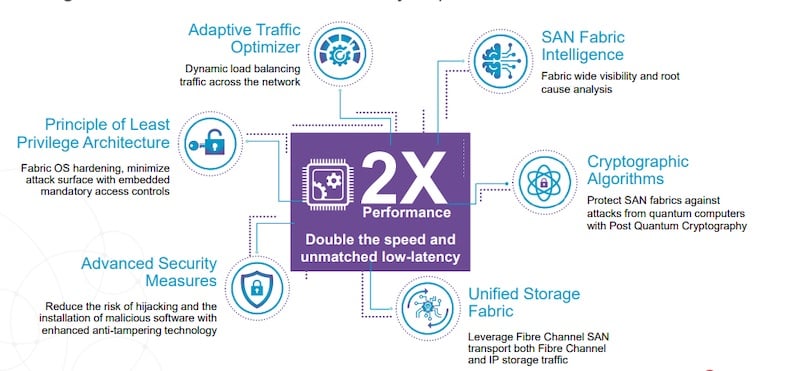
Features of the Brocade Gen 8 technology
To that end, Brocade G820 offers 56 ports of 128G SFP+ in a 1U design. Its one-chip 96-lane architecture allows Broadcom to dedicate 56 lanes to active ports for a dense top-of-rack building block that can sustain high-IOPS workloads with minimal hop latency. The chip also introduces modular scalability and I/O ports that support Fibre Channel and encapsulated IP storage traffic. In that way, Broadcom helps organizations bring NVMe/TCP into a predictable Fibre Channel environment without turning the SAN into a general-purpose IP network.
And, to manage heterogeneous and high-volume traffic, Gen 8 introduces the Adaptive Traffic Optimizer, which continuously classifies flows based on protocol, speed, and latency profile. It groups similar flows into dedicated performance classes to prevent slower traffic from blocking higher-speed NVMe or FC32 workloads. When traffic composition shifts, the system re-provisions virtual channels dynamically to match real-time demand.
Quantum-Safe Cryptography and Hardening Measures
Another notable feature of the release is that Broadcom has added safeguards for future quantum-enabled attacks. As Shimomura says, “Quantum computing is coming, and we're planning for a future where security is going to be more important than ever… It’s better for us to be planning and executing now in anticipation of where we think things are going.”
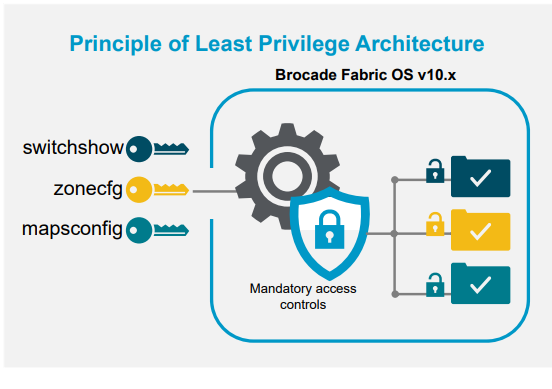
Broadcom’s Principle of ‘Least Privilege Architecture’
Specifically, Gen 8 introduces quantum-safe cryptography for switch-to-switch links. It uses AES-256 in-flight encryption and full support for CNSA 2.0-aligned post-quantum algorithms, with further hardening based on a principle-of-least-privilege architecture embedded in Fabric OS 10.x.
Similarly, Broadcom implements mandatory access controls that restrict administrative actions to narrowly scoped roles. They also validate firmware integrity with hardware-rooted trust anchors and anti-tampering mechanisms that block unverified software loads.
For end-to-end protection, Gen 8 also integrates with Emulex host bus adapters through SPDM-based authentication and attestation.
Telemetry, Autonomy, and Fabric-Wide Visibility
According to Shimomura, Gen 8 uses AI-powered features to remove manual correlation work traditionally required in SAN management. Dubbed “SAN Fabric Intelligence”, the feature correlates data across the entire fabric and maps traffic from virtual machines through switch ingress and egress points to individual storage devices. In turn, it lets the system identify sources of congestion, slow-draining devices, over-subscription patterns, and recurring issues over time.
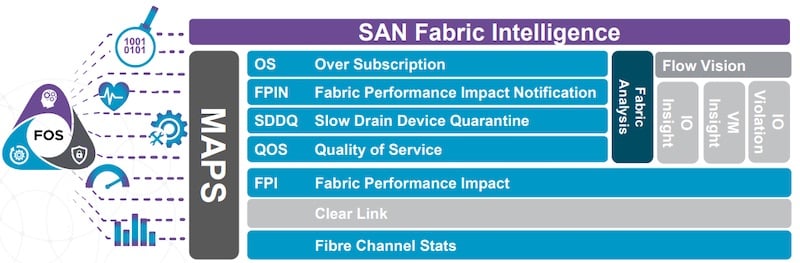
Broadcom’s SAN Fabric Intelligence
Broadcom derives many of these algorithms from machine-learning analysis performed in its support environments, then hard-codes them into FOS for consistent real-time operation. Shimomura notes that while these routines do not represent adaptive learning in the strictest AI sense, they apply insights from large-scale fleet analysis to autonomously correct or isolate problematic flows during active operation.
Preparing for the Quantum Era
The Gen 8 platform continues Broadcom’s view that data centers require deterministic performance and aggressive security postures. Reflecting, Shimomura puts it into perspective.
“We’ve been around since ’95 and many in the IT industry have predicted the death of Fibre Channel many times. As much as the industry thinks we’re going away, I think we’re going to be here for a long time.”
All images used courtesy of Broadcom.