Facebook
 Google
 GitHub
 Linkedin
Electronica Exclusive: Synaptics Makes Edge AI Pivot to Meet the IoT Evolution
The company is taking on a new role to embrace the world of IoT.
At Electronica 2024, Synaptics presented itself as a company in transition. Renowned for its legacy in touch and fingerprint technologies, the company is charting a new course in edge processing and AI for IoT. I had the opportunity to sit down with Neeta Shenoy, vice president of corporate marketing, and Nebu Philips, senior director of strategy and business development for IoT/edge processors.
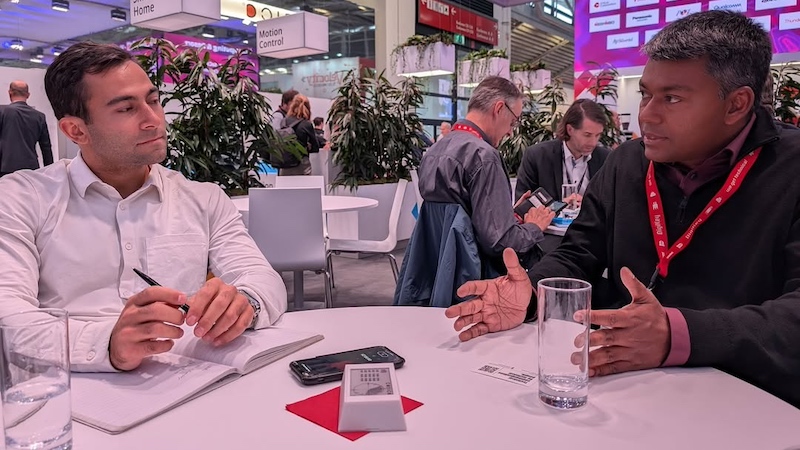
At Synaptics’ Electronica booth, Jake Hertz (left) sat down to interview Synaptics’ Nebu Philips (right) and Neeta Shenoy (not shown). Images used courtesy of Synaptics’ Instagram
Though Synaptics did not unveil new products at the conference, the conversation provided an in-depth look at their 2024 achievements and their vision for the future.
Synaptics Builds a New Identity
Synaptics has long been a leader in IoT connectivity by providing solutions for devices like smart appliances and security systems. This year, the company launched its Astra line of processors, a clear indication of the company’s shift toward a more comprehensive role in IoT.
“We’re in the early stages of establishing ourselves as a processor company for IoT,” Shenoy explained. “Historically, we’ve been recognized for our connectivity solutions. With Astra, we’re combining compute and connectivity to strengthen our story in IoT markets like smart home, security, and appliances.”
This repositioning is a strategic effort to compete with established players such as NXP, STMicroelectronics, and Texas Instruments. Synaptics is creating an ecosystem that integrates its connectivity IP with cutting-edge processing capabilities. The goal is to provide end-to-end solutions supported by a robust distribution network and go-to-market strategies.
The Astra line, currently available, is designed to address the need for low-power, efficient compute in edge applications. Shenoy acknowledged that scaling in the processor market will take time but expressed confidence in their growing portfolio and partnerships.
AI Models for Real-World IoT Applications
Philips elaborated on Synaptics’ approach to embedding AI into IoT devices. While many AI solutions rely on cloud-based processing or large hardware, Synaptics is designing efficient, localized AI models that work within the constraints of IoT environments.
“One of the key challenges is adapting AI to resource-constrained devices,” said Philips. “Our processors, equipped with built-in NPUs, accelerate AI models like transformers and enable real-time applications.”
At Electronica, Synaptics showcased a contextual language model integrated into a dishwasher demo. The dishwasher used AI-enabled voice interactions for appliance-specific queries, such as cycle details or loading instructions, without requiring internet connectivity.
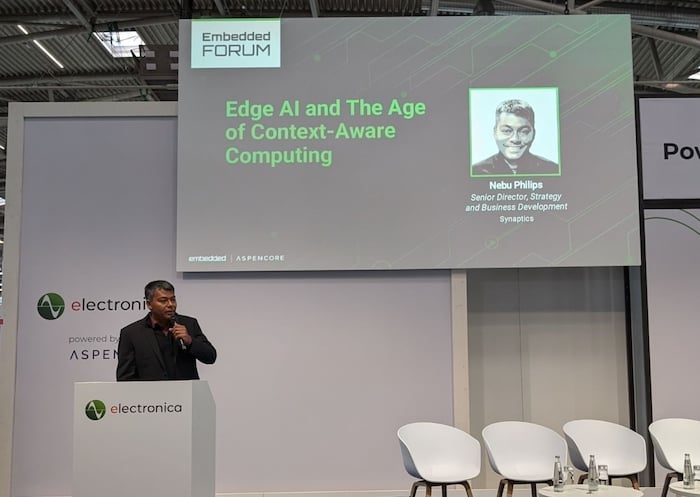
In his Electronica Embedded Forum keynote, Nebu Philips discussed context-aware computing. Image used courtesy of Synaptics’ LinkedIn
Philips highlighted other applications, including coffee machines that track consumption patterns to reorder pods automatically and AI-driven refrigerators that manage grocery supplies.
“We’re making AI tangible by focusing on practical, localized intelligence,” he said.
Synaptics is also exploring vision-based AI models for IoT. At the conference, the Synaptics team demoed its Astra system-on-module (SoM) using a smart camera stack with real-time video acceleration and reduced power consumption.
“This is the kind of efficiency that defines edge AI,” Philips said.
The Standardization Imperative
One of the most pressing challenges in edge AI is the lack of standardization in tooling and development environments. Many ecosystems rely on proprietary compilers and vendor-specific toolchains, creating barriers to adoption.
Philips emphasized the role of hyperscalers like Google and Meta in addressing this fragmentation.
“These companies have the resources to define open standards, and their contributions are critical for the democratization of AI,” he noted.
Similarly, Synaptics is aligning its development with emerging standards, focusing on frameworks like TensorFlow Lite and PyTorch. However, Philips acknowledged that the current state of compilers is chaotic.
“Every vendor claims compatibility, but you’re often locked into their ecosystem. It’s like the Wild West right now,” he said.
Despite these challenges, Philips predicts that the ecosystem will mature significantly within the next two years. Synaptics is hoping to capitalize on this evolution by ensuring its processors and tools are compatible with the dominant frameworks that emerge.
The Astra Machina Kit
One of Synaptics’ most significant milestones this year was the release of the Astra Machina development kit, a comprehensive prototyping solution for simplifying AI integration into IoT devices.
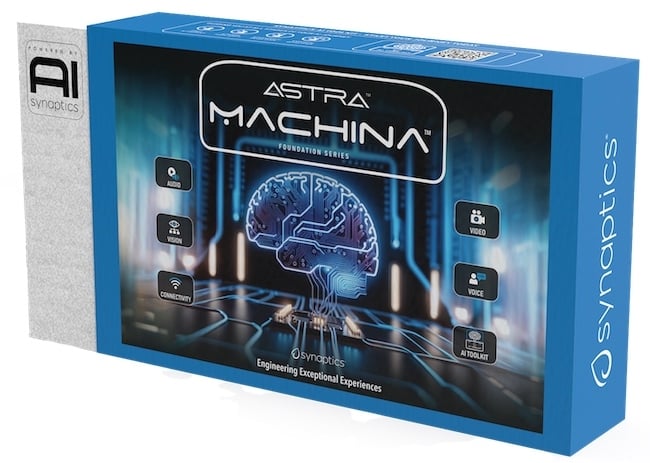
Astra Machina Foundation series development kit. Image used courtesy of Synaptics
The kit, which is already available through distribution partners, includes hardware, software, and pre-built models.
“We want to make AI tangible for developers,” Shenoy explained. “The Astra Machina Kit provides everything needed to prototype and design with ease.”
The company sees this as a necessary step in accelerating the adoption of AI at the edge. By offering accessible tools, Synaptics aims to empower developers to create innovative applications across a range of industries, from consumer appliances to industrial systems.
A Powerful Shift in Focus
Synaptics plans to continue building momentum for its Synaptics Astra Processor portfolio, with updates expected at Embedded World 2025 in Nuremberg, Germany.
“Embedded World is where we’ll continue to push forward our Astra story,” Shenoy said. “It’s a highly technical, engineering-focused event, and it’s the perfect platform to showcase our progress.”
Philips added that the company’s focus on partnerships will play a central role in its future success. By collaborating with hyperscalers, OEMs, and software developers, Synaptics aims to drive adoption and innovation in edge AI.
This transitional phase for Synaptics is ambitious and challenging. By combining its legacy in connectivity with cutting-edge processing and AI capabilities, the company hopes to become a key player in the rapidly evolving IoT landscape.
Related Content