Facebook
 Google
 GitHub
 Linkedin
Exclusive—Synopsys Debuts ESUN IP for Breaking AI ‘Slowest Packet’ Bottleneck
Launched today, Synopsys’ ESUN IP solution slashes AI tail latency and eliminates networking bottlenecks to enable seamless, scalable performance for modern AI infrastructure.
Today, Synopsys announced the industry's first complete IP solution for the new Ethernet for Scale-Up Networks (ESUN) open standard, covered here in this exclusive All About Circuits article.
As artificial intelligence training and inference clusters scale up from dozens to thousands of interconnected accelerators, data center architects are confronting an unforgiving physical reality: the network can no longer be treated as background plumbing. It has evolved into a primary determinant of overall system performance.
In massive modern workloads, accelerators must constantly exchange intermediate data and synchronize at every single computational step. This structural shift means that raw bandwidth is no longer the sole metric of success; the network must deliver data with absolute predictability. Synopsys’ new ESUN IP is designed to eliminate the systemic tail latency that leaves expensive supercomputing resources sitting idle.
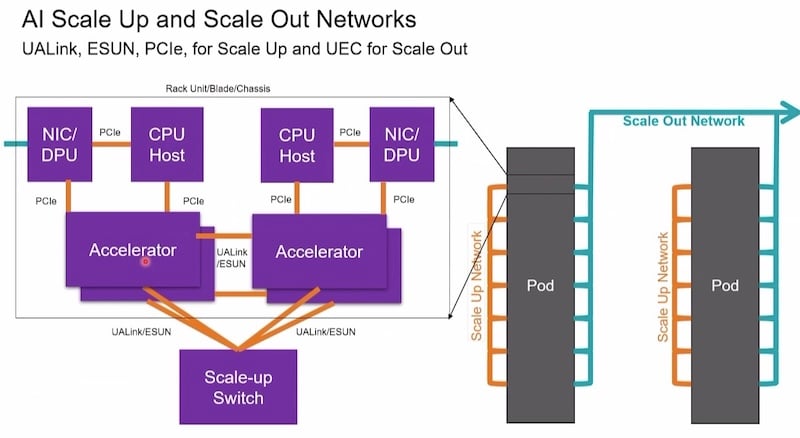
Where ESUN fits into AI data center connectivity
To learn more about Synopsys’ ESUN IP, we were pleased to engage in an exclusive interview with Priyank Shukla, Senior Director for Product Management - Interface IPs - at Synopsys.
“We are very excited to make this IP available to the ecosystem,” said Shukla. “Our engineer customers can tape out their chips using the IP on a variety of SoCs types—it could be a switch, it could be memory expansion, or it could be an accelerator.”
Behind the Tech: The AI Networking Dilemma
Traditional Ethernet architectures have underpinned the global internet for decades, operating on a "best-effort" model where transient packet loss, variable latency, and high-level software retries are acceptable trade-offs. However, that foundational paradigm completely breaks down under the strict, tightly synchronized requirements of large-scale AI fabrics.
In a massive distributed AI training cluster, overall performance is dictated not by average throughput, but entirely by the slowest packet. If a single packet experiences a delay or drop, the entire synchronization cycle across thousands of parallel accelerators stalls, ballooning job completion times. At scale, these inefficiencies trigger a cascading sequence of system penalties.
- Unpredictable Latency: Standard packet retransmissions introduce lag spikes that break deterministic execution windows.
- Coarse Congestion Control: Existing network management mechanisms lack the granular precision required to balance high-density burst traffic, leading to wasted bandwidth.
- Protocol Overhead: Large legacy routing headers consume a substantial slice of the available network pipeline, eating directly into usable compute bandwidth.
Faced with these constraints, some hardware developers have turned to complex, proprietary interconnects. However, closed ecosystems introduce severe trade-offs, including vendor lock-in, fragmented architectures, and long-term deployment risks.
Evolving Ethernet for AI Fabrics
Rather than abandoning the highly interoperable Ethernet ecosystem, the industry—championed by open consortia—is actively evolving it. The ESUN standard introduces a targeted suite of link-layer and network-layer optimizations specifically tuned for tightly coupled scale-up topologies, all while keeping the physical layer anchored to standard Ethernet.
One of the most immediate structural efficiency gains occurs at the packet level. Traditional networking relies on large, multi-byte IP headers (frequently spanning 20 to 40 bytes) that introduce massive overhead for small, frequent AI synchronization messages.
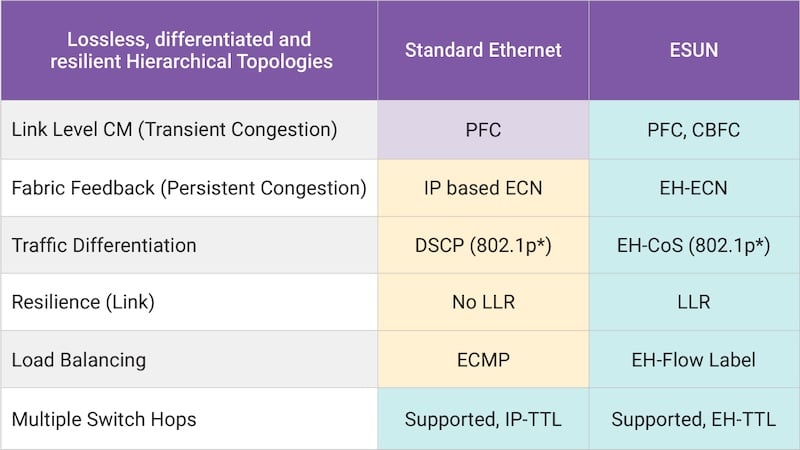
Standard Ethernet versus Ethernet for Scale-Up Networks (ESUN)
ESUN replaces this legacy structure with an incredibly streamlined, lightweight ESUN header measuring just a few bytes. This radical reduction slashes protocol overhead to maximize effective throughput and minimize latency, while cleanly retaining native support for traffic prioritization, congestion signaling, and load balancing.
Furthermore, ESUN transitions network reliability from reactive software stacks down to proactive hardware silicon. By implementing Link-Level Retry (LLR), transient transmission errors are caught and corrected instantly at the hardware boundary, entirely bypassing slow, legacy recovery paths. Concurrently, Credit-Based Flow Control (CBFC) enables granular, per-channel congestion management to intelligently prevent packet drops before they manifest.
Inside the Synopsys Complete ESUN IP Stack
To accelerate the global deployment of open AI infrastructure, Synopsys has delivered a fully integrated, pre-verified Layer 1 and Layer 2 hardware IP subsystem designed to eliminate systemic integration risks.
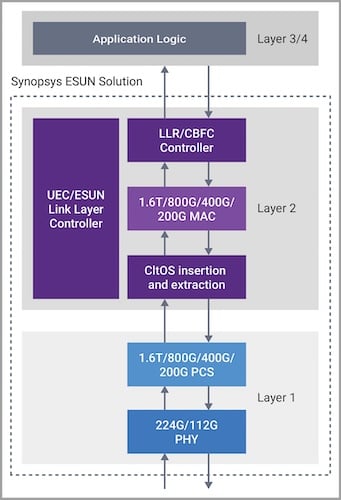
Synopsys’ complete ESUN IP solution
The complete hardware IP stack includes:
- A 1.6T Multi-Rate Ethernet MAC: Optimizes data throughput dynamically across demanding data paths.
- A 1.6T Physical Coding Sublayer (PCS): Features advanced, hardware-accelerated Forward Error Correction (FEC) to preserve signal integrity at extreme line rates.
- A UEC-Compliant Link Layer Controller: Delivers native, low-latency execution of hardware-level LLR and CBFC architectures.
- A Silicon-Proven 224G PHY: Built upon a widely implemented physical architecture thoroughly validated across advanced process nodes.
- Comprehensive Verification IP: Provides full system-level validation and simulation support out of the box.
There are also power reduction implications to using the ESUN IP, according to Shukla. “The more efficiently you connect these accelerators together, you can do inference faster, and you don't have to go on the hops,” he said. “Uou have to burn power to take it from here to there. You will save power on the interconnect with this technology.”
One Architecture for Scale-Up and Scale-Out
A key advantage of this unified hardware IP subsystem is its architectural adaptability. Silicon design teams can leverage the exact same underlying subsystem core to handle both ultra-low-latency scale-up configurations (ESUN) inside the accelerator pod and high-efficiency scale-out networks (Ultra Ethernet) across the wider data center fabric.
This versatile framework directly addresses the strict layout, power, and media constraints of modern data center infrastructure. As network speeds ascend from 100G and 200G up to next-generation 448G line rates, the maximum physical reach of traditional copper cabling shrinks dramatically from 5 meters down to a single meter.
This rapid degradation forces a hard architectural pivot toward optical signaling and co-packaged optics inside the rack. Because the Synopsys ESUN controller architecture is media-agnostic, it handles transitions between copper and optical mediums seamlessly.
By serving as a core pillar of a broader High-Performance Computing (HPC) connectivity platform, this solution integrates smoothly alongside Ultra Accelerator Link (UALink), PCIe, CXL, and high-bandwidth memory (HBM) controllers. This flexible, open-standard foundation ensures that as AI data demands step into the future, compute, memory, and networking can finally scale tightly together.
Shukla explains that there's a wide base of established and potential new customers for this IP. “We leverage our 25 years of experience in designing Ethernet IPs,” he said.
“We’ve been serving this market for a while—we have 2,000 designs in the last 25 years in different segments. Those same teams are now implementing this ESUN IP for scale-up networks.”
All images used courtesy of Synopsys.