
 Facebook
 Google
 GitHub
 Linkedin
Historical Engineers: John Logie Baird, Inventor of the First Color TV
While the television traces its origins back to several inventors, John Logie Baird was the first to demonstrate a live working television system and the first color television system.
John Logie Baird, born in 1888 in Scotland, was an electrical engineer who played a significant role in developing television. His experiments were a mix of successes, failures, and creative improvisations. Despite setbacks, Baird’s persistence led to the first public demonstration of television and set the groundwork for many future technologies.
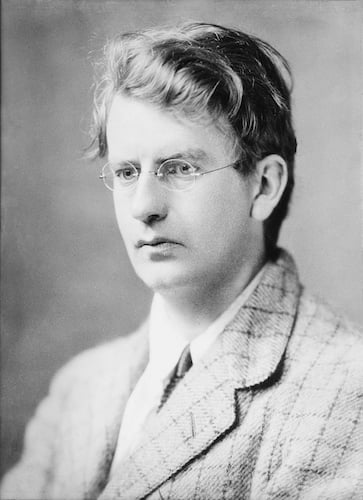
John Logie Baird in 1917. Image used courtesy of the U.S. Library of Congress
Early Experiments and Inventions
Baird studied engineering at the University of Glasgow, and he took his first job at the Clyde Valley Electrical Power Company after he was classified as unfit for WWI active duty due to chronic health problems.
Baird was an inventor by nature. At 34, he tried to create industrial diamonds and air-soled shoes. Some attempts were less practical, like homemade hemorrhoid cream and rust-resistant glass razors. While none of these ideas were commercially successful, they helped him build experience and fund his future projects. He dabbled in businesses selling socks and soap, which gave him the resources to pursue his work on television.
Baird’s early televisor experiments relied on the Nipkow disk, a device invented in 1883 by Paul Nipkow. The disk used a spiral of holes to scan images for transmission. Baird modified this design, adding lenses to allow more light through each hole. When small disks proved inadequate, he built larger ones, culminating in an eight-foot disk with eight-inch lenses.
His big breakthrough came in 1925 when Baird produced a clear image with shades of gray. The subject was a ventriloquist's dummy named "Stooky Bill," produced in a 32-line, vertically-scanned image at five pictures per second. From this lab demonstration, Baird determined that at least 30 scanning lines were needed to display recognizable human faces. While bandwidth limitations restricted improvements, this achievement marked the beginning of functional television.
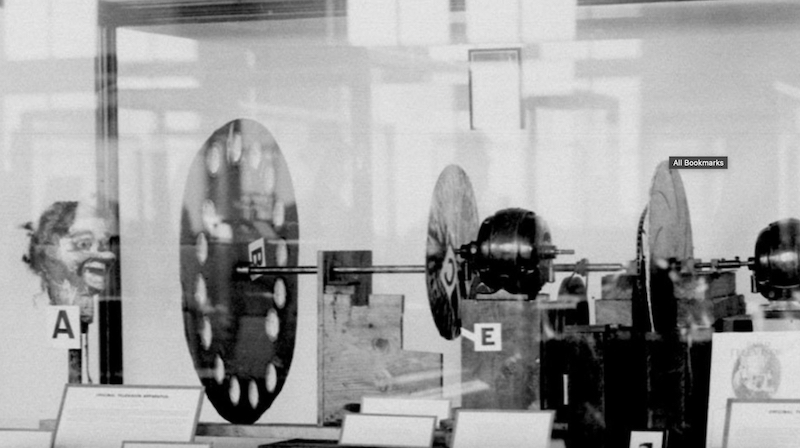
Baird's experimental apparatus pointed at "Stooky Bill." Image used courtesy of the BBC
The First Public Demonstration of Television
On January 26, 1926, Baird publicly demonstrated his television system, built using an amalgamation of old household items, including a hatbox, tea chest, scissors, darning needles, bicycle light lenses, and sealing wax. The resulting semi-mechanical analog television system used only five scanning lines, displaying basic silhouettes. While crude, it proved the concept of transmitting images. As he improved the design, Baird focused on increasing line count to improve image quality. Laboratory experiments confirmed that while higher scanning lines worked, transmitting signals remained challenging due to bandwidth limitations.
Then, in 1928, Baird demonstrated several firsts in television technology. He introduced the first color television system, using a process that would later influence NASA’s live broadcasts from space. That same year, he showcased stereoscopic (3D) television and infrared imaging, which had implications for security and scientific applications. He even achieved transatlantic television transmission, sending live images from London to New York via the Baird Television Development Company, predating similar achievements by over three decades.
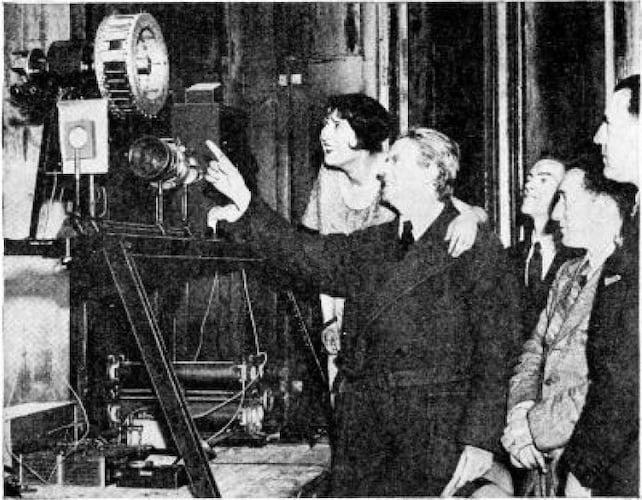
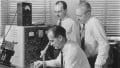
Baird demonstrating his television system in New York in 1931. Image used courtesy of World Radio History
Another one of Baird’s notable inventions was “phonovision,” a system for recording television onto discs. The system consisted of a large Nipkow scanning disk attached by a mechanical linkage to a record-cutting lathe. While playback was initially unsuccessful, the concept laid the groundwork for future video recording technologies.
Baird’s Lasting Legacy
Baird’s contributions had a lasting influence on modern broadcasting technology. His experiments with infrared television led to innovations in CCTV systems, now widely used in security and surveillance. His work on color television helped shape NASA’s methods for transmitting color images from the moon. Similarly, his recording experiments foreshadowed the development of modern video recording and playback systems.
Despite health issues and limited resources, Baird consistently pushed the boundaries of visual transmission. His persistence turned an ambitious idea into a functional technology that became one of the most transformative communication tools of the 20th century. In 2014, Baird was inducted into The Honor Roll of the Society of Motion Picture and Television Engineers (SMPTE), which posthumously recognizes individuals who were not awarded membership in their lifetime but whose contributions would have been sufficient to warrant it.
Baird died at age 57 in Bexhill, England.












Today’s engineering, like all areas of human knowledge, is built on the foundations developed by previous generations.
Today’s engineering is built on decades or even centuries of efforts, successes and failures, of those who, with greater or lesser notoriety, but always with great commitment, preceded us and created the conditions for us to develop our work.
That is why it is important to remember these names, removing them from anonymity or preventing them from falling into oblivion.
Good job!