
 Facebook
 Google
 GitHub
 Linkedin
Intel 8086: How a Stopgap CPU Became the Foundation of Modern Computing
Released in June 1978 after a three-month architecture sprint, the 8086 was meant to buy Intel time while it finished its real next-gen processor. But the real one failed, and the stopgap built x86.
When Intel launched the 8086 in 1978, the company didn’t expect it to define the next 50 years of computing.
The 16-bit processor was approved in May 1976 as a stopgap, designed in three months by a single software engineer, Stephen Morse, with minimal management oversight and one binding constraint: that it be compatible with assembly-language source code written for the older 8080.
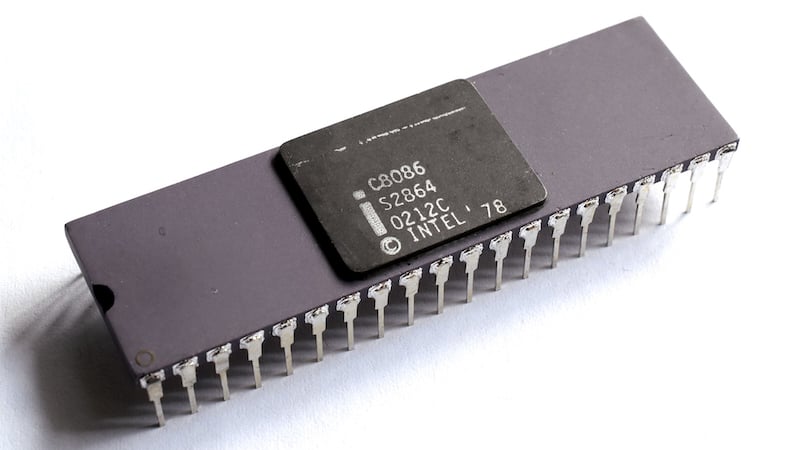
A rare Intel C8086 processor in a purple ceramic DIP package with side-brazed pins. Image (modified) used courtesy of Thomas Nguyen via Wikimedia Commons (CC BY-SA 4.0)
Intel's real next-gen plan was a different chip entirely, but that chip failed. Morse's 29,000-transistor stopgap became the architectural ancestor of every x86 processor shipping today. The PCI vendor ID Intel still uses for its own silicon is, fittingly, 8086.
The 8800 Problem
In the mid-1970s, Intel was pinning its long-term future on a processor originally called the 8800 and later renamed the iAPX 432. It was meant to be a generational leap: a 32-bit, object-oriented, capability-based architecture that would leapfrog the entire industry and define how serious computing was done in the 1980s. It was also running years behind schedule.
Meanwhile, Intel's existing 8-bit business was under serious pressure. Federico Faggin, the engineer who led the design of the 4004 and 8080, had left Intel in 1974 to co-found Zilog, and the resulting Z80 was eating into the 8080's customer base.
Motorola was developing the 68000, and National Semiconductor and others were circling. Intel needed something shippable in 1978 to keep its existing customers from defecting before the 432 was ready, and the 8086 project was approved as that something. Nobody at the time expected it to outlive the 432 by more than a few years.
Three Months, One Engineer, One Instruction Set
Stephen Morse was an unusual choice to design it. He was a software engineer at a company where CPU architecture had always been the domain of hardware engineers. He got the job partly because he had impressed Intel management with a critical evaluation of the 8800's design flaws. He started work in May 1976, and in August of the same year, he published Rev. 0 of the instruction set, including the register structure, addressing modes, interrupt mechanism, and I/O space.
Management gave him almost no constraints. The 8086 had to be assembly-language compatible with the 8080 so that existing customer code could be ported with a recompile. It also had to address at least 128 KB of memory because one Intel customer was already running into the 8080's 64 KB ceiling.
Beyond that, Morse was on his own. He has said in interviews that the freedom came from low expectations: nobody at Intel thought the design would last long, so nobody placed barriers in his way. His work included the four 16-bit general registers (AX, BX, CX, DX), the segmented memory model that stretched 16-bit pointers across a 1 MB address space, the string-processing instructions, and the decimal arithmetic instructions.
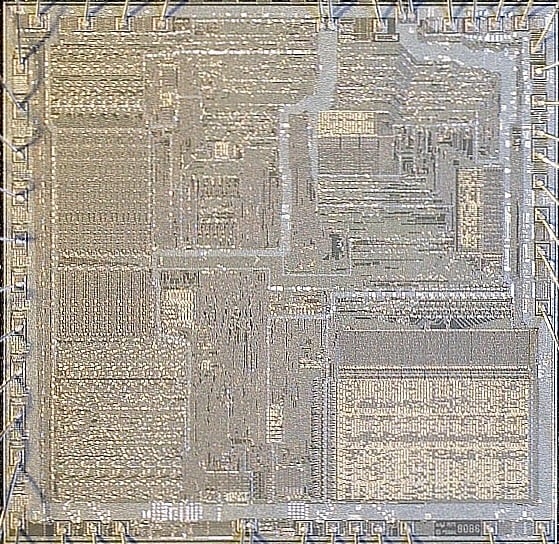
The Intel 8086 CPU die. Image used courtesy of Pdesousa359 via Wikimedia Commons (CC BY-SA 3.0)
Jim McKevitt then turned the architecture into silicon. According to project manager Bill Pohlman, McKevitt designed the entire 8086 logic without making a single error. Bruce Ravenel, who would later architect the 8087 floating-point coprocessor, helped refine the final revisions. The chip launched roughly two years after Morse had started. It ran at 5–10 MHz on Intel's HMOS-III process and contained 29,000 transistors.
8080 Compatibility
The 8086's first year was unremarkable, and the 8088 followed in 1979, internally identical but with an 8-bit external data bus, allowing cheaper board designs with fewer support chips. Morse left Intel in March 1979 and had no involvement with the 8088 or any subsequent processors.
Then IBM came shopping for a CPU for its 1981 PC. According to David Bradley, an original member of the IBM development team, Motorola's 68000 was eliminated because IBM was institutionally more comfortable with Intel. The deciding factor between the 8086 and 8088 was the cost of supporting RAM and ROM; the 8088 won. The IBM 5150 went on sale, an entire market of clones followed, and the x86 instruction set was locked into the industry within five years.
The iAPX 432, the chip the 8086 was supposed to be a temporary cover for, finally shipped in 1981, but it was a commercial failure. Intel discontinued it in 1986. The stopgap became permanent because the software base around it grew faster than any replacement could ever justify breaking it.
If anything, the 8086's story is a useful corrective to the idea that computing architecture is decided on technical merit. Modern x86 processors still expose the AX, BX, CX, and DX registers Morse defined in three months in 1976, under the assumption that his design would be discarded long before anyone built a personal computer industry around it.












I worked on a robotics project in the UK around 1979/80 and we decided to use the 8086, ordered samples and the development tools. I remember the ceramic chips arrived individually packaged like precious gifts of jewelry…
Very interesting article. The fact that you mention Stephen Morse and his efforts is very honourable.
The first IBM PC’s were slower than many of the 6502 home computers, specifically Acorn Atom, BBC, and I believe Commodore 16 and 64 at least. That advantage quickly disappeared though with later PC’s and compatibles running faster 8086’s.