
 Facebook
 Google
 GitHub
 Linkedin
The Motorola 68000: A 32-Bit Brain in a 16-Bit Body
Motorola’s 68000 blended 32-bit power with a 16-bit bus, creating a balanced, orthogonal, and elegant architecture that powered everything from Macintosh to arcade machines.
When the Motorola 68000 landed in 1979, it represented a leap in how CPUs could be designed. Internally, it used a full 32-bit architecture, with 32-bit general-purpose registers, 32-bit arithmetic, and a clean, flat 24-bit address space (16 MB). But to keep packaging and system costs in check, it presented a 16-bit external data bus and a 24-bit address bus. This earned it the nickname the “16/32-bit CPU”, and it allowed the 68000 to fit into systems that couldn’t yet afford a full 32-bit ecosystem.
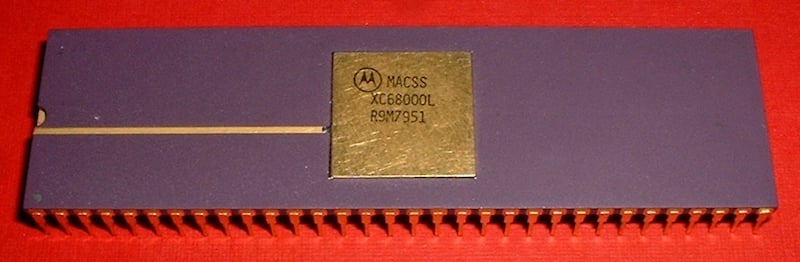
Pre-release of the XC68000 chip made in 1979. Image used courtesy of Arnold Reinhold via Wikimedia Commons (CC BY-SA 3.0)
That duality helped it succeed. The 68000 was fast and capable—shipping at 8 to 10 MHz in early systems—but also practical. Its packaging, power requirements, and asynchronous bus interface made it straightforward to integrate into both desktop systems and high-performance workstations.
By the early 1980s, the 68000 was appearing in a wildly diverse set of machines, including the Apple Macintosh 128K (1984), the Commodore Amiga 1000 (1985), the Atari 520ST (1985), and the Sega Mega Drive and Genesis consoles (1988).
Orthogonality You Could Build an OS On
The 68000’s architecture was unusually clean for its time and beloved by both OS developers and compiler writers. Its orthogonal instruction set allowed most operations to be used with most addressing modes. It featured:
- Eight data registers (D0-D7) and eight address registers (A0-A7)
- A condition code register (CCR) for flags
- Built-in user/supervisor mode split, with separate stack pointers for each
- A comprehensive interrupt and exception vector table beginning at 0x000000
- Support for position-independent code via PC-relative addressing modes
Those addressing modes included everything from register direct to pre- and post-increment, displacement, and even indexed with base and offset. For many systems programmers, this was their first taste of an architecture that felt like it was designed with software in mind.
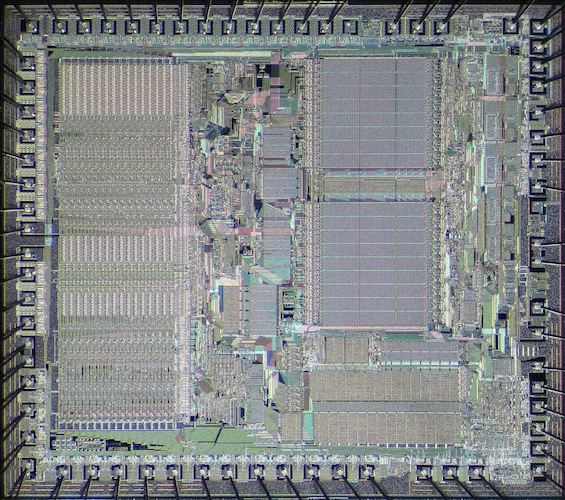
Die of a Motorola 68000. Image used courtesy of Pauli Rautakorpi via Wikimedia Commons (CC BY-SA 3.0)
The exception model was extremely robust. On reset, the CPU would fetch the supervisor stack pointer (SSP) from address 0x000000 and the initial program counter from 0x000004. Interrupts, traps, and faults generated rich stack frames that made debugging and context switching easier.
Dominating GUIs and Games
The 68000 became the dominant architecture for a full decade of computing. It was central to the rise of graphical user interfaces, powering the first Macintosh, the Amiga line, and Atari’s ST series. It also formed the core of early UNIX workstations like Sun Microsystems’ Sun-1, which used a custom external MMU to support memory protection and multitasking.
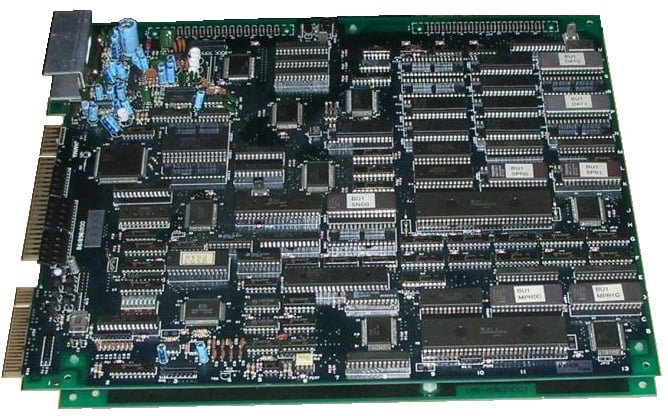
Two Hitachi 68HC000 CPUs used on an arcade-game PCB. Image used courtesy of Robivy64 via Wikimedia Commons (Public domain)
Even as desktop OSes matured, the 68000’s deterministic instruction timing and flexible bus interface made it attractive in gaming and embedded systems. It ran the main CPU in the Sega Genesis, the NEC TurboGrafx-16, and countless arcade boards in the late 1980s and early 90s.
Its popularity also spawned a full family of successors, including:
- 68020 (1982), offering improved exception handling and support for virtual memory
- 68020/030/040/060, with full 32-bit data buses and floating-point support
- 68008, a low-cost variant with an 8-bit data bus (famously in the Sinclair QL)
Even after Motorola’s desktop dominance failed, the 68xxx family lived on in embedded roles, with derivatives remaining in use in industrial and automotive systems well into the 2000s.
32-Bit Performance in a 16-Bit Envelope
The 68000 taught an entire generation of engineers what a “clean” architecture looked like. It didn’t just succeed on the strength of its silicon but because it was approachable, logical, and robust.
Its orthogonality made code generation easier. Its trap handling and stack frames made multitasking on OSes practical. Its flat memory model avoided the complexity of x86 segmentation, and its bus handshake design gave it flexibility in system integration.
For engineers working with RISC-V or Arm cores today, the 68000 remains a valuable study in tradeoff engineering. It delivered 32-bit performance within a 16-bit envelope, favored compiler ergonomics, and proved that architecture design could be both elegant and effective.
Do you consider the 68000 a game-changing CPU? Tell us about your experience with this microprocessor—or any other favorites—in the comments below.













I learnt machine code on the Sinclair QL using the 68008, then the full 68000 on the Atari ST. I loved its elegance and flat memory model. I remember looking in confusion at Intel 8086 machine code and the complexities of extended and expanded memory!
My first CPU was a similarly minded CDP1802. It was an 8-bit machine that had 16, 16-bit registers that could be reconfigured and swapped in function as needed. Imagine trying to go from that level of flexibility to the 6502 with its three 8-bit registers. When I saw it, I thought the 68000 to be the ideal next step in CPUs. Unfortunately, I was never able to buy a 68000 system with one nor find any commercial work on the CPU. Nice article!