Facebook
 Google
 GitHub
 Linkedin
Intel Supports AI Workstations With New GPUs and AI Accelerators
At Computex 2025, Intel expanded its hardware lineup with GPUs for AI inference and creative workloads and an accelerator for large-scale generative AI training.
At Computex 2025, Intel unveiled a sweeping refresh of its AI-focused hardware portfolio, reinforcing its position in both the workstation and data center markets. With the introduction of the Arc Pro B-Series GPUs and the third-generation Gaudi AI accelerator, Intel is bringing professional-grade AI compute to a broader spectrum of developers, creators, and enterprise users.
Arc Pro B-Series: Targeted Acceleration for Edge AI Workflows
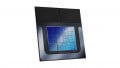
The newly launched Arc Pro B60 and B50 GPUs are based on Intel’s Xe2 architecture and feature integrated XMX cores, Intel’s AI-optimized vector and matrix processing units. These GPUs were purpose-built for AI inference and design workloads in architecture, engineering, and creative sectors.
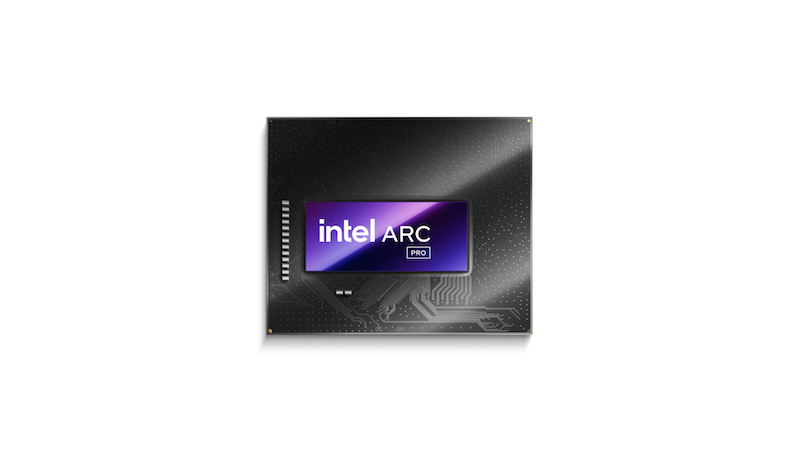
Both GPUs support PCIe 5.0 x8 connectivity and containerized Linux AI deployment stacks.
The flagship Arc Pro B60 boasts 20 Xe cores, 160 XMX engines, and 24 GB of GDDR6 memory across a 192-bit bus, yielding 456 GB/s of memory bandwidth and 197 TOPS (INT8) performance. With a TDP range between 120 W and 200 W, the B60 supports multi-GPU scalability and is certified across major ISV platforms like SolidWorks, Maya, and Blender.
Meanwhile, the B50 offers a more power-efficient solution at 70 W, with 16 Xe cores and 128 XMX engines delivering 170 TOPS. It pairs 16 GB of GDDR6 memory on a 128-bit bus (224 GB/s bandwidth), making it useful for lightweight AI tasks such as image upscaling or CAD acceleration in compact workstations.
Gaudi 3: A Heavyweight for Enterprise AI
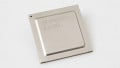
At the high end, Intel introduced its Gaudi 3 accelerator, a dual-die processor designed to handle the demands of generative AI training and real-time inference at scale. Built on TSMC’s 5-nm node, Gaudi 3 (white paper linked) features 8 Matrix Multiplication Engines, 64 Tensor Processor Cores, and 128 GB of HBM2e memory with a bandwidth of 3.7 TB/s.
Its compute power reaches 1.8 PFLOPs for FP8 and BF16 workloads, with significant architectural improvements over Gaudi 2, such as doubled MMEs, 1.5× memory bandwidth, and a 40% boost in power efficiency. Intel claims that Gaudi 3 outperforms Nvidia’s H100 by up to 1.7× in LLM training and delivers 2.3× the inference efficiency in key workloads like Llama2-13 B.
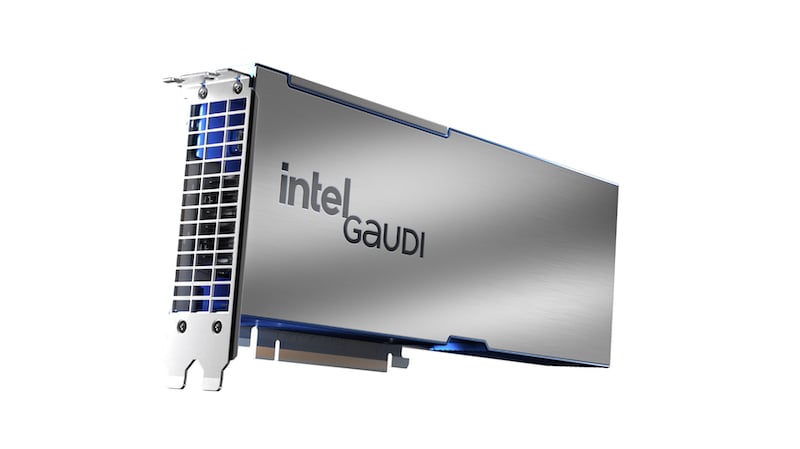
These liquid-cooled systems are optimized for sustained performance in distributed AI clusters.
One of Gaudi 3’s key differentiators is its integrated networking. Each chip includes 24 RDMA-capable 200 Gbps Ethernet ports, supporting All2All scale-up topologies with 1.05 TB/s of bi-directional intra-node bandwidth and 150 GB/s inter-node scale-out. This open Ethernet-based fabric avoids vendor lock-in and simplifies scaling across up to 512 nodes without proprietary switches.
Intel AI Assistant Builder
Complementing the new silicon, Intel’s AI Assistant Builder has exited beta and is now available on GitHub. This open framework allows developers to build and run lightweight AI agents locally on Intel-powered systems. Combined with containerized Linux support and ISV-certified drivers, Intel’s software ecosystem is aligning closely with its hardware roadmap.
The Arc Pro series supports both consumer and pro driver stacks on Windows, while Gaudi 3 leverages the Habana Synapse AI SDK, which includes native support for PyTorch, TensorFlow, and ONNX. These tools are optimized for the architectural nuances of the MME and TPC engines and enable granular scheduling for mixed workloads across the compute pipeline.
While Nvidia still dominates the AI compute space, Intel’s new GPUs and AI accelerators provide a compelling alternative, especially for customers seeking open standards, flexible scaling, and efficient large model deployment. With commercial availability expected in the second half of 2025, Intel’s AI acceleration portfolio appears well-positioned to challenge the incumbents.
All images used courtesy of Intel.