Facebook
 Google
 GitHub
 Linkedin
Melexis Introduces Low-Field Current Sensors for Smart Power Designs
The new MLX91218-LF sensor fits into applications below 200 A for home and light industrial smart energy monitoring.
Melexis has released its new MLX91218-LF low-field (LF) Hall effect sensor for high-speed, high-accuracy current sensing with dual overcurrent detection. The part uses proprietary Integrated Magnetic Concentrator (IMC) technology, enabling smaller metal shields. IMC technology locally converts the horizontal magnetic field (Bx) into a vertical component (Bz) that can be measured with silicon Hall plates inside the chip.
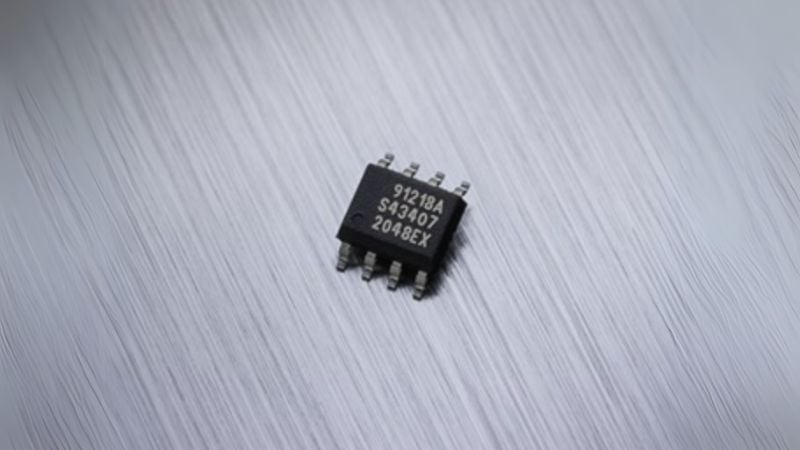
MLX91218-LF Hall effect current sensor in SOIC-8 package.
The MLX91218-LF low-field sensor joins Melexis' very high-field sensor MLX91218-VHF and extra high-field sensor MLX91218-XHF.
A Brief Review of Hall Sensor Basics
Melexis' new device is a Hall sensor, a semiconductor device that sits next to the current path and measures the magnetic field generated. Electric current flowing through a conductor generates a magnetic field proportional to the current flow. The Hall sensor internally converts that magnetic field into a voltage proportional to the strength of the magnetic field. Magnetic field strength is measured in Teslas and is typically in the micro- and milli-Tesla range for current flow in common equipment.
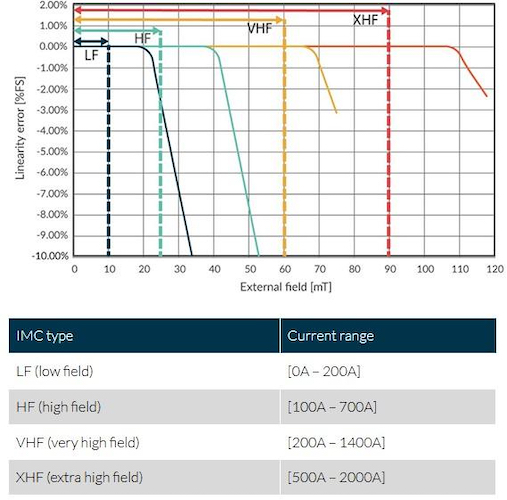
Comparing linearity and current sense range of MLX91218 product family members.
A key advantage of a Hall sensor, like the MLX91218-LF, is that it does not sit in the current path as a shunt sensor does. Shunt sensors, the other dominant current sense technology, take a small amount of the power and convert it to a heat loss proportional to the voltage drop across the resistive element. Hall sensors are completely outside of the current path and, therefore, don’t have the same loss and wasted heat generation.
Key Features of the MLX91218
Melexis manufactures the MLX91218 sensors with a standard CMOS-integrated circuit fab process in an 8-pin SOIC. The new LF variant produces 600 mV per milli-Tesla, giving it a current sense range of up to 200 A. Melexis also offers companion products with maximum currents up to 2,000 A.

Block diagram of the 400-kHz IMC-Hall current sensor IC.
Some other key features of the device include:
- 3.3 V or 5 V supply voltage
- Dual overcurrent detection, utilizing either internal threshold or external threshold
- Selectable ratiometric or fixed (Vref) analog output
- DC to 400-kHz bandwidth
- 2-µs response time
- High linearity down to ±0.5% full-scale
- Offset drift (<5 mV)
- Sensitivity drift (<1.5%)
The sensors are also AEC-Q100 automotive qualified and feature very low thermal drift for a wide temperature range.
Deployment Architecture
The MLX91218-LF sits on a small printed circuit board parallel to the current flow within a shield. Melexis recommends the shield be laminated steel or iron rather than the more common ferromagnetic core. The laminated construction is smaller and lighter and can be molded into a U shape rather than a full circle or doughnut construction.
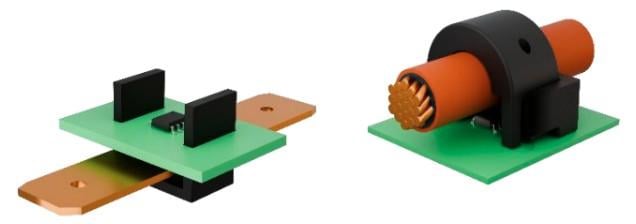
MLX91218 mounting with the shield. Busbar (left) and cable (right) configurations.
One of the key features of Melexis’ IMC technology is a magnetic field concentrator built into the chip. With this technology, the MLX91218 does not use the external shield as a magnetic field concentrator, decreasing its size compared to conventional Hall sensors. The smaller U-shaped shield is easier to assemble and less expensive than the shields and concentrators of conventional Hall sensors.
Dual Over Current Detection
The MLX91218 sensor has two overcurrent detection modes for greater flexibility in applications. Internal overcurrent detection (OCDINT) reads predefined threshold voltage values stored in an internal EEPROM. No extra components are required for this mode of operation. The OCDINT mode offers greater overcurrent detection than the standard current measurement range of the sensor, determining the cause of excess current, such as short-circuit events.
The second mode, external overcurrent detection (OCDEXT), relies on a threshold voltage applied to the VOCEXT pin. The voltage on the pin is translated into a current and used to detect overcurrent events. The OCDEXT functionality can be used in concert with an external resistive voltage divider to expand the range or provide bidirectional or unidirectional overcurrent detection. While the OCDEXT provides better accuracy, including for overcurrent values close to the standard measurement threshold, it is not as fast as OCDINT detection.
Precise Monitoring for Smart Power Delivery
The MLX91218 is designed for automotive, light industrial, and home applications such as battery management, high voltage traction inverters, DC to DC converters, and smart fuse overcurrent detection. Smart power delivery requires precise monitoring and fast response to changing load conditions. By remaining outside of the current path, the sensors reduce system losses. The internal concentrator decreases footprint and simplifies manufacturing assembly. The fast response times, high accuracy, and dual OCD modes make the part easy to integrate within smart power systems.
Related Content