Facebook
 Google
 GitHub
 Linkedin
Murata, TDK, and Knowles Raise Capacitor Expectations With New Lineups
The new capacitors feature higher voltage ratings, improved thermal and vibration performance, and new safety qualifications for automotive and industrial applications.
Murata, TDK, and Knowles have each expanded their capacitor portfolios with components designed for higher-voltage, higher-stress power electronics. The new products include Murata’s DE5 safety-certified ceramic capacitors, TDK’s expanded axial and soldering-star aluminum electrolytic lineup, and Knowles’ Type PPH polypropylene film pulse capacitors.
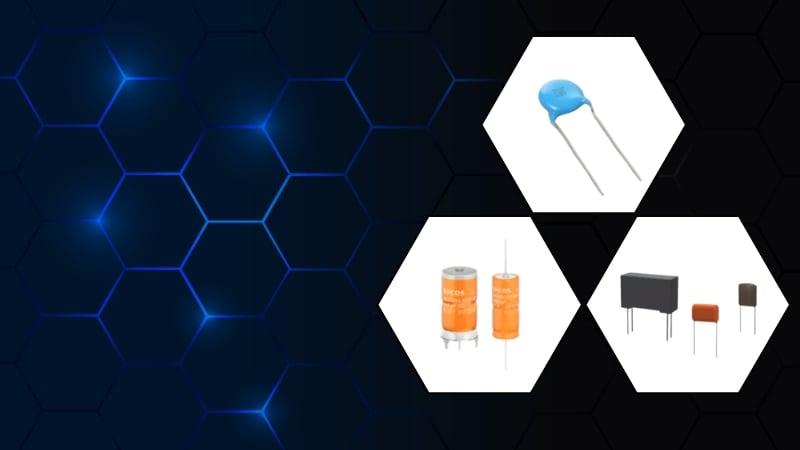
The three families address different parts of the power system. Murata’s DE5 raises the company’s automotive safety-capacitor offering from Y2 to Y1 certification; TDK adds 125-V devices for higher-voltage DC-link capacitor banks; and Knowles targets high-voltage switching and snubber circuits with AEC-Q200-qualified film capacitors rated as high as 2,000 VDC.
Murata Moves Up to Y1
Murata’s DE5 series is a new line of lead-type disc ceramic capacitors intended primarily for automotive powertrain and safety applications, including onboard chargers, charging cables, and DC-DC converter filters. The series carries IEC 60384-14 X1/Y1 certification and is AEC-Q200 Rev. E compliant, giving designers an option when the Y2 rating of Murata’s existing DE6 series does not provide enough voltage or impulse margin.

Murata’s DE5 series offers X1/Y1 safety certification and a 12-kV, impulse-withstand rating for automotive power applications. Image used courtesy of Murata
That difference is fairly substantial. The DE6 series supports a Y2 rating of 300 VAC and a 5-kV, impulse-resistor voltage, while the DE5 increases those figures to a Y1 rating of 500 VAC and 12 kV. The new capacitors are also rated for 760 VAC in X1 applications and 1,500 VDC. Capacitance values range from 100 pF to 4,700 pF, with component diameters from 6 mm to 14 mm.
For automotive designs, the DE5 operates at temperatures up to 125°C and is rated for 1,000 temperature cycles from -55°C to +125°C. The capacitors use a flame-retardant epoxy coating equivalent to UL94 V-0, along with a halogen-free external resin. Combined with the higher Y1 rating, these features provide designers with greater insulation and voltage margin for EV charging applications that require performance beyond standard Y2 requirements.
TDK Gives DC Links More Headroom
TDK took a different approach with its B43693/B43793 and B41687/B41787 families of aluminum electrolytic capacitors. The company added 125-V components to the B43693/B43793 range while upgrading its existing 63-V B41687/B41787 series, covering DC-link applications from 48-V battery systems to approximately 120-V architectures.
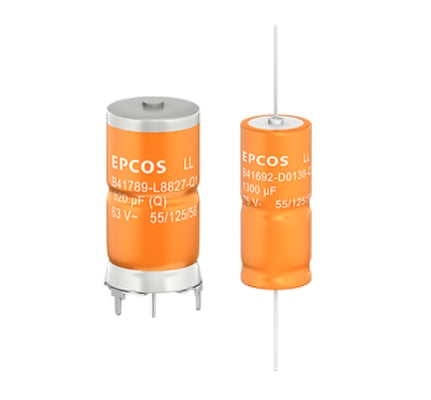
TDK’s axial capacitors target high-ripple-current DC-link applications. Image used courtesy of TDK
The new 125-V devices eliminate the need to connect lower-voltage capacitors in series in some 96-V systems, reducing component count and simplifying DC-link capacitor banks. The series covers 56 µF to 650 µF, supports ripple currents up to 21.6 A, and operates at temperatures up to +140°C. The 63-V family reaches +150°C with capacitance values from 510 µF to 4,800 µF.
The capacitors are also built for vibration, with a standard rating of 20 g and versions up to 60 g available on request. For designs that need more ripple-current capability, the 125-V parts can be mounted to a heat sink. TDK reports that an 18-mm × 30-mm capacitor increases its current rating from 5.2 A to 11.1 A when the case is maintained at +105°C. This can help designers use fewer capacitors while saving space in xEV, micromobility, forklift, and other compact power systems.
Knowles Takes on High-Voltage Pulses
Knowles’ new Type PPH series is aimed at high-voltage switching applications in automotive and industrial power electronics. The double-metalized polypropylene film capacitors are designed for pulse, snubber, and commutation circuits using SCRs, IGBTs, and SiC MOSFETs, helping handle voltage spikes and high ripple currents.
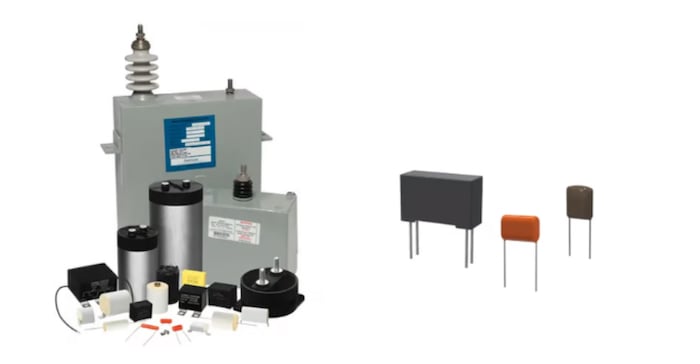
Knowles expands its film capacitor portfolio with the new Type PPH series. Image used courtesy of Knowles
The PPH family covers capacitance values ranging from 0.001 µF to 4.7 µF, voltage ratings from 630 VDC to 2,000 VDC, and an operating temperature range of -55°C to +105°C. The polypropylene construction gives the capacitors self-healing capability, while low losses help keep temperature rise under control during high-frequency operation. The series has a specified dissipation factor of 0.1% at 25°C and 1 kHz.
The series is also AEC-Q200 qualified and specified for 2,000 hours at 85°C/85% relative humidity at rated voltage. A separate life test calls for 2,000 hours at 85°C and 125% of rated DC voltage, with a stated life expectancy of 100,000 hours at rated voltage and an 85°C hot-spot temperature. Those qualifications make the parts suitable for EV powertrains and charging systems, as well as for industrial inverters, power supplies, and renewable-energy equipment.
Specific Solutions for Specific Applications
Murata, TDK, and Knowles are addressing different capacitor requirements, but each new family pushes an existing design in a specific direction. Murata moves beyond its DE6 series with higher Y1 safety and impulse ratings. TDK extends its axial and soldering-star portfolio into higher-voltage DC-link systems. Knowles adds an automotive-qualified film option for high-voltage pulse circuits. For engineers, the result is a broader set of components for handling higher voltages, ripple currents, temperatures, and environmental stresses without unnecessarily complicating the surrounding power design.