Facebook
 Google
 GitHub
 Linkedin
New PC-Based Oscilloscope From Pico Ups the Bandwidth Game to 33 GHz
Pico has released a new series of PC-based, high-bandwidth sampling oscilloscopes with direct-input triggering and pre-trigger capture capabilities.
Pico Technology recently added three members to the PicoScope 9400A series, its PC-based, high-bandwidth sampling oscilloscope line. The original 25-GHz 9400A model is now joined by options at 6 GHz, 16 GHz, and 33 GHz.
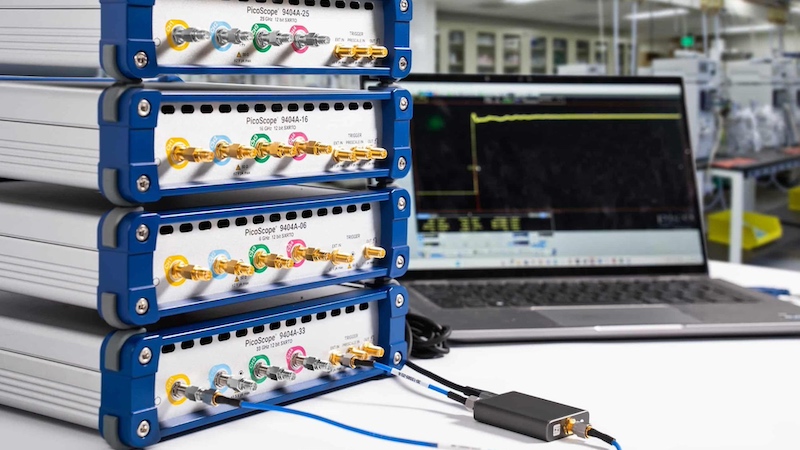
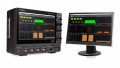
PicoScope 9400A series PC-based oscilloscopes.
The top-end, 33-GHz model delivers rise and fall times under 12 picoseconds. All 9400A series scopes come with four inputs at 12-bit voltage resolution. Jitter stays at a reportedly industry-leading 1.5 picoseconds RMS.
Series 9400A Features and Capabilities
The 9400A series (datasheet linked), in most cases, can trigger directly off the input data signal. Up to 6 GHz, no external hardware is required for direct triggering. Higher bandwidth signals up to 20 GHz use a splitter to feed the signal to the external trigger and the data input.
Some of the key features of the series include:
- Four independent inputs
- Up to 33-GHz bandwidth (6-GHz, 16-GHz, 25-GHz, and 33-GHz models)
- Step transition capture down to 14 ps and impulses down to 22-ps wide
- Maximum sample rate of 5 TS/s (timing resolution of 0.2 ps) using random sampling
- Trigger options for direct signal triggering, external trigger signal, and recovered clock trigger
- Trigger jitter as low as 1.2 ps + 0.1 ppm RMS (typical)
- 12-bit vertical resolution with a wide ±1 V/±800 mV input range (model dependent)
- Software compatible with Windows 7–11
- Up to eight scopes can be connected at a time
Some specifications require a 30-minute warm-up and setting time before operating at the highest performance limits.
Sampler-Extended, Real-Time Oscilloscope
The 9400A series combines the best of a direct triggering real-time oscilloscope, a sampling scope, and an extended pre-trigger capture window. Pico describes the result as a "sampler-extended real-time oscilloscope" (SXRTO). SXRTO capability enables sampling before and after a trigger point, in real-time, without an external trigger.
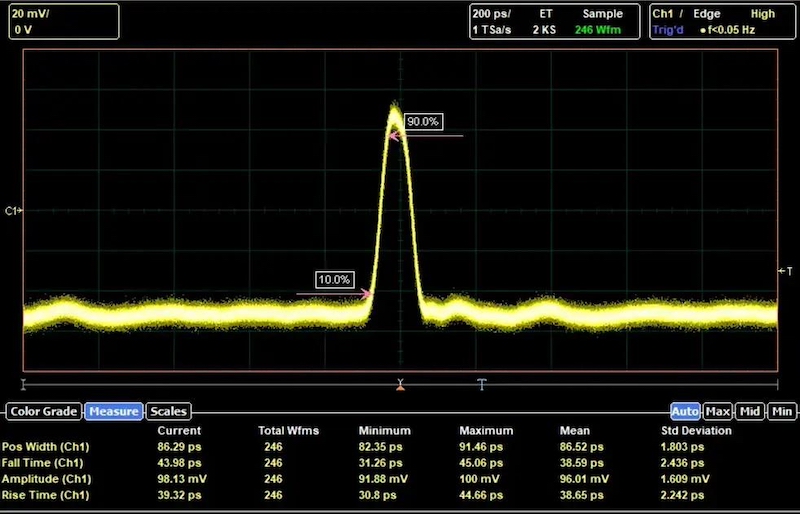
Laser pulse measurement, with a rise time of less than 50 ps and a pulse width of less than 200 ps.
Real-time oscilloscopes (RTO) send their input to a free-running analog-to-digital converter (ADC). An RTO digitizes and stores data in a circular buffer and triggers based on digital data in the buffer. This creates some ambiguity about the start of the trigger condition. Pico’s SXRTO free-runs, captures, and stores data in a similar buffer. However, the trigger is taken from the actual analog signal before digitization. This removes ambiguity and, by overlaying successive captures, gives a complete picture and an effectively higher sampling rate.
Software Details
As a PC-based oscilloscope, software is as important as the hardware. On the PC side, the scopes are supported by the company’s PicoSample 4 Windows software. PicoSample 4 works at any resolution and across multiple monitors. Inputs can be separated into two or four individual grids or combined into one. The software can plot signals in XY mode with or without additional voltage-time grids.
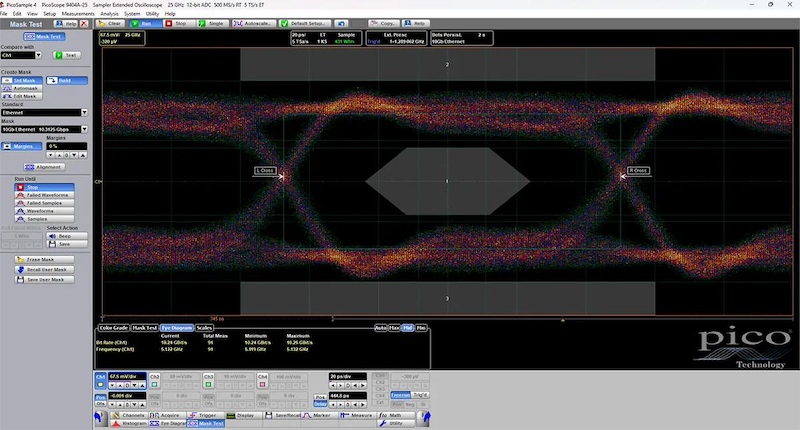
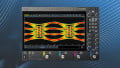
PicoSample 4 software.
PicoSample 4 provides numerous display options, flexibility with scales and labeling, and various measurement, math, and analysis options. Up to eight PicoScope 9400A units can be addressed when using a LAN connection.
The software runs on Windows 7 through 11 and has a 32-bit version available for Windows 7 through 10. It requires a USB connection for setup and can use either USB 2.0 or 3.0 or Ethernet LAN for operation.
Clock and Data Recovery Option
While many signals can be triggered with the scope’s direct trigger capability, some high-speed data signals require an external trigger. High-speed signals often deliver non-optimum results if the data signal is accompanied by a trigger. Crosstalk from the trigger can cause jitter and skew. Further, some signals, such as the output of a long-distance fiber optic cable, do not have a triggering signal available.
The 9400A series has a factory-option clock and data recovery (CDR) capability that can take the data signal and recover a triggering signal out of it. With the factory CDR option, any of the four input channels can be routed to the CDR circuit. The resulting trigger can be used in a conventional manner without the risk of skew or jitter. The CDR also provides a separate data and clock signal out the back via SMA (f) connectors.
Flexible Testing Applications
PicoScope 9400A series scopes are designed for some of the most demanding applications. The units will find homes in semiconductor and materials research, high-speed electronics, communications, and high-energy physics applications. All four models in the series are available now.
All images used courtesy of Pico Technology.