Facebook
 Google
 GitHub
 Linkedin
Photonics Investments—Part 3: Three Game-Changing Photonics Technologies
In the final part of this series, we zero in on three photonics technologies expected to be essential for demanding computing and communication systems of the future.
Tucked inside one of Nvidia’s sprawling research campuses, engineers in a climate-controlled cleanroom are wrestling with a problem that could define the next era of computing: how to move light, not electrons, across chips to eliminate the growing bottleneck of data transfer in AI supercomputers.
A few hundred miles away, in a lab at the University of Virginia, physicists are preparing squeezed-light states to push past quantum limits of detection. Across the Atlantic, researchers in Europe are delicately integrating quantum dots and nanodiamonds into microscopic circuits to send single photons down optical fibers—one by one, with perfect precision.
While they may appear disparate at first glance, these initiatives are part of a greater narrative in the field of photonics. Light-based technologies—long used in telecommunications and imaging—are rapidly evolving into fundamental building blocks for computing, sensing, and secure communication systems of the future. These are not just marginal improvements, but radical departures from current approaches, and they are still in the delicate pre-commercial phase, where the risks are high but the potential is transformative.
Three Significant and Ambitious Technologies
Today, three photonics-related technologies stand out as the most significant and ambitious:
- Co-packaged optics for data interconnects in AI and high-performance computing
- Ultra-sensitive optical detectors using quantum-enhanced techniques
- Scalable quantum photonics systems operating at telecom wavelengths
Together, those three technologies illuminate a path forward for next-generation digital infrastructure.
Co-Packaged Optics
In March 2025, Nvidia made a bold move at its annual GTC conference: it unveiled the Spectrum-X and Quantum-X switch platforms, built on co-packaged optics technology. These devices embed silicon photonics directly into switch hardware, breaking the traditional mold of pluggable transceivers and copper connections that have long been a limiting factor in data centers.
Nvidia said that, by integrating silicon photonics directly into switches, the company intends to shatter the old limitations of hyperscale and enterprise networks and open the gate to million-GPU AI factories.
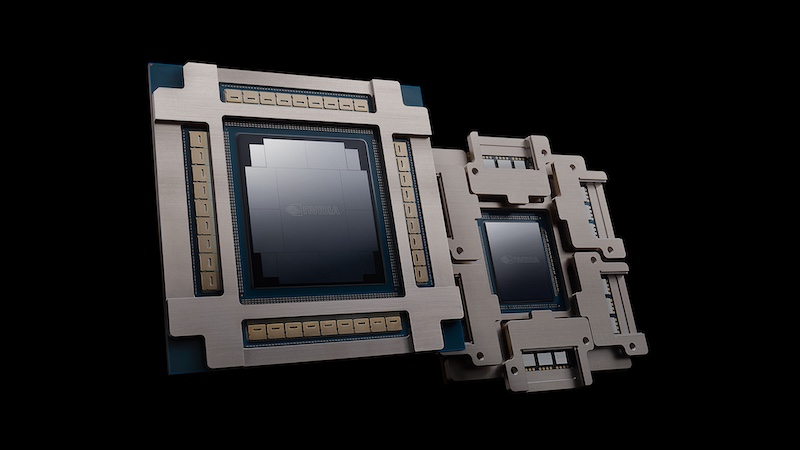
Co-packaged optics built on 200G SerDes technology for the two Nvidia platforms: Spectrum-X Ethernet platform (left); Quantum-X800 InfiniBand platform (right). Image used courtesy of Nvidia.
The challenge is as monumental as the opportunity. AI models now routinely span billions of parameters, distributed across thousands of GPUs. But the interconnects between those GPUs—often copper wires or inefficient fiber links—consume massive power, generate heat, and introduce latency. Co-packaged optics addresses that problem by moving data via light at blistering speeds—1.6 terabits per second per port in Nvidia’s latest hardware—right next to the processor itself.
Ashkan Seyedi, Director of Optical Interconnect Products at Nvidia, put it bluntly: “The innovations and the power savings enabled by co-packaged optics are intimately tied to your packaging scheme, your packaging partners, your packaging flow.” His team, working with collaborators at TSMC, Lumentum, Coherent, and others, is betting that this technology could deliver a 3.5× improvement in power efficiency while reducing the number of required lasers by up to 75%.
Still, co-packaged optics isn't ready for every use case. Even Nvidia CEO Jensen Huang has acknowledged that this technology isn’t mature enough yet for use directly between GPU die interconnects, and is being phased into networking switches first. But once proven at that level, the path is clear. The AI factories of the future—spanning entire warehouses and cities—will run not on electrons alone, but on light.
Quantum Optics
While engineers at Nvidia push photons to move data faster, a group of researchers at the University of Virginia is focused on sensing the faintest traces of light—sometimes just a few photons—better than ever before.
Under the leadership of Associate Professor Xu Yi in the Department of Electrical and Computer Engineering, a team of physicists and engineers has embarked on a groundbreaking project funded by DARPA. The goal: to build next-generation optical detectors capable of exceeding the quantum detection limit by up to 40 times.
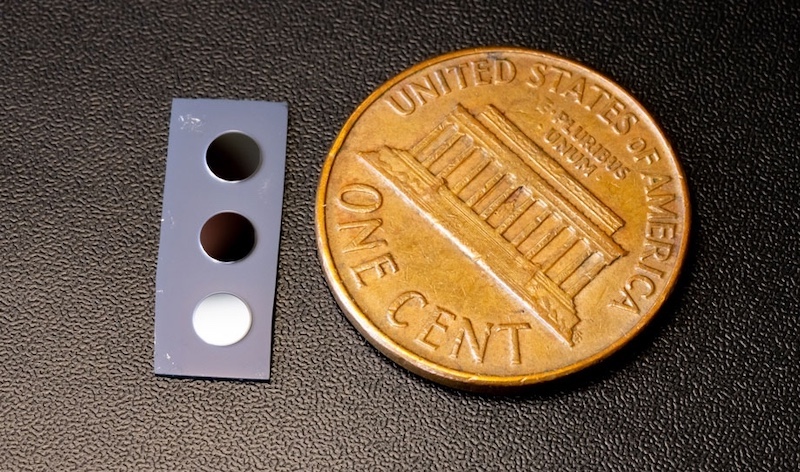
This silicon chip contains three optical microresonators. Yi’s research team verified the generation of 40 qumodes from a single microresonator. This showed that multiplexing of quantum modes can work in integrated photonic platforms. Image used courtesy of University of Virginia.
Their approach hinges on quantum optics, particularly squeezed light—a non-classical state of light that can reduce quantum noise in one observable at the expense of another. Combined with advanced photonic integration, squeezed light can allow detectors to extract information from weaker signals with higher fidelity than conventional systems.
"We speak to Xu Yi, who is leading DARPA-funded research seeking to exceed the quantum detection limit by up to 40 times," noted Electro Optics magazine earlier this year. The team also includes Andreas Beling and Joe Charles Campbell, prominent figures in optoelectronics, and a growing network of collaborators across disciplines.
Their work is still in its early stages, but the implications are immense. Ultra-sensitive detection capabilities could revolutionize a wide range of applications—from space-based LIDAR and deep-space communication to biomedical imaging and quantum key distribution. Essentially, wherever light is faint and precious, these detectors could make the difference between noise and signal.
There are significant challenges: maintaining coherence in squeezed light states, integrating quantum components on-chip without excessive loss, scaling up fabrication processes, and managing thermal drift in compact systems. But if successful, the UVA group’s work could redefine the floor of what we can detect and measure with light.
A Quantum Internet
Meanwhile, on the quantum front, an international network of scientists is racing to build the foundational elements of the quantum internet—a communication system based on quantum entanglement and single-photon transmission, promising fundamentally unhackable encryption and distributed quantum computing.
Among the leading efforts is a team led by Paweł Holewa and colleagues in Europe, who have developed deterministic quantum dot-based photon sources that emit in the telecom C-band (around 1550 nm), the same frequency range as existing fiber-optic infrastructure. Their devices produce highly pure, indistinguishable photons—crucial for quantum interference—using epitaxial growth and microcavity engineering, enabling integration at scale.
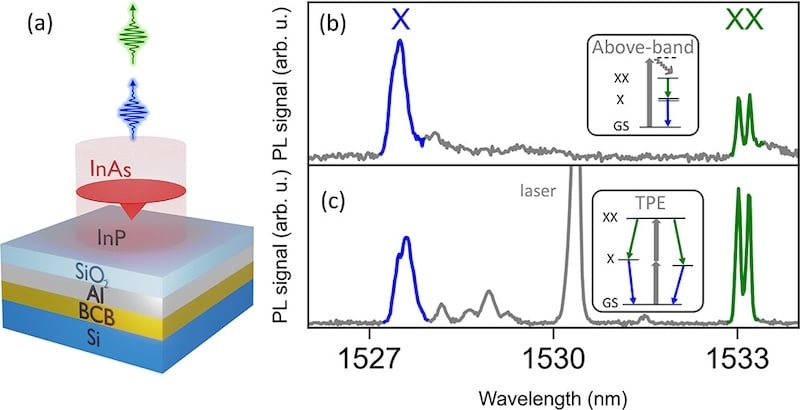
This shows the Si-compatible quantum-dot mesa structure used in the study done by Holewa and his colleagues. A single InAs quantum dot is embedded in an InP matrix with a metallic Al bottom mirror. Image used courtesy of Paweł Holewa and co-authors.
Another milestone came from a collaboration involving Neil Sinclair, Mikhail D. Lukin, and Marko Lončar at Harvard and MIT. They demonstrated nanophotonic quantum memory nodes using silicon-vacancy (SiV) centers in diamond cavities, with telecom-compatible frequency conversion. In 2023, their system achieved remote entanglement over more than 75 kilometers of optical fiber, including both spooled and live urban fiber.
Such achievements bring the dream of a long-distance quantum internet closer to reality. But obstacles remain daunting. Photon loss, frequency mismatch, and the delicate nature of quantum states make scaling these systems extremely difficult. Ensuring that photons are indistinguishable and synchronized, while preserving their quantum states over kilometers of noisy fiber, is a central engineering challenge.
Still, researchers are optimistic. High-purity sources, reliable quantum memories, and low-loss integrated photonic circuits are converging—albeit slowly—into a coherent platform. As these components improve and standards emerge, quantum communication may soon leave the lab and enter metropolitan-scale deployments.
These Technologies are Fundamental Leaps
These three emerging technologies—co-packaged optics, quantum-enhanced detectors, and scalable quantum photonics—are not merely improvements in speed, sensitivity, or coherence. They represent fundamental leaps in how we move, sense, and process information. And while each faces unique challenges in scalability, fabrication, and integration, their development paths are now converging.
A faster interconnect, like Nvidia’s co-packaged switches, won’t reach its full potential without equally advanced detectors. Quantum photonic systems will remain limited curiosities unless built with high-performance sources and ultra-sensitive receivers. Together, they offer a vision of computing and communications systems that are not only faster and more efficient but also fundamentally more secure and more powerful.
With commercial viability still a few years away for many of these innovations, the next phase will involve hard engineering: reducing costs, improving reliability, and navigating the transition from prototype to product. But the direction is clear. In the not-so-distant future, our networks, computers, and sensors may all rely on the same ethereal messenger: the photon.