Facebook
 Google
 GitHub
 Linkedin
pSemi Unveils Multi-Level Buck Converter for Direct Charging Designs
Claimed as the “world’s first” 4-level buck converter, the device enables high-efficiency 6 A fast charging for mobile and portable electronics.
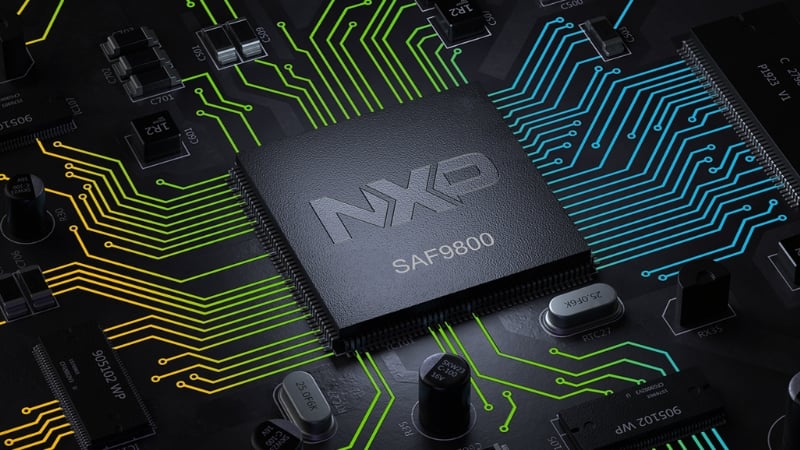
At APEC 2026 last week, pSemi demonstrated the PE26100, a high-efficiency multi-level buck converter that doubles as a regulated multi-level buck converter and a fixed-ratio charge pump to support various fast-charging ecosystems. pSemi hopes that this module will change how power is managed for next-generation mobile devices, especially as manufacturers move toward high-power USB Power Delivery (USB-PD) and programmable power supply (PPS) standards.
At the event, All About Circuits was able to learn more about this new technology from its inventor, Gregory Szczeszynski, a Sr. Director of Architecture and IC Development for pSemi.
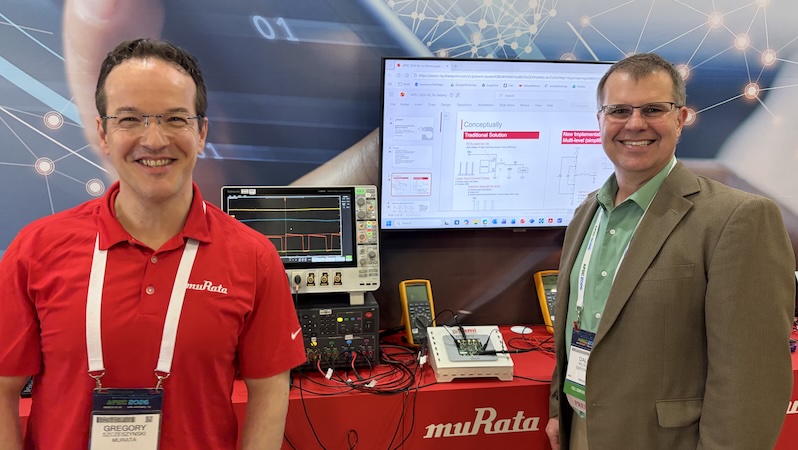
Gregory Szczeszynski of pSemi and Dale Wilson of All About Circuits were all smiles as they discussed the new PE26100 4-level buck converter at APEC 2026.
Szczeszynski explained that smartphones used to ship with a custom USB-PPS charger that allowed fast charging. However, phones are no longer shipped with a custom charger. This leads to frustration when the consumer plugs the smartphone into a high-power USB-PD charger, but only gets slow, inefficient charging.
While there are many designs in academia for buck converters that support more than 3 levels, according to Szczeszynski, these did not lend themselves to realistic volume implementations. In his 'eureka' moment, Szczeszynski figured out a method to balance the capacitors in a 4-level design separately from the algorithm used in the control loop. This led to the design and release of the PE26100, which pSemi believes will revolutionize the USB charging market. "We didn't invent 4-level charging, but we figured out how to industrialize it."
The PE26100 Module
Compatible with an input voltage range of 4.5 to 18.5 V (i.e., standard for USB-PD and wireless charging), the PE26100 delivers up to 6 A of output current for single-cell lithium battery charging. For high-tier applications requiring even greater current delivery, multiple units can be configured in parallel to scale the fast-charging capacity beyond the standard 6A limit.
Most notable about the device is its flexibility. When a fixed input voltage is supplied by a source such as USB-PD, the PE26100 operates in a regulated multilevel buck mode. Specifically, the module can transition between 4-level and 3-level buck modes depending on the input voltage, with the 4-level mode for higher-voltage inputs and the 3-level mode for mid-to-low-voltage inputs.
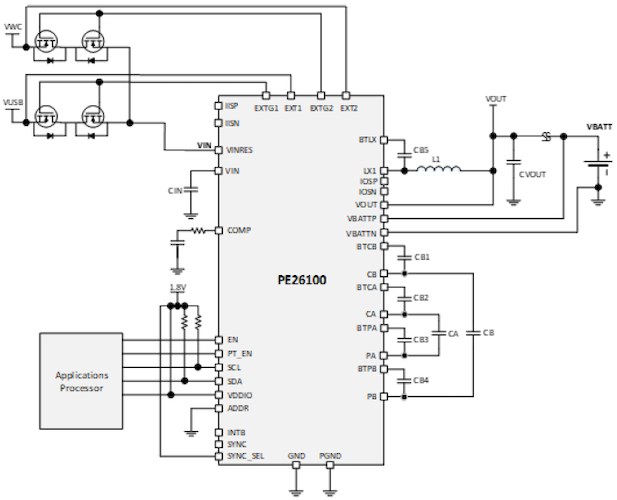
PE26100 typical application circuit. Image used courtesy of pSemi.
When a variable input voltage is applied from a source such as a USB PPS, the PE26100 operates as a switched-capacitor charge pump with a fixed-ratio divider (2:1 or 3:1) to improve power efficiency. The module’s fixed-ratio divider lets the same component handle different charging protocols in an ultra-thin form factor.
Meanwhile, to manage system safety, the IC includes internal telemetry for monitoring temperature, voltage, and current, accessible via an I2C interface, as well as hardware protection against overvoltage, undervoltage, and overcurrent conditions. The IC also includes a user-triggered thermal throttle and detailed fault status reporting that lets the system's application processor dynamically manage the thermal envelope during intensive charging cycles.
Multi-Level Buck Conversion in Mobile Power
Multi-level buck conversion resolves the trade-off between efficiency and component size in DC-DC power delivery.
In a standard two-level buck converter, the switching node toggles between the full input voltage and ground. This creates high-voltage stress on the inductor, requiring a larger physical component to manage energy storage and ripple current without saturation. To reduce the inductor size in a two-level system, designers usually need to increase the switching frequency, which results in higher switching losses and lower efficiency.
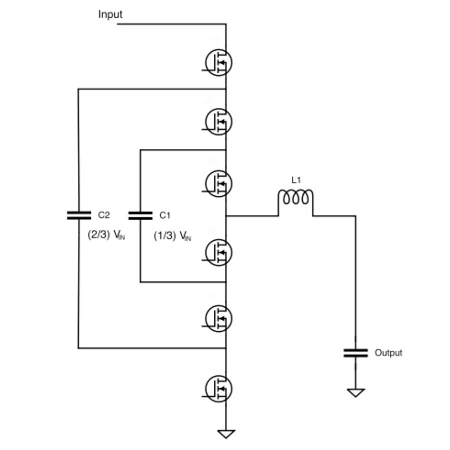
Multi-level buck converter. Image used courtesy Bodo’s Power Systems / EEPower.
The multi-level approach uses additional flying capacitors in the circuit to create intermediate voltage steps. By dividing the input voltage into smaller increments, the converter greatly reduces the inductor's voltage swing.
This reduction allows engineers to use an inductor with a much lower profile and smaller inductance than a traditional buck converter would require for the same current levels. Furthermore, the effective switching frequency at the output is multiplied by the number of levels, thereby naturally reducing the output current ripple.
All things considered, multi-level buck converters help power systems achieve higher energy density, translating into high-current charging circuits that fit within the thin z-height requirements of current mobile devices.
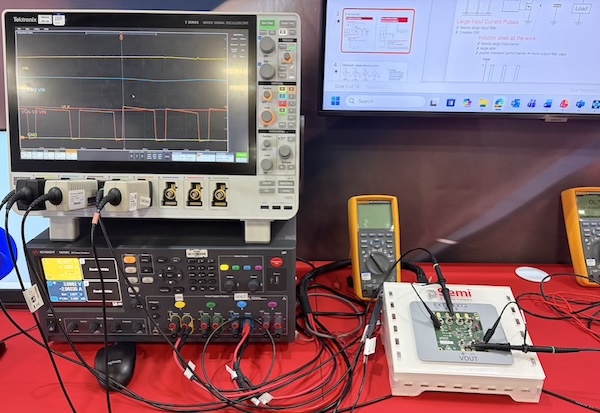
At APEC 2026, pSemi demonstrated the operation of the new PD26100 4-level buck converter.
The Future of Portable Fast Charging
The PE26100 is currently available in a wafer-level chip-scale package, with production quantities offered in 5,000-unit tape-and-reel packages.