Facebook
 Google
 GitHub
 Linkedin
Nvidia Quantum Middleware Jumpstarts Quantum Fault Tolerance
A new addition to Nvidia's CUDA-Q quantum computing platform adds logical qubit error correction and abstraction to significantly speed reliable quantum application development.
Nvidia recently announced a logical orchestration layer for its open-source CUDA-Q quantum computing platform. The new layer, called CUDA-Q Logical, helps incorporate fault tolerance into quantum computing applications. The layer promises to enable faster quantum architecture development by abstracting the physical hardware layer (PHY) for fault tolerance and logical qubit development. Fermilab, an early user of the new software, shrank an expected five-month development program to three weeks.

With the CUDA-Q Logical orchestration layer, the Nvidia CUDA-Q platform now provides an open, programmable way to design and test fault-tolerant quantum computing use cases. Image used courtesy of Nvidia
Qubit instability is one of the primary challenges holding back the commercialization of quantum computers. Improving stability involves complex conventional software and quantum circuit configurations for error correction and grouping multiple physical qubits into logical qubits. Researchers must manually create and recreate these configurations for each new quantum algorithm or hardware variation.
The CUDA-Q Platform: A “Quantum Middleware”
A quantum processing unit (QPU) is not a linear processor like a conventional computer CPU. More like a field-programmable gate array (FPGA), a QPU is a formless configurable array of qubits. At power-up, it does not come with ready-to-use hardware, yet quantum “programs” are typically written in high-level languages like C# or Python.
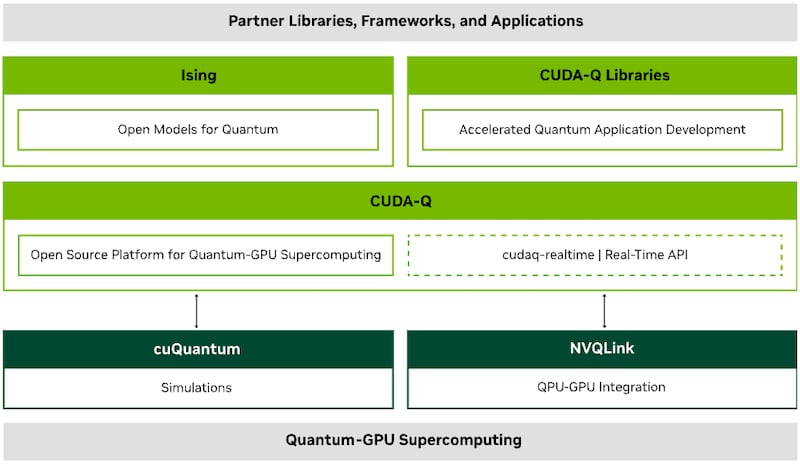
Nvidia CUDA-Q platform within quantum computing framework. Image used courtesy of Nvidia
Middleware sits between the language code and the QPU. It includes software that converts quantum gate descriptions and logic into a configuration the QPU can implement. A significant component of the software workload involves quantum error correction (QEC) and the configuration used to create virtual qubits from groups of physical qubits.
CUDA-Q Logical: Logical Orchestration
Orchestration is a layer in the middleware stack that bridges algorithms and physical quantum hardware. It manages and schedules QEC, and it acts as an abstraction layer for photon pulses and qubit interactions that manipulate superposition and entanglement. CUDA-Q Logical adds stability functionality while abstracting the PHY. It lets developers work consistently with logical qubits that may differ in physical architecture, without manually configuring them.
The key functionality of CUDA-Q Logical includes logical-qubit virtualization, integrated error correction, and abstraction to get closer to a “write once, run anywhere” model. By including logical qubits and QEC in an abstracted form, improved QEC algorithms can be substituted with little or no need to adapt high-level code. Quantum algorithms become faster to develop and more portable across diverse hardware.
Researchers at Fermilab have utilized CUDA-Q Logical to validate results from earlier runtime quantum computing work. They recreated several manually created fault-tolerant QPU configurations with the new Nvidia software. Removing much of the physical-layer configuration will let quantum developers focus on algorithm development while others independently work to improve QEC tools and logical qubit configurations.
Sandia National Laboratories QUOPS
Sandia National Laboratories also recently joined the Nvidia open-source middleware effort with a new benchmark system. QUOPS measures quantum application progress toward utility-scale. QUOPS is a hardware-agnostic method of evaluating quantum computer power that goes beyond just counting qubits.
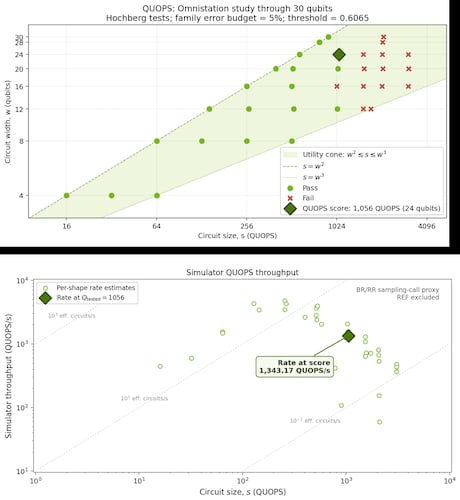
QUOPS benchmark report. Image used courtesy of Sandia Labs (Github)
Qubit count has traditionally been the primary measurement of quantum computer progress. However, a simple count doesn’t consider redundancy, qubit grouping, virtual qubits, or algorithm efficiency. The new QUOPS benchmark utilizes a mirror-circuit fidelity estimation (MCFE) workflow to estimate passing circuit sizes and simulator throughput, and benchmarks logical implementation costs.
Digging Deeper Into CUDA-Q Logical
CUDA-Q starts with Nvidia’s CUDA graphics processing unit (GPU) based parallel computing platform and programming model. It allows for development that combines computation across CPUs, GPUs, and QPUs within a single platform. It allows hardware-abstracted quantum computing development with high-level languages, such as Python and C#.
CUDA-Q Logical is a standalone, modular component within the CUDA-Q platform, built on multilevel intermediate representation (MLIR). CUDA-Q essentially acts as a library for accessing logical QPU constructs independent of the underlying hardware.
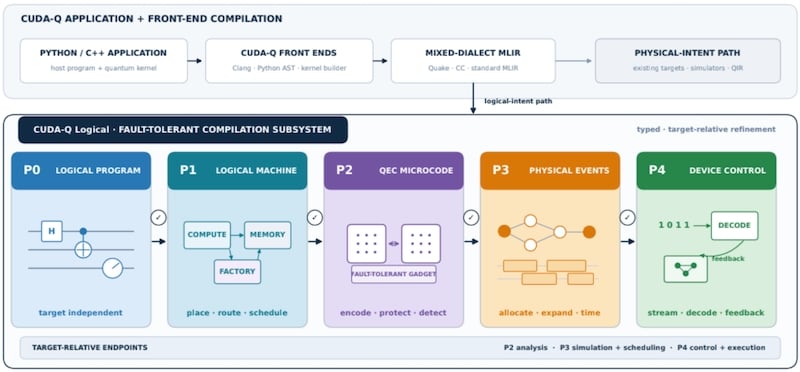
CUDA-Q Logical workflow. Image used courtesy of Nvidia
CUDA-Q Logical fits within the workflow and offers explicit typed representations of fault-tolerant architectural states and QEC bindings. Before CUDA-Q Logical, developers had to manually create the intermediate steps to ensure reliable QPU operation. A change in physical hardware would require a significant rebuild. CUDA-Q Logical provides API-style, pre-built functionality to replace the manual build-and-rebuild process.
CUDA-Q Availability
Nvidia has made the platform available on GitHub under the GPLc3 license. Nvidia provides more details on CUDA-Q Logical in a published technical paper.
Related Content