Facebook
 Google
 GitHub
 Linkedin
Qorvo Intros Power Doublers Aimed at DOCSIS 4.0 Cable Networks
The new power modules offer high output and flexible power options for scalable DOCSIS 4.0 HFC upgrades.
Qorvo has announced two new hybrid power doublers to support upcoming DOCSIS 4.0 broadband networks. DOCSIS 4.0 presents opportunities and complexities for operators, with expanded frequency ranges and stricter requirements on signal integrity and power efficiency.

Qorvo designed the high-output power doublers for smart DOCSIS 4.0 upgrades. Image used courtesy of Qorvo
With the new amplifier solutions, Qorvo aims to simplify network scaling, facilitate cost-efficient transitions to DOCSIS 4.0, and ultimately reduce the need for expensive downstream amplification stages.
Two High-Output, Hybrid Power Doublers
The QPA3311 and QPA3316 are GaAs/GaN-based hybrid power doubler amplifiers fabricated on Qorvo’s GaN25 process. Each module delivers 23 dB of gain and supports a frequency range from 45 MHz to 1,794 MHz with a focus on DOCSIS 4.0 downstream applications.
While similar in gain and frequency support, the two devices differ notably in power handling and voltage requirements. The QPA3311 operates at 24 V and consumes 12.5 W, with a total composite power (TCP) output of 74 dBmV at 51 dB composite carrier noise (CCN). These specifications skew the QPA3311 toward power-efficient system designs that prioritize end-of-line signal integrity without excessive power overhead.
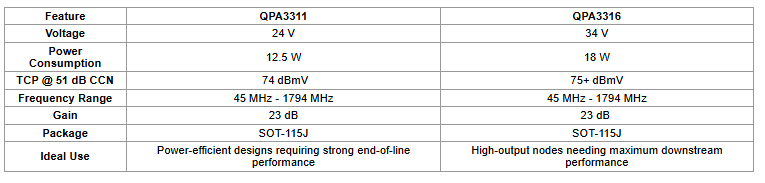
Comparing the QPA3311 and the SPA3316. Image used courtesy of Qorvo
In contrast, Qorvo engineered the QPA3316 for maximum downstream output, drawing 530 mA at 34 V and delivering over 75 dBmV TCP. This higher power rating allows it to support demanding node environments where line amplification is minimized. Both devices feature a SOT-115J package and are stable under all terminations.
Another notable feature of both modules is their external current control pin, which allows system designers to dynamically balance distortion performance against power consumption. Such adaptability could be a boon in amplifier designs that experience varying network loads.
Power Doublers in DOCSIS 4.0 Networks
DOCSIS 4.0 is the latest specification for broadband cable networks, bringing with it multi-gigabit symmetrical data speeds over hybrid fiber-coaxial (HFC) infrastructure. While DOCSIS 4.0 pushes downstream bandwidth ceilings to 1.8 GHz, legacy HFC architectures face a growing mismatch between new spectrum demands and existing amplification infrastructure.
In this context, power doublers help fill the gap by boosting signal levels in the final stages of the transmission chain. Yet, to be effective at these elevated frequencies, amplifiers must exhibit an elusive combination of gain, linearity, return loss performance, and thermal stability.
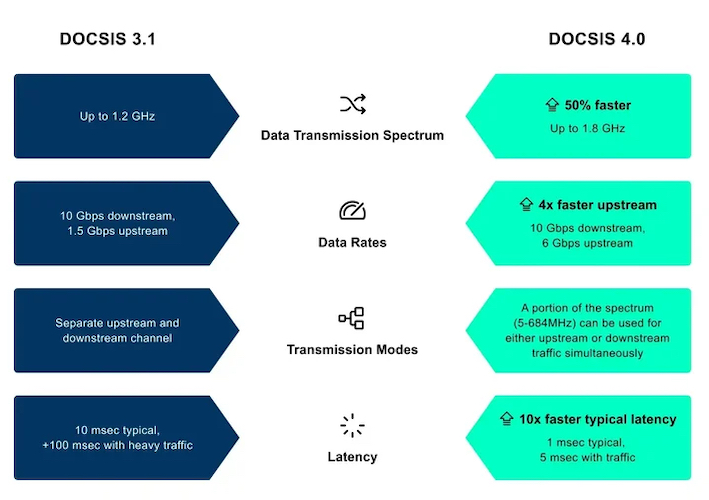
DOCSIS 3.1 versus DOCSIS 4.0. Image used courtesy of PPC Broadband
In traditional cascaded HFC networks, signal degradation accumulates through each amplification stage. Without sufficient linearity, amplifiers introduce harmonic and intermodulation distortion that compromises signal quality. Return loss, which reflects the mismatch between amplifier impedance and the transmission line, also becomes increasingly difficult to manage as frequency increases. Poor return loss can cause reflections that distort signals and reduce amplifier efficiency.
DOCSIS 4.0 networks also introduce new challenges tied to network intelligence and power efficiency. As operators move toward smart amplifiers with integrated telemetry and remote management capabilities, power doublers can accommodate varying load conditions and support fine-grained performance tuning.
DOCSIS 4.0 Scalability Through Amplification
With the QPA3311 and QPA3316, Qorvo hopes to provide cable operators a way to simplify DOCSIS 4.0 migration without extensive infrastructure overhauls. Both devices are production-released and support scalable HFC designs aligned with Unified DOCSIS strategies. The amplifiers are now available in production quantities.