Facebook
 Google
 GitHub
 Linkedin
Exclusive—Renesas Exec Talks Humanoid Robotics, Analog Solutions, and More
In this interview article, Renesas VP Peter Jenkins discusses how the company is leveraging its automotive sensor heritage and mixed-signal ICs to power the future of edge AI and humanoid robotics.
In an era where digital computing often dominates semiconductor mindshare, the analog and sensing technologies bridging the physical and digital worlds remain more vital than ever. For its part, Renesas Electronics, well known for its vast portfolio of microcontrollers and digital processors, wants to remind us that it’s equally well positioned as a power in analog integrated circuits and advanced sensors.
From fundamental building blocks like op-amps to innovative programmable mixed-signal solutions like GreenPAK and AnalogPAK, Renesas says it is continuing to grow its footprint to support high-speed data transmission, complex signal chains, and flexible design architectures.
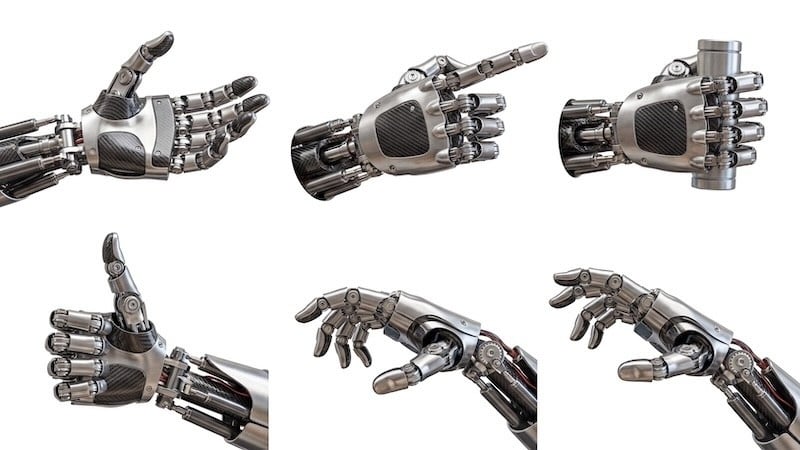
The humanoid robotic hand is an application that exemplifies the need for advanced sensing and analog and mixed-signal technologies. Image used courtesy of Adobe Stock (licensed).
In this interview article, I sat down with Peter Jenkins, Vice President & General Manager, Analog & Mixed Signal at Renesas, to discuss how the company’s extensive automotive sensor lineage is fueling new breakthroughs in industrial and humanoid robotics. As edge AI and physical AI demand increasingly sophisticated, safety-compliant sensing capabilities, Renesas leverages its deep history in high-reliability applications to drive multi-sensor integration.
From power sequencing to multi-functional ICs for robotic hands, Jenkins highlights how Renesas’s comprehensive portfolio and targeted "Winning Combinations" are shaping the future of smart, automated systems.
Jeff Child, All About Circuits: In today’s digital world, often the control and computing devices in the semiconductor industry get a lot of the attention. Obviously, Renesas is strong in that world with its wide portfolio of MPUs, MCUs, and other digital devices. But electronic systems always have to interface with the physical world, so analog ICs and sensors are more important than ever. Can you talk about where Renesas fits into that side of the market?
Peter Jenkins, Renesas: Just as you say, the analog parts and sensors are hot right now. The industry has realized that #1: They can’t live without high speed data, and #2 They can’t live without sensing. On the one hand those basic analog functions—op amps, muxes, switch ICs—the demand in that market is still massive. Renesas has a very big history in those areas, and we’re building on that. Meanwhile, we also offer the next level in analog which is programmable analog technology and configurable mixed-signal solutions, served by our GreenPAK and AnalogPAK product lines, for example.
So with those products you have your basic analog building block and your programmable analog building blocks. Those have never gone to the wayside, right? They've always been there and they're always growing. They’ve become so common in fact, that they don't get the attention they deserve. But that market is still very hot for us and growing.
Child: So those basic analog building blocks remain very important and the market for them is strong and growing. Now let's talk about where some of the interesting new demands are happening, particularly on the sensor side. Applications like industrial robotics, for example, are extremely dynamic right now and putting big demands on sensing technology, right?
Jenkins: Yes, exactly. For me, when I look at where the market is going, it’s sensing—it has already started and will continue to expand very rapidly. We’ve already seen in automotive sensing all of its functional safety requirements, safety standards, the high level of complexity and flexibility in those designs. Now all of that exact same criteria is making its way over to industrial robotics and humanoid robotics. All of the major players there will start requiring the same level of technology and compliance that automotive did.
That puts Renesas in a very advantageous position. We have a rich history in automotive sensing, and we're using that as a “gasoline on the fire” type of approach to help us penetrate those markets like humanoid robotics. And that’s already happening.
Child: Robotics is a space where the analog world and the edge AI world intersect, right?
Jenkins: I think of the phrase “analog is everywhere,” but it doesn't even do it justice to the types of activity that we're seeing—especially as you're trying to bring in the concept of physical AI, in other words doing edge AI processing to all that data. It all starts with sensing, right? And then there’s also the analog signal chain to bring that to the core computer or to the “brain” of a humanoid robot.
So the analog market—for lack of a better word—is crazy. And in such a good way, because analog IS everywhere, and Renesas is riding this momentum to provide our solutions to engineers in all these hot markets.
Child: Exciting times for analog technology for sure! On that note, going back to the configurable analog and configurable mixed-signal side of things, let’s talk in more detail about what Reneas offers there.
Jenkins: Let’s take power sequencing for example. That’s the number one task that our GreenPAK ICs are used for. When a hardware designer opens up their schematic and they label the page power sequencing diagrams, GreenPAK is the first thing they think of. For us, that’s a great metric of success
A lot of our focus in the future is going to be how do we redefine what a normal solution looks like for these markets? And how do you innovate with these Renesas products? You’ll see that coming up with GreenPAK—one recent example being our recent SLG46801, our smallest GreenPAK configurable mixed-signal device.
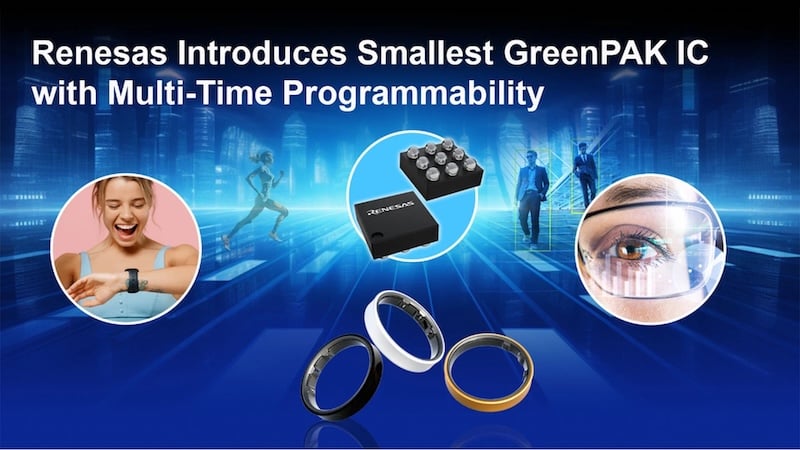
Recently announced, the SLG46801 is Renesas’ smallest configurable GreenPAK IC with multi-time programmability.
Child: Renesas offers its GreenPAK family but also its AnalogPAK family. Would you position the two for me?
Jenkins: Yes, AnalogPAK is an extension of our GreenPAK family, and includes more of the traditional op amp function, along with a couple other analog building block functions. We also have AnalogPAKs that embed ADCs.
In contrast, GreenPAK focuses more on the glue logic functionally—adding some trigger points and, as I mentioned earlier, power supply sequencing.
Which one to use depends on your end application. AnalogPAK is relatively new, and we’re getting a lot of market traction there. The well established GreenPAK line has been a staple for a lot of core functions, but is also finding new uses, for example: charging cradles for new consumer IoT devices like smart wearables. When your application is space constrained and a little too kludgy, GreenPAK offers the integration to go to the next level.
Child: On a side note, for the power side I know Reneas also has a third offering: HVPAK.
Jenkins: Yes. So, think of GreenPAK as more for the configurable logic side, and then we have HVPAK which is more for the power side. Meanwhile, AnalogPAK is designed for more of the true dedicated analog functions. We offer those three families of programmables.
Child: There’s a type of information resource Renesas has that I find particularly intriguing and that is your applications focused “Winning Combinations” featuring diagrams of applications showing how various Renesas devices can be used together. I’m more aware of those from the digital side, but can you talk about how those extend to the analog side too?
Jenkins: Yes. For our Renesas Winning Combinations, we want to be both a core solution and a pull through solution. Here’s what I mean by that: Let’s say we're showcasing our RA8 MCU. Within our analog and mixed-signal offerings, we have everything from I2C muxes to NOR flash to a sensor to whatever device goes next to those. Those are our pull-through functions on some of our great winning combos.
But then, in reverse, you'll have these newer applications that are heavily commoditized, but they want an inductive position sensor that does this specific function. So there our analog devices are the core of the winning combo and everything else is part of the pull-through solutions.
That means analog and mixed-signal is on both sides of that metric. There's so much variety in our portfolio that we're both an ancillary solution that makes the core solution look good, or we're a core solution where everything else makes us look good. We play on both sides.
Child: One thing you alluded to earlier is that you have a lot of these analog parts that are successful in the automotive market, but they are attractive to the exploding areas of control and robotics. I’m guessing that’s because these automove parts have to meet a lot of standards, and be built for harsh environments in order to be used in the automotive market.
Jenkins: Yes, that applies for sensors in particular. We truly have a strong foundation of automotive heritage in our sensor portfolio. In fact, 1 in 3 cars on the road today has at least two of our sensors—pressure sensors, force sensors, torque sensors—all of those. We cover everywhere from pedal position to temperature management—all of that.
In order to be successful in that market having processes in place for functional safety, ISO 26262, etc. is a must. Depending on the region that you're in, some of our suppliers need qualifications like ACQ.
Now you have robotics companies coming to us saying that robots for the home, for example, have a lot of human interaction. And they want the level of safety and reliability that you see in automotive because those standards are already well established.
Take sensor technologies in automotive like steer-by-wire or pressure. In robotics, a hand has two sensors combined—either per joint or per articulation. It could be pressure and force, and then skin and position—something like that. There's always two sensors that go together. A sensor like our pressure sensors used in the car today can be used on when a humanoid robot touches and it feels the pressure it's applying to an egg or a can of Coke. So, complete implementations, but because the interaction is still with a human, the level of safety is still required. It's the number one request we get today for robotics: ‘Tell me about your functional safety portfolio for automotive, because I want to use that.’ That applies to humanoid robotics or any other robots that interact with humans.
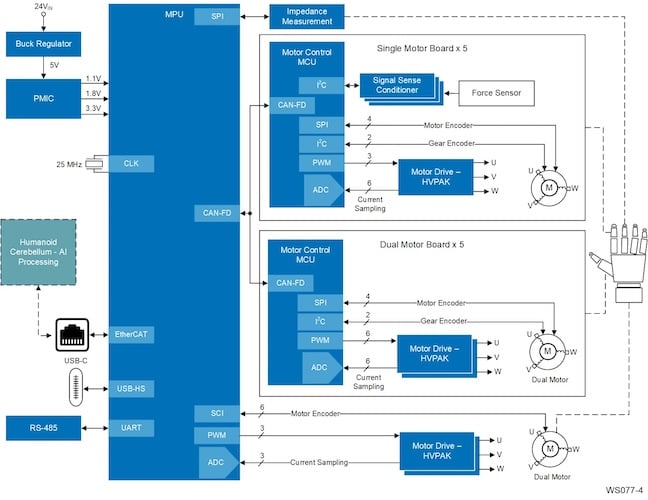
Renesas design example of a dexterous humanoid robotic hand system
Child: Let’s talk about integration of multiple sensor functions. Given today’s technology, I imagine you could integrate quite a few sensor functions onto one chip—like a Swiss Army Knife sensor IC. But is that idea practical given that no one wants to over design this sort of thing. And, like you said, sometimes they just need two sensors.
Jenkins: You know, what's funny is that our future is actually slowly pointing us into that direction. Today, I would say that—outside of the ‘brain’—arguably the most complex area for a human is the hand. There are tendons, skin, touch, joints—all that and other stuff that you have to replicate for a humanoid robot.
Today you've got essentially four sensing ICs in the hand. There’s impedance to mimic human touch. Impedance is better than capacitive or resistive touch because it's immune to dirt or you could wear a glove and still react to it. It's immune to water— basically impervious to outside environments. That impedance sensing will take human touch to the next level.
For grip, you've got either resistive sensing or perhaps some type of optical sensing. Force sensing will be part of that too.
Meanwhile, for the joints you've got inductive position sensing. That’s way better than your traditional encoders because it's a smaller solution and it's cheaper. Your classic optical encoder solutions eventually will go away, leading to something that's more effective at scale and at cost, like an inductive position sensor. That also helps for the overall size and weight of the solution too. I already talked about force sensing, or like a strain gauge signal condition.
Child: So, those are the four different sensor functions?
Jenkins: Yes, those are the four: touch, grip, your joints, and force. Those are the typical sensing solutions you would find in a hand. But they're gripped in twos. So resistive sensing, grip, and force—those are typically combined, close by one another. Then there is position and then either force or resistive for joint positioning. So you have inductive positioning plus resistive force that are often combined as well. That's your second suite. So you’ve gone from four ICs to four functions that are encapsulated in two ICs. That's the next evolution. We reduce the number of sockets and we optimize the solutions that go together.
Child: Got it. And presumably the integration needs of the automotive might be different in that sense than in the robotics market, right?
Jenkins: Correct. Right now humanoid robot development is still very new. You can make use of all the automotive ICs for how big they are and their functionality, and a lot of it's good for proof of concept for low volume manufacturing in humanoid robotics. We’ll get to the next stage where you go from four sensor functions to two. Those 2 are optimized for their functions in the hand, right? Then, what's the second generation after you've already innovated? You then take the four into one.
Child: As we wrap up here, is there any key takeaway you want to leave our readers with Peter?
Jenkins: Our goal is that we don’t want Renesas to be the world’s best kept secret when it comes to analog and these other technologies we’ve talked about here. We've got a lot to offer.
All images used courtesy of Renesas, unless otherwise specified.