Facebook
 Google
 GitHub
 Linkedin
Qorvo’s Solid-State Power Amplifiers 50% Smaller Than Counterparts
The compact GaN-based Spatium solid-state power amplifiers extend reliable wideband performance from 2 GHz to 40 GHz.
Qorvo has announced a new generation of solid-state power amplifiers (SSPAs) to replace traditional traveling wave tube amplifiers (TWTAs) in defense, communications, and radar systems. The new release comprises four new products, with the flagship QPR3238 operating across 32 GHz to 38 GHz and achieving a continuous-wave saturated output power of 51.5 dBm.
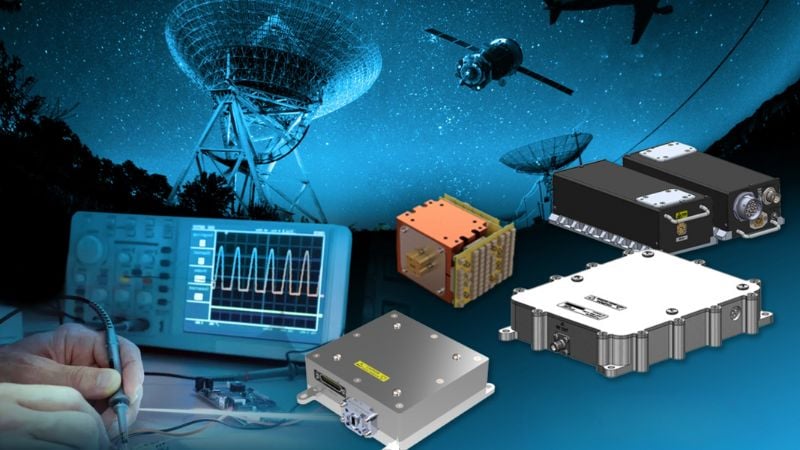
Qorvo claims these solutions may speed up the industry’s transition to solid-state power with scalable, proven technology.
Up to 50% smaller in system size and weight, Qorvo’s new designs are meant to eliminate the mechanical and thermal complexities associated with conventional vacuum-based amplifiers.
A Closer Look at the Flagship SSPA
The QPR3238 delivers 51.5 dBm (approximately 141 W) of saturated power in continuous-wave mode and up to 52 dBm (158 W) in pulse operation. It achieves this output with 15% power-added efficiency and 51.5 dB of gain, utilizing a fully solid-state GaN MMIC array. The amplifier operates from a 24 V supply at a quiescent current of 10 A and supports both CW and pulsed modes, with a maximum pulse width of 500 µs at a 50% duty cycle.
Notably, the device is built on Qorvo’s patented Spatium architecture, which spatially combines the outputs of numerous parallel GaN devices. Using a waveguide network that equalizes amplitude and phase, Spantium creates a single coherent output with minimal loss. The result is a high-efficiency amplifier capable of instantaneous bandwidth from 32 GHz to 38 GHz.
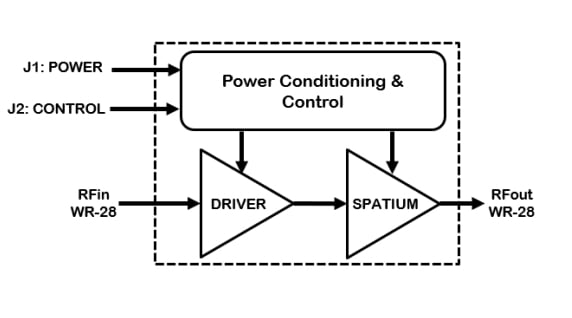
QPR3238 functional block diagram.
Along with integrating its own driver stage, the QPR3238 incorporates a DC enable control that supports RF pulsing and modulation. When the amplifier is disabled, its current draw approaches zero to reduce heat generation and improve overall system noise performance. Switching time from enable to 90% RF output is typically 165 ns, enabling high pulse repetition frequencies of up to 0.5 MHz. Both input and output interfaces use WR-28 waveguide flanges, with orthogonal orientation to simplify integration in compact enclosures.
Measured data shows consistent gain flatness and efficiency across the entire operating band, with minimal degradation under temperature variations from -40°C to +43°C. Power dissipation reaches ~900 W at full drive and is managed through dual-sided cooling. Notably, the module measures 280.7 mm x 139.7 mm x 87.1 mm, which is roughly half the volume of comparable TWTAs that deliver similar output power.
Qorvo's other driver amplifiers (including the QPB3238J and QPB0618J) share this GaN-based construction and offer 37 dB to 50 dB gain with up to 45-dBm saturated output, depending on frequency range. The QPB1840N Spatium amplifier further extends operation to 40 GHz, delivering 44 dBm of output power in a 2.8-kg package with integrated bias control.
Spatial Combining in Solid-State Power Amplifiers
Spatial power combining is an integral aspect of Qorvo’s SSPA architecture. Traditional power amplifiers rely on planar combiners that merge transistor outputs through transmission lines, which introduces loss and limits bandwidth. In contrast, spatial combiners distribute RF energy through 3D waveguide networks that sum signals in free space or quasi-optical domains.
In a spatial combiner, each GaN MMIC amplifier operates as a phase-coherent element. The output fields from these elements are combined electromagnetically within a shared cavity or manifold. This geometry minimizes insertion loss and thermal concentration, improving overall efficiency. Spatial combining also scales linearly: adding amplifier blades increases total power without requiring redesign of individual MMICs.
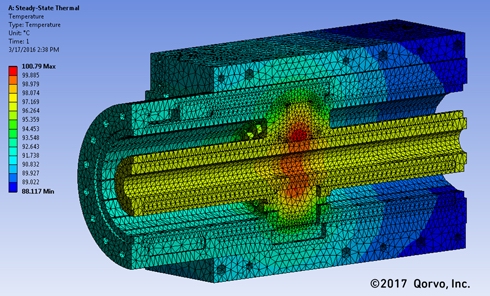
Thermal simulation using Qorvo's Spatium QPB1006.
At Ka-band and higher, waveguide-based spatial networks outperform corporate combiners due to lower resistive losses and reduced sensitivity to phase imbalance. The approach affords wide instantaneous bandwidths while maintaining amplitude flatness and stability. When paired with GaN-on-SiC devices, which sustain high junction temperatures and deliver superior power density, spatially combined SSPAs achieve output levels once practical only with vacuum tubes.
Another advantage is reliability. TWTAs depend on high-voltage electron beams and cathode heating. Solid-state combiners use no moving parts or high-voltage supplies. They start instantly and maintain consistent gain without degradation from filament aging.
Solid-State Scaling
With a compact design that cuts size and weight by roughly half while delivering equivalent power, linearity, and pulse response, the QPR3238 and related devices seem practical replacements for high-power TWTAs in the 32–38 GHz range. The QPR3238 and its supporting amplifiers are available now through Qorvo and authorized distributors.
All images used courtesy of Qorvo.