Facebook
 Google
 GitHub
 Linkedin
Qualcomm Levels Up Mobile Processors, Wi-Fi 8 Portfolio, and RF Hardware
Qualcomm’s AI-native Wi-Fi 8 platforms, R19-ready 5G modems, and custom Oryon CPUs set the company up for the next generation of mobile and networking infrastructure.
Qualcomm recently announced its Wi-Fi 8 portfolio, the Qualcomm X105 5G Modem-RF, and the Snapdragon 8 Elite Gen 5 for Galaxy to support AI workloads.
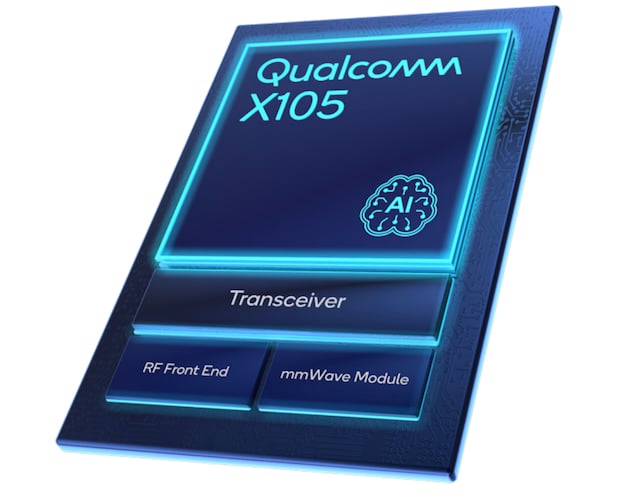
Block diagram of the Qualcomm X105. Image used courtesy of Qualcomm
The company claims that it designed these platforms to manage the dynamic network traffic patterns of AI workloads by distributing intelligence across the edge-to-cloud continuum. As a result, they have a broad hardware stack that includes mobile devices and networking infrastructure, like enterprise access points and broadband gateways.
Qualcomm Targets Connectivity on Several Fronts
The first of Qualcomm’s releases is the FastConnect 8800 Mobile Connectivity System, which it touts as the industry’s first mobile solution to feature a 4x4 Wi-Fi radio configuration with peak speeds over 10 Gbps. This 6-nm single-chip system integrates Wi-Fi 8, Bluetooth 7, Ultra Wideband (UWB), and Thread into a single architecture, providing up to three times the gigabit wireless range of previous chips.
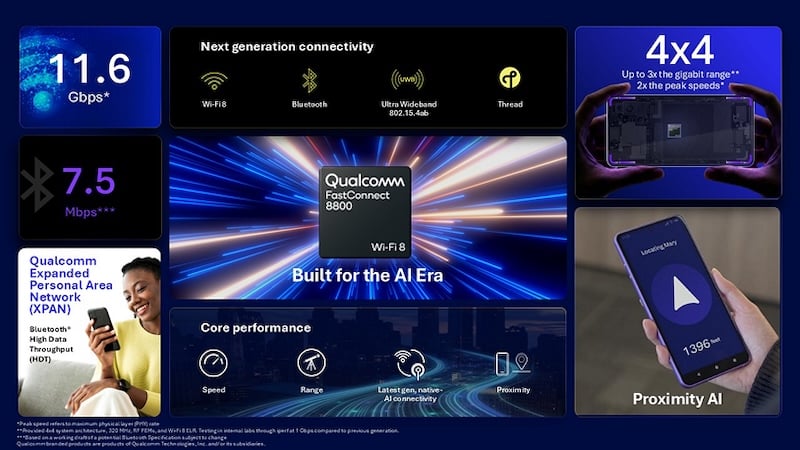
Features of Qualcomm’s FastConnect 8800 Mobile Connectivity System. Image used courtesy of Qualcomm
The company also announced several new Dragonwing platforms, including the Dragonwing NPro A8 Elite. This platform features a 5x5 Wi-Fi 8-radio system to potentially increase throughput by 40% at typical distances and lower latency by 2.5x during peak usage. All of these platforms also have specialized packet-processing engines and on-device AI acceleration to ensure that networking tasks remain performant alongside AI-driven workloads.
The Wi-Fi releases coincide with Qualcomm’s X105 5G Modem-RF, which the company claims is the world’s first 3GPP Release 19-ready modem. According to the company, the new architecture should enable download speeds of 14.8 Gbps and upload speeds of 4.2 Gbps for future 6G development. It also includes the Qualcomm Turbo DSDA, which offers 60% higher throughput with Multi-SIM CA support compared to its predecessors.
Finally, the newly released Snapdragon 8 Elite Gen 5 for Galaxy will power the latest Samsung Galaxy S26 series using a custom-built 3rd Gen Qualcomm Oryon CPU and an integrated Hexagon NPU. This platform uses agentic AI to handle background actions and personalized workflows, such as Advanced Professional Video (APV) capture and real-time nudges.
Understanding 3GPP Release 19
3GPP Release 19 (Rel-19) is the second phase of the 5G-Advanced standard, which introduces new technologies in the transition to 6G. Engineers can use Rel-19 to improve wireless connections by implementing Multiple-Input Multiple-Output (MIMO) techniques and improving uplink performance. These specifications enable higher data rates and more reliable connections in challenging environments, such as dense urban areas or the cell edge. Rel-19 also supports Non-Terrestrial Networks (NTN), which integrate terrestrial base stations and satellite constellations to provide global network coverage.
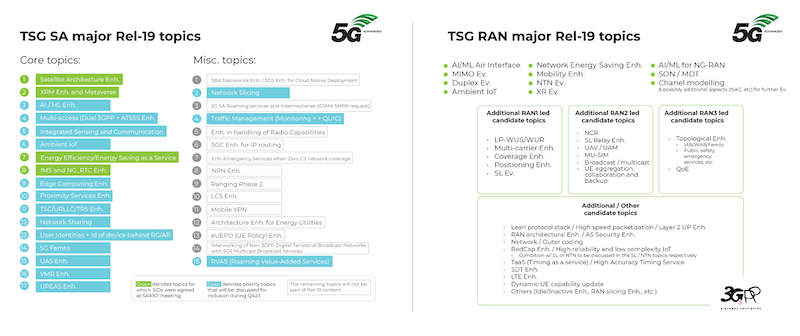
Core features of Rel-19. Image used courtesy of 3GPP
In addition, Rel-19 includes AI in the Radio Access Network (RAN) to let modems dynamically classify and prioritize traffic types based on specific application requirements, such as gaming or video conferencing. By implementing AI-powered beam management and channel state information (CSI) feedback, Rel-19 reduces signaling overhead and improves spectral efficiency. The standard also includes provisions for lower power consumption through efficient wake-up signals, which is important for maintaining battery life in mobile devices and industrial IoT sensors while they perform data-intensive tasks.
Future Connectivity and Deployment
Qualcomm expects its new hardware products to change how we use mobile devices by enabling centimeter-level proximity sensing and ultra-low-latency mesh backhaul. By putting AI directly into the modem and processor, mobile devices and other computing systems may eliminate lag in real time without using the cloud, resulting in steadier performance with fewer interruptions.
The company is currently sampling its Wi-Fi 8 portfolio to customers, with the first commercial networking products expected in late 2026. The Snapdragon 8 Elite Gen 5 for Galaxy is now available on the Samsung Galaxy S26 Ultra globally and on the S26+ and S26 models in select regions.