Facebook
 Google
 GitHub
 Linkedin
Quantum Control at the Edge: New Frontiers Without Magnets or Cryogenics
From spin-polarized graphene to vacuum-engineered insulators, three research breakthroughs push quantum materials closer to practical, scalable technologies.
As quantum technologies inch toward real-world deployment, the focus is shifting from foundational physics to material systems that support quantum behavior under accessible conditions, without relying on strong magnetic fields or extreme cooling.
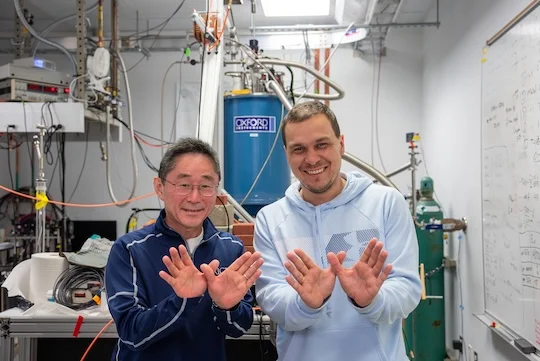
Junichiro Kono (left), who led a recent research effort to engineer quantum materials using vacuum fluctuations, is pictured with Andrey Baydin (right). Image used courtesy of Rice University
In this roundup, we explore three cutting-edge advances that bring that vision closer: TU Delft’s realization of spin currents in graphene without magnetic fields, Rice University’s use of vacuum fluctuations to manipulate topological phases, and NC State’s discovery of solitonic coherence in hybrid perovskites at room temperature. Together, they present a compelling roadmap toward high-functionality, low-footprint quantum devices.
TU Delft Demonstrates Quantum Spin Hall Effect in Graphene
In a breakthrough for low-power quantum electronics, researchers at Delft University of Technology (TU Delft) have observed quantum spin currents in graphene without applying any external magnetic field, marking a significant advancement in the development of spintronic devices.
Spintronics, short for "spin-based electronics," exploits the quantum property of electron spin—a kind of intrinsic angular momentum akin to a tiny magnetic moment—to carry and manipulate information rather than relying solely on charge as in traditional electronics. This approach offers the potential for dramatically faster and more energy-efficient circuits as well as inherently quantum-coherent devices.

An artist’s impression of the quantum spin Hall effect in a graphene-based spintronic device, integrated in a chip. Image used courtesy of ScienceBrush/Talieh Ghiasi
The team achieved this by engineering a graphene layer on top of a magnetic material (CrPS₄), inducing the quantum spin Hall (QSH) effect. This phenomenon allows electrons with opposite spins to travel along opposite edges of the material in a dissipationless and topologically protected manner. Because the spin currents are preserved over long distances and remain robust even in the presence of defects, they present an effective platform for ultrathin, scalable quantum circuits. Notably, this is the first experimental demonstration of QSH behavior in graphene without the need for impractically large magnetic fields, removing a major roadblock to integrating spintronics into chip-scale systems.
These findings could accelerate the development of spin-based memory, logic devices, and interconnects in quantum computing platforms, leveraging graphene’s favorable properties alongside the emerging class of 2D magnetic materials.
Rice Engineers Tune Quantum Materials via Vacuum Fluctuations
Rice University researchers have demonstrated a novel method to engineer quantum materials using vacuum fluctuations confined within specially designed optical cavities, structures formed by two facing mirrors that trap and amplify virtual photons.
In this study, optical cavities play a central role as a platform to manipulate matter without external magnetic fields, leveraging the quantum properties of the vacuum itself. Specifically, the team designed a chiral optical cavity that enhances vacuum fluctuations of circularly polarized light in one direction, introducing asymmetry (chirality) critical for altering material properties.
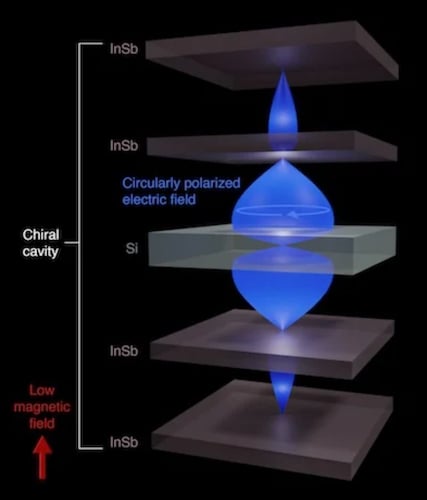
A chiral cavity. Image used courtesy of Nature Communications and Rice University
By embedding lightly doped indium antimonide in a photonic-crystal cavity, the researchers created long-lived, directionally selective electromagnetic fields capable of modifying the electronic structure of materials placed inside. Using both classical field simulations and quantum electrodynamics, they showed that inserting graphene into this cavity opens a bandgap and transforms it into a topological insulator, a material class vital for quantum computing.
The innovation lies in how the cavity itself becomes an active quantum control element, enabling materials to be transformed passively, without high magnetic fields or invasive doping. This opens the door to a new field of “vacuum engineering,” where light–matter interactions within tailored cavities can be used to create exotic quantum states and scalable quantum devices.
NC State Unlocks High-Temperature Quantum Coherence in Perovskites
A research team led by North Carolina State University has identified a mechanism enabling macroscopic quantum coherence at room temperature, an advance that could transform how we design quantum materials. By investigating hybrid perovskites, the researchers discovered that under specific excitation conditions, polarons—quasiparticles formed by electrons coupled with lattice distortions—can group into solitons, coherent units that resist thermal disruption. This collective ordering enables superfluorescence, a hallmark of macroscopic quantum phase transitions.
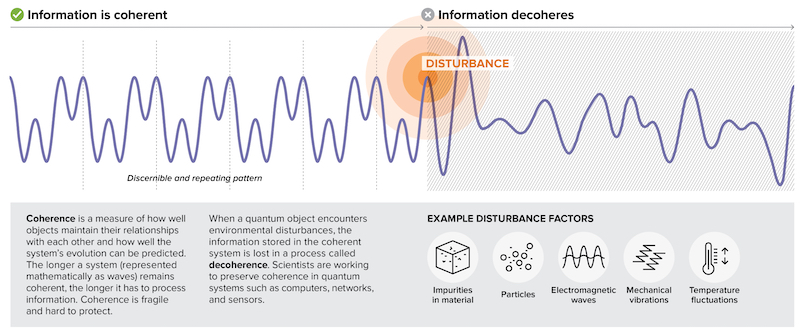
Diagram of quantum coherence. Image (modified) used courtesy of Argonne National Laboratory
These findings are significant because exotic quantum states such as superconductivity, superfluidity, and superfluorescence typically require cryogenic environments to prevent decoherence. Achieving such states at ambient conditions is a central goal in quantum materials research; it would drastically reduce cooling infrastructure, enabling more practical and scalable quantum technologies. The study not only demonstrated the soliton formation experimentally but also validated it with simulations that show how solitons suppress thermal noise, preserving coherence.
By outlining the material conditions and theoretical underpinnings for this process, the research provides a blueprint for engineering quantum materials that function at high temperatures. This could represent a breakthrough for developing quantum computers, sensors, and communications systems that operate without the burden of extreme refrigeration.
Featured image used courtesy of Rice University.