Facebook
 Google
 GitHub
 Linkedin
Renesas Debuts Flagship RX MCUs on 22 nm Process With Embedded MRAM
The 600-MHz RX74M and RX74N more than double the performance of the RX72M and RX72N and swap embedded flash for MRAM.
Renesas Electronics has launched the RX74M and RX74N, two flagship 32-bit microcontrollers (MCUs) that are the first in its RX family built on a 22-nm process and the first RX devices to integrate embedded MRAM. The devices target factory automation and energy infrastructure equipment and are available now.

The RX74M and RX74N are designed for industrial automation and a range of industrial equipment.
Both MCUs run at up to 600 MHz, which Renesas says delivers more than twice the performance of the 240-MHz RX72M and RX72N that preceded them as the top of the RX line.
How the RX74M and RX74N Stand Apart in the RX Family
Both devices use Renesas' RXv3e CPU core with a double-precision floating-point unit and a register bank save function to shorten interrupt response. The RX74M product page lists 6.01 CoreMark/MHz for the core, which works out to roughly 3,600 CoreMark at 600 MHz. Renesas also offers 300-MHz variants that cut power consumption by more than 20%.

Block diagram of the RX74M. Visit page 17 of the datasheet for an enlarged image.
The memory subsystem pairs 1 MB of dual-bank code MRAM and 48 KB of data MRAM with 256 KB of zero-wait-state tightly coupled memory and 1.5 MB of ECC SRAM. For larger applications, the MCUs can execute in place from external Octa flash with on-the-fly decryption.
Both parts operate from 1.62 V to 3.6 V across a junction temperature range of -40°C to 125°C. Packages run from a 100-pin LFQFP to a 320-pin LFBGA. Developers use the same Flexible Software Package across Renesas' RX, RA, and RZ families.
Why 22 nm and MRAM Matter for an Industrial MCU
Embedded flash has become difficult to scale alongside logic. Flash cells are built in the front end of line (FEOL) and require additional mask layers, while MRAM is fabricated in the back end of line (BEOL) and is compatible with standard CMOS logic processes. Renesas cited this as a key reason for its MRAM development work when it presented 22-nm embedded STT-MRAM circuit technology at the 2022 IEEE VLSI Symposium. That test chip achieved a 5.9-nanosecond random read access time at a 150°C junction temperature and 5.8 MB/s write throughput.
The practical gain for designers, however, is write behavior. Flash must erase a block before rewriting it, while MRAM can be written directly, which Renesas says speeds up code and data updates, shortens programming times, and reduces system downtime during firmware updates. The benefit is greatest in equipment that frequently stores parameters or event logs, such as drives and meters. Renesas hasn’t published endurance or retention figures for the RX74 parts.
The RX74 devices aren’t Renesas’ first MRAM-based MCUs. The company introduced 1 MB of embedded MRAM on TSMC's 22ULL process with its Arm-based RA8P1 AI MCUs in 2025. The RX74M and RX74N carry that memory technology into the company’s proprietary RX architecture.
Features and Applications
The two devices diverge on networking. The RX74M is the network-focused part, integrating an EtherCAT slave controller, a two-port Gigabit Ethernet MAC with a TSN-capable switch, and three CAN FD channels on a single chip. It supports EtherCAT, PROFINET, EtherNet/IP, and redundant EtherNet/IP Device Level Ring (DLR) topologies without an external networking chip.
Its motor control resources include 200-MHz PWM timers with up to 34 PWM outputs. Other interfaces include USB 2.0 high-speed host/function/OTG, I3C, I2S, and an SD/SDIO host. Renesas targets the RX74M at AC drives, industrial robots, and PLCs. The RX74N drops EtherCAT and uses a single Gigabit Ethernet channel; it targets smart meters, power conditioners, and HVAC systems.
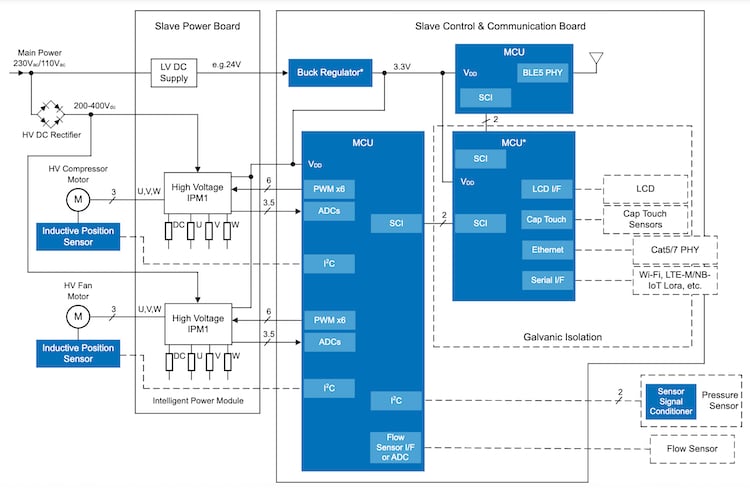
Application block diagram of smart HVAC control with an integrated slave actuator in which the RX74N may be used.
Both MCUs carry the same security architecture. ProtectZone partitions the RX CPU into secure and non-secure regions, while next-gen Renesas Secure IP (RSIP) adds public-key cryptography, authenticated encryption, and additional hash algorithms. The crypto engine covers AES, ChaCha20, RSA, ECC, SHA-2, and SHA-3, alongside a true random number generator and tamper detection. Renesas says the RSIP supports migration to post-quantum cryptography and helps manufacturers meet the EU Cyber Resilience Act.
Ecosystem support includes industrial protocol stacks and tools from Codewerk, RT-Labs, and IAR, plus RTOS support from eForce and Zephyr. Renesas has also published two Winning Combinations reference designs built on the new MCUs: a maglev conveyor system and a smart HVAC controller with an integrated slave actuator. Evaluation boards are available alongside the devices.
All images used courtesy of Renesas.
Related Content