Facebook
 Google
 GitHub
 Linkedin
SiTime Unveils Software for Data Center and Network Time Synchronization
Announced today, the new software works with SiTime hardware to create the most accurate and reliable data center, networking, and communications timing system.
Today, SiTime announced the addition of the TimeFabric software suite to their precision time hardware portfolio. SiTime, known for their highly accurate timekeeping hardware, has added a software solution that increases time synchronization accuracy by a factor of 9 over comparable quartz-based alternatives.

SiTime introduces TimeFabric software for improved timing synchronization.
The TimeFabric software works with SiTime OCXOs, TCXOs and network synchronizer hardware. The software comes with two modules: an IEEE 1588 standards-compliant synchronization module, and a proprietary software technology that can extend critical holdover performance to 24 hours.
Time-Synchronization in a Local and Global World
Data operations within and without a network require precise synchronization of time. Whether it be exchanging money or parallel operations in a massive AI data center, everything is being triggered and recorded based on date and time. All of these triggers and time stamps must be synchronized from across the globe through different transmission mediums and processed equally on fast and slow computing equipment.

Scope of time-synchronization
Global synchronization is managed through network time protocol (NTP) and global positioning system (GPS) time. Local area network (LAN) systems are synchronized by precision time protocol (PTP) which is defined by the IEEE 1588 specification. PTP works under a hierarchical topology with all individual node clocks syncing to a primary source clock.
The primary source clock may be located in a dedicated time server or referenced to a designated source system. The primary source clock is synchronized via NTP or GPS to the global clock. The new SiTime software operates within the domain of a local primary source clock.
The Sliding Scale of Time Accuracy
Time accuracy requirements vary on a sliding scale. Home electronics are typically fine with an error of no more than 10 milliseconds. Mobile computing and Internet of Things (IoT) devices typically need a 1 microsecond or less error level. Infrastructure networks and data centers are far more stringent, needing time error to be less than 5 nanoseconds. The higher the speeds involved, the greater the level of precision required.
When systems don’t sync up, the result is a time error. Time errors can lead to delays and processor idle time while the two systems re-sync. Piyush Sevalia, executive vice president of marketing at SiTime put it into perspective with a reference to studies he read from Meta and Broadcom. He noted that the studies indicated that GPUs are idle 35% of the time. Reducing such inefficiency is behind the introduction of TimeFabric software.
AI data centers are particularly sensitive to synchronization. In an AI data center large language model (LLM) processing often requires extreme parallel operations. This requires extremely tight time synchronization in order to accurately break the task apart and reassemble it after processing.
"The more time-synchronized you are, the less time error you have, the more optimal you will be in queuing up those tasks," said Sevalia. If the systems are not well synced, adding delays to get back in sync slows the effective system speed down to the lowest common denominator.
TimeFabric Software Capabilities
SiTime’s IEEE 1588 PIP Solution software standards-compliant integrated servo and stack improves system performance and reduces time to market for developers of time-sync dependent hardware. The system delivers tighter control and greater timing stability over generic IEEE 1588 solutions. Networks using the SiTime software with SiTime clocking devices have improved scheduling and load balancing capability and can deliver a higher utilization factor.
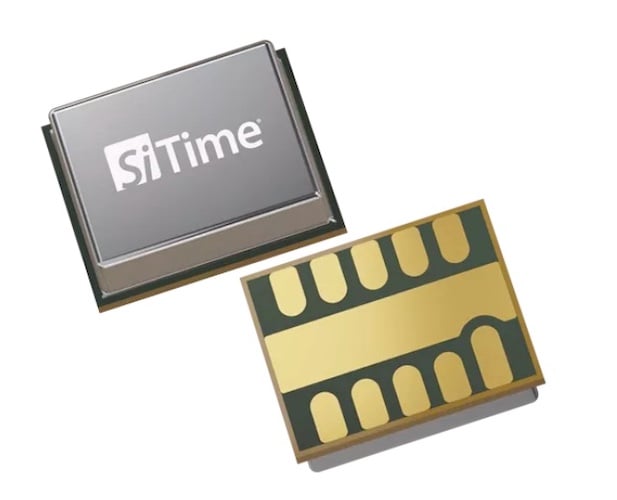
SiTime MEMS OCXO chips gain double holder capability with TimeFabric software.
The new SiTime Holdover Extension software reference allows for greater than 24-hour holdover time without the need to change timing hardware. Holdover refers to the amount of time two independent clocks can remain in synchronization if disconnected from each other.
Holdover occurs when a primary source clock is unreachable. Under a holdover situation, the local node clock is tasked with maintaining a best effort at synchronization while disconnected from the primary source.
SiTime offers three different MEMS OCXO (oven controlled crystal oscillator) chips that, on their own, support 12-hour holdover time: The SiT5811, SiT5812 or SiT7101. With the TimeFabric software, the parts can support up to 24-hour holdover.
Further Optimization in the Future
TimeFabric has already demonstrated significant user benefits, but SiTime sees more opportunities yet to come. The software today is optimized for SiTime hardware but the company is still exploring the idea of wider spread optimization and greater levels of precision.
All images used courtesy of SiTime.