Facebook
 Google
 GitHub
 Linkedin
Smaller, Smarter, Sooner: 3 Prototypes Shaping Medical Diagnostics
Researchers at Northwestern, Cambridge, and UCLA have developed diagnostic devices that push the boundaries of size, usability, and real-time data capture.
Medical diagnostics are shifting fast, from bulky, hospital-based equipment to compact, intelligent devices that operate in real-time and closer to the point of care. In this article, we look at three recent prototypes: a dissolvable pacemaker powered by light, a handheld AI-driven heart sound recorder, and a bioinspired sensor platform that tracks hundreds of metabolites in the body.
Northwestern Claims World’s Smallest Pacemaker, Powered by Light
Engineers at Northwestern University have built a new pacemaker small enough to be injected through a syringe. It’s about the size of a grain of rice—1.8 mm wide, 3.5 mm long, and 1 mm thick—and it’s designed specifically for temporary use, especially in newborns recovering from heart surgery. After it’s no longer needed, the device dissolves into the body’s fluids; no surgery is required to remove it.
This design moves away from traditional hardware in two major ways: it doesn’t use wires, and it doesn’t use radio signals or batteries. Power comes from a galvanic cell, a simple battery made from two dissimilar metals that generate current when surrounded by body fluid. The device is controlled through light. A soft, flexible patch sits on the patient’s chest and monitors heart rhythm. If the heart rate drops, the patch sends out pulses of infrared light, which travel through the skin and switch the pacemaker on. The device then sends tiny, timed electrical pulses to stimulate the heart.
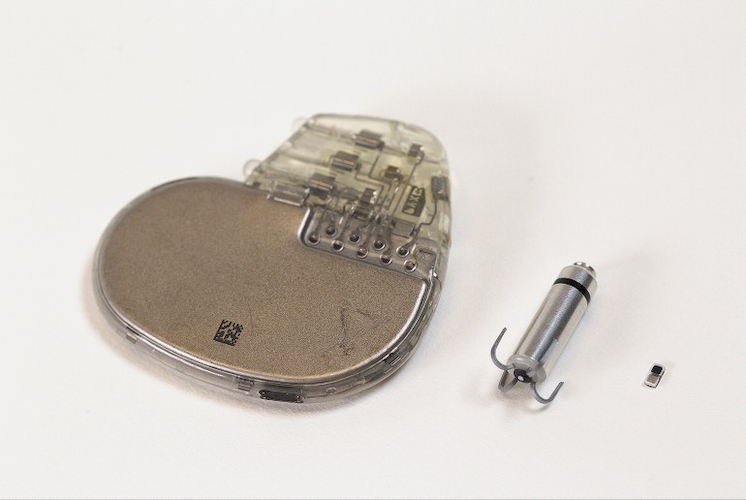
A traditional pacemaker (left), a leadless pacemaker (middle), and Northwestern’s new pacemaker (right). Image used courtesy of Northwestern University
The original version from a few years back used NFC for communication and power, which required a larger antenna. Switching to light-based activation made it possible to shrink the device dramatically and cut out bulkier components. Despite its size, the stimulation performance is on par with conventional pacemakers.
For infants with congenital heart defects (around 1% of births), reliable short-term pacing after surgery is essential. Conventional pacemakers require wires that protrude from the body and often must be pulled out later, which can lead to complications like bleeding or scar tissue damage. This dissolvable version avoids that risk entirely. There’s also room to scale because the devices are so small and independently controllable by different wavelengths of light; multiple units can be placed across the heart for more complex pacing. That could mean better synchronization, arrhythmia termination, and integration into other implants like valve replacements.
The team, led by John Rogers and Igor Efimov, has shown efficacy in animal models and human donor hearts. Future steps include further clinical testing and exploring broader use cases (for example, for nerve stimulation or pain management).
Cambridge Researchers Present Handheld AI Device for Heart Screenings
Cambridge researchers have built a handheld heart sound recorder that might replace the stethoscope in early screening for valve disease. The device is about the size of a drink coaster, but unlike a traditional stethoscope, it has six sensors embedded in a flexible surface. That makes it easier to use accurately, even by people without medical training, and it works through clothing, which is important in busy GP settings and in screening programs that prioritize comfort and privacy.
The device picks up heart sounds through vibration-transmitting materials and stores them for analysis. A machine learning algorithm developed alongside the hardware interprets the recordings and flags signs of valve disease. Early results suggest it may outperform general practitioners in detecting early-stage disease.
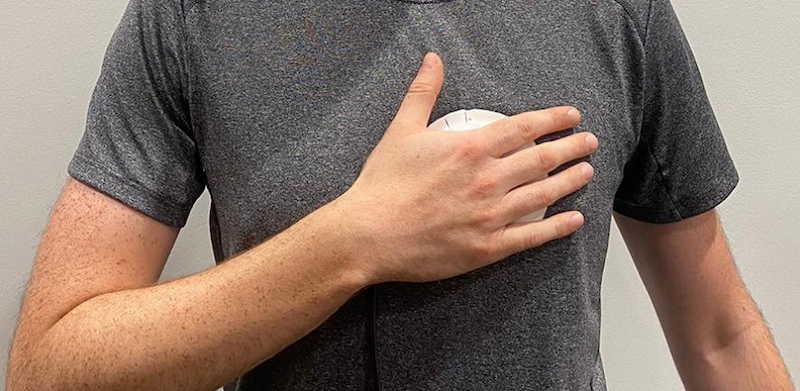
Cambridge researchers have developed a handheld device that could replace stethoscopes as a tool for detecting certain types of heart disease. Image used courtesy of the University of Cambridge
Valve disease is often missed until it causes serious symptoms. While auscultation remains the most common frontline tool, it’s used in less than 40% of cases where patients present with valve-related symptoms. Echocardiograms are more reliable but have long wait times and require hospital infrastructure.
This device sidesteps both issues. It simplifies heart sound acquisition and aims to triage patients before hospital visits. In tests, the prototype worked well for male participants and leaner female participants. Some challenges remain for signal quality in higher-BMI individuals and those with breast implants, particularly in the mitral and tricuspid regions.
The team plans to upgrade to a wireless version, using Bluetooth Low Energy and ADCs, and is pursuing certification for medical use. They’re also integrating the device into broader screening projects and expect it could play a role in population-level monitoring, especially in low-resource settings. A patent has been filed, and clinical studies are next.
Real-Time Metabolite Tracking With Bioinspired TMR Sensors
UCLA researchers have developed a sensor platform that tracks metabolites in real time inside the body. These are tandem metabolic reaction-based (TMR) sensors, and they use enzymes and cofactors, the same molecular machinery your body uses, to detect and measure metabolites continuously. The platform runs complex, multi-step reactions on flexible electrodes made from single-wall carbon nanotubes, converting biochemical events into electrical signals.
Traditional sensors, especially wearable ones, are limited to detecting blood glucose or a few basic molecules. The TMR platform can directly or indirectly detect over 800 metabolites. That coverage expands to most of the human metabolome with just one intermediate conversion. Instead of using one enzyme for one reaction, the platform runs several in sequence and parallel, mirroring how metabolism works in the body. This design reduces interference and improves signal quality by using helper enzymes that neutralize unwanted reactions.
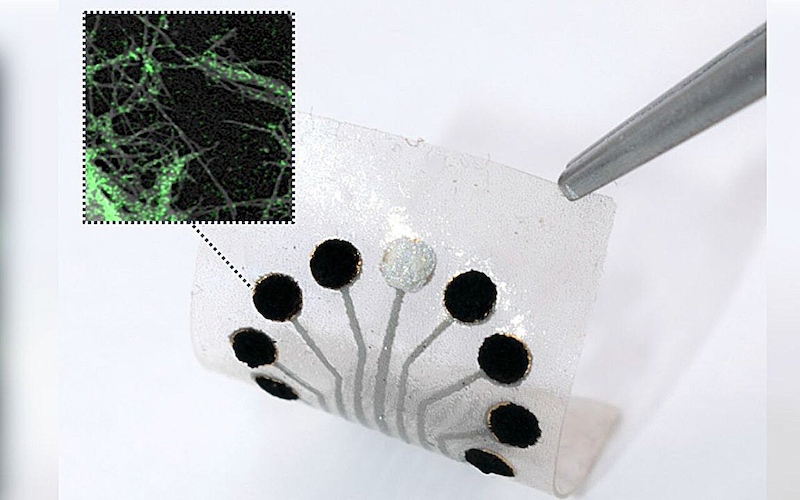
A spectroscopic image shows on-electrode molecules that drive metabolite-sensing reactions. Image used courtesy of the University of California, Los Angeles
In early trials, the team tested the sensors in sweat and saliva to monitor metabolic markers related to epilepsy, diabetes, and even gut-brain communication. One test showed the device could track a metabolite produced by gut bacteria that builds up in the brain and may contribute to neurological disease. The researchers measured a dozen key metabolites and got stable, high signal-to-noise ratio readings from complex biological fluids.
The implications are wide. For healthcare, this platform could help manage chronic diseases, tune drug dosing in real time, or personalize nutrition and fitness tracking. In research, it could speed up drug development by showing how candidate compounds affect metabolism immediately. For emerging fields like microbiome science, it opens a path to monitoring how microbial metabolites interact with your brain and body.
The team, based at UCLA’s California NanoSystems Institute, is now working on wearable versions of the sensor and expanding clinical testing. The architecture is scalable and doesn't require complex manufacturing, so commercialization could follow once reliability in clinical environments is confirmed.
Related Content