Facebook
 Google
 GitHub
 Linkedin
Synaptics Intros Multimodal Edge AI MCU and Triple Combo Wireless SoC
Announced today ahead of Embedded World, the new MCU families bring new possibilities to edge and connected devices.
We kick off our Embedded World 2025 coverage this week with news from Synaptics. The show has always served as a launching pad for the industry’s latest and greatest advances in computing technology. At this year’s event, Synaptics had two major releases: an expansion of their SR Series of multimodal edge AI MCUs and the new SYN461x family of wireless SoCs.
All About Circuits got to chat with Synaptics’ Vineet Ganju, VP of Wireless Connectivity Products, and Nebu Philips, Senior Director of Strategy and Business Development for IoT/Edge Processors, to learn about the new devices firsthand.
SR Series
The Synaptics SR Series, which consists of the SR110, SR105, and SR102, seeks to integrate high-performance edge computing with multimodal AI processing in a way that optimizes power efficiency for IoT applications. Speaking to the impetus for these new MCUs, Phillips explains, “The traditional MCUs don’t cut it. And then the traditional low-end MPUs don’t quite cut it either, given the type of form factors and battery power devices that you need at the far edge of IoT. So that requires a new class of edge silicon.”
All three devices are built on the Arm Cortex-M55 architecture with Helium technology, with the SR110 and SR105 adding an Arm Ethos-U55 NPU to support intelligent, always-on sensing and scalable inference capabilities. The series includes multiple operational tiers: high-performance (100 GOPS), efficiency, and ultra-low-power (ULP) always-on sensing, allowing adaptive workload execution based on system demands.
Looking at the architecture, the SR100 Series incorporates a hierarchical compute structure with three distinct domains. The always-on domain operates at sub-100 µW power and handles initial event detection through motion and audio filters. When a trigger event occurs, the system transitions to the efficiency domain, powered by a 100 MHz Cortex-M4 and Synaptics’ in-house micro NPU for preliminary AI inferencing.
If further processing is needed, the performance domain activates, utilizing the Cortex-M55 at 400 MHz alongside the 100 GOPS Ethos-U55 NPU to execute complex AI workloads, such as image segmentation, object classification, and real-time facial recognition.
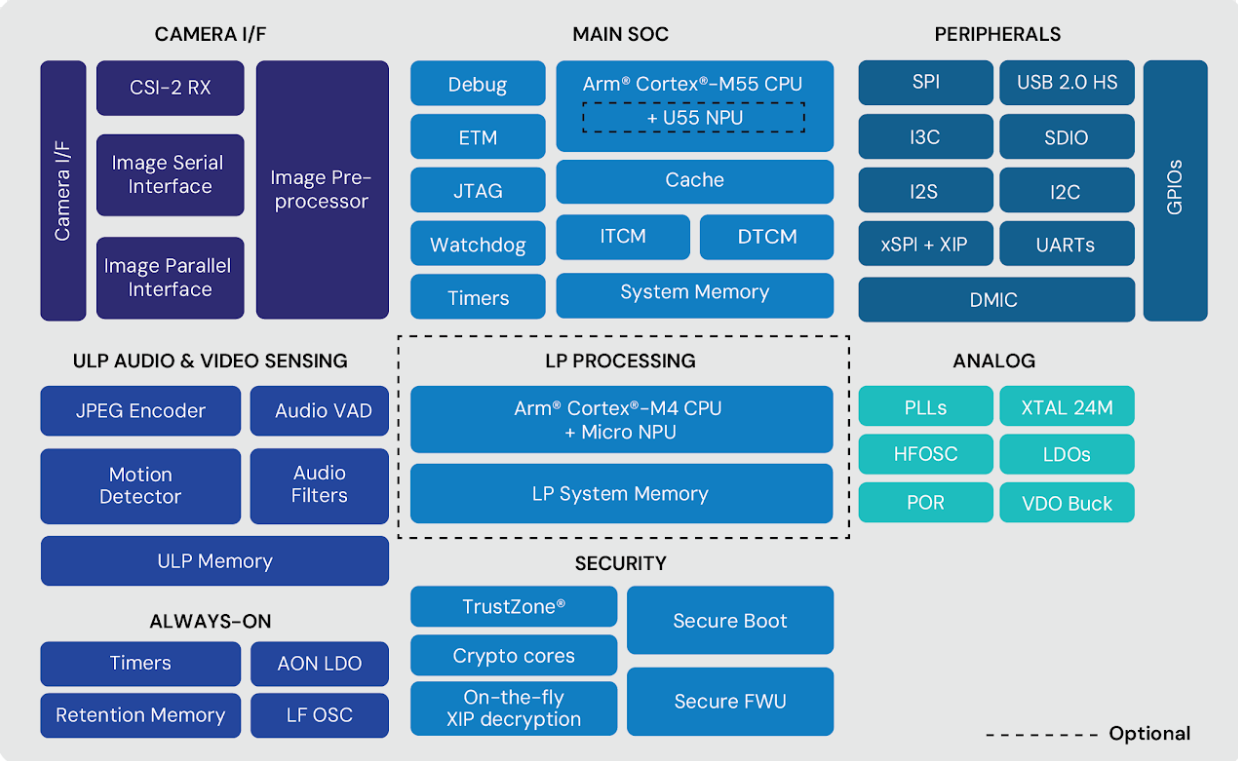
Block diagram of the SR100 Series. (Click on image to enlarge)
The MCU also integrates a MIPI-CSI camera interface, digital camera input support, and an image signal processing (ISP) pipeline for streaming vision applications. Its audio processing capabilities include digital microphone interfaces and voice activity detection. The SR Series also features cryptographic security with AES-256, RSA-4096, SHA-512, and secure boot functionalities.
Designed for battery-powered IoT devices, the SR100 Series supports multiple low-power modes, including active (sub-100 mW), low-power (sub-10 mW), and ULP always-on (sub-100 µW).
Explaining the domains, Phillips tells us, “Starting with an always-on very low power sensing domain, when the primary compute subsystems are powered off, the always-on gear keeps on sensing for detections in the environment. Any change generates a trigger event, which then kicks the SoC into gear.”
SYN461x Family
The Synaptics SYN461x is an ultra-low-power wireless SoC designed for embedded Edge AI IoT applications. Fabricated using a 22 nm process node, it integrates Wi-Fi 6E, Bluetooth 6.0, and IEEE 802.15.4 (Zigbee/Thread), making it a “triple-combo connectivity solution”. To this end, the SoC delivers a peak data rate of 50 Mbps while maintaining low power consumption, with active transmit at approximately 300 mA and active receive at around 30 mA. Meanwhile, sleep currents can be even lower than 100 µA.
As Ganju explains, “With this device, Synaptics has redesigned it from the ground up to be optimized for lower power and lower system cost.”
“You'll see that we're hitting power consumption points that are the lowest in our family for sure, and it's actually the lowest in the industry for this class of processors.”
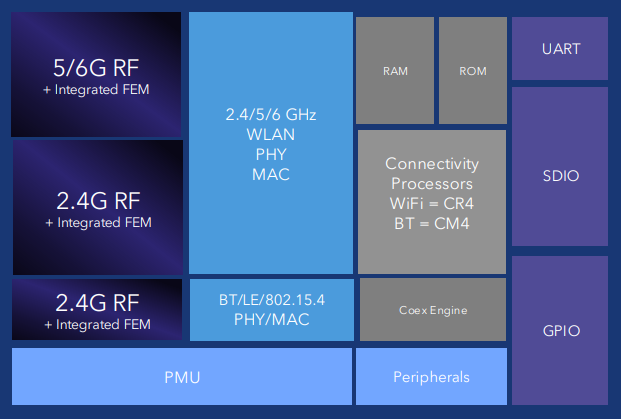
Block diagram of the SYN461x
The SYN461x architecture features an integrated front-end module (FEM) that includes transmit/receive switches, low-noise amplifiers (LNAs), and power amplifiers (PAs). Such integration minimizes design complexity by requiring only a diplexer and a crystal as external RF components.
The SoC also incorporates separate processor cores for Wi-Fi and Bluetooth functions and host CPU offloading, utilizing an Arm Cortex-R4 for Wi-Fi and a Cortex-M4 for Bluetooth. Additionally, Bluetooth 6.0 support includes advanced features such as Channel Sounding for distance measurement and LE Audio with Auracast broadcast capabilities.
To further lower system cost and area requirements, the SoC package design offers a low-pin-count WLBGA-PTH configuration. According to Synaptics, this packaging solution can result in up to 25% cost savings. As Ganju reiterates, “We designed a second package that's a lower pin count, more spacing between the balls. That allows the product manufacturers to have a less expensive PCB board design. Just yet another example of how we're lowering the system cost even further.”
Looking Forward
Reflecting on the journey and the future, Phillips says the edge has become redefined.
“People didn’t think you could do so much processing down at the edge. They thought everything was going to have to be done up in the cloud. But time proved that notion incorrect. Now, the next step is not just doing processing at the edge but AI at the edge. And we’re in a whole new area there.”
The SYN461x family is now available for purchase, while the SR-Series is available for development with Synaptics’ Astra Machina Micro development kit.
All images used courtesy of Synaptics.