Facebook
 Google
 GitHub
 Linkedin
Teledyne e2v Adds 16-GB Variant to Rad-Hard DDR4 Memory Portfolio
The company claims the new 16-GB DDR4 model is the highest density space-grade DDR4 memory on the market.
Teledyne e2v recently announced its new 16-GB, radiation-tolerant DDR4 memory. The new chip joins Teledyne e2v’s 4-GB and 8-GB rad-hard DDR4 parts. The new chip is form factor and pin compatible with the prior 4-GB and 8-GB versions. At 16 GB, the new model is the highest density space-grade DDR4 memory on the market, having taken that crown from Teledyne e2v's 8-GB model. The memory device meets NASA Level 1 and European Cooperation for Space Standardization (ECSS) Class 1 space certifications.
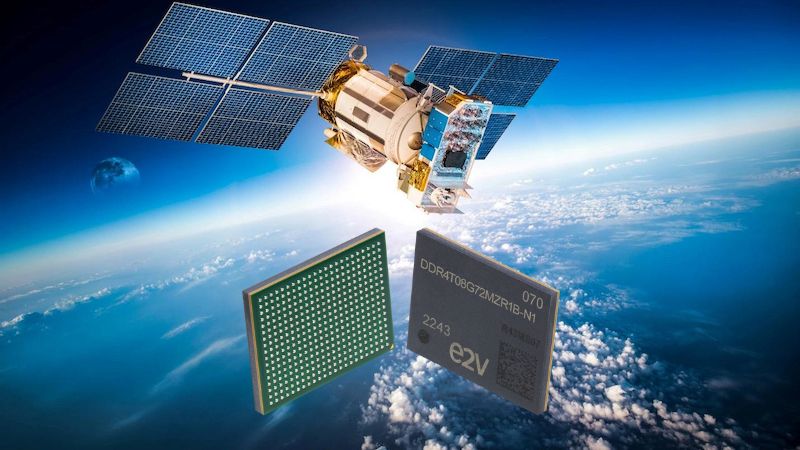
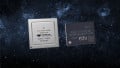
Teledyne e2v's DDR4T16G72MZR1B 16-GB memory.
Level 1 and Class 1 refer to the highest-level space use certification requirements, where a failure could jeopardize the mission objectives. Components with these certifications must meet strict design, validation, and test requirements. The parts can operate in the harshest space-based applications, subjected to severe temperature variations and radiation exposure.
Prepped for the Radiation-Realities of Space
The 16-GB DDR4 memory chip is space qualified to NASA Levels 1, 2, and 3 (based on NASA EEE-INST-002—Section M4—PEMs) and ECSS Class 1 (ECSS-Q-ST-60-13C). Some of the radiation-tolerant features of the device include:
- Single event latch-up (SEL) linear energy transfer (LET) threshold > 60.88 MeV.cm²/mg
- Single event upset (SEU) LET 2.6 MeV.cm²/mg and upset cross-section at 60.88 MeV.cm²/mg=8.73E-12 cm²/bit
- Single event functional interrupt (SEFI) evaluated from LET 2.6 MeV.cm²/mg and SEFI cross-section at 60.88 MeV.cm²/mg=4.17E-4 cm²/device
- Total ionizing dose (TID): 100 krad(Si)
- Proton up to 190 MeV
The new memory chip shares some similar specs with the 4-GB and 8-GB variants, including its 72-bit data bus width, usable as 64-bit data bus with 8-bit ECC. The 16-GB model also features transfer speeds of up to 2.4 GT/s (up to 150 Gbps) and a VDD of 1.2 V and an external VPP of 2.5 V. All three DDR4 devices in the series operate across a vast temperature range: -40°C to +105°C or -55°C to +125°C.
In addition, all come in a 15 mm x 20 mm x 1.92 mm organic 391-pin PBGA package, with a BGA ball diameter of 0.4 mm and a ball pitch of 0.8 mm. The memory chips are available in both leaded (63%Sn, 37%Pb) and lead-free (96.5%Sn, 3%Ag, 0.5%Cu) RoHS packages. The organic BGA packaging offers several advantages over the more traditional ceramic column grid array (CGA) large-chip packages. Organic substrates enable higher density routing and can lead to lighter and thinner packages. The BGA attachment delivers a lower height profile than the CGA.
Compatible With the Family and Beyond for Easy Upgrades
Teledyne pairs the DDR4 family with a line of space-grade processors and third-party FPGAs, including the Teledyne e2v 16-core 64-bit Arm LX2160-Space and the quad-core 64-bit Arm LS1046-Space and QLS1046-Space.

Block diagram of the LS1046-Space.
The memories in the DDR4 line use a multi-chip package architecture to achieve the ultra-high densities suitable for space-based embedded systems and applications. The new 16-GB DDR4 chip shares the same form factor and pin layout as the earlier 4-GB and 8-GB parts, enabling easy upgrades of older designs and flexibility for new designs. The parts can be swapped without PCB layout updates or other hardware changes. Teledyne e2v intentionally designed the new part with this interchangeability to account for increasing complexity in space-based electronics designs, along with the need for consistency and compatibility that comes with certification requirements.
The new DDR4 chip is also compatible with a wide range of third-party processors and FPGAs. Pin and form factor compatibility increases the part's marketability by allowing drop-in replacement as memory needs increase.
Support Resources Available
Engineering models are available now for design, testing, and validation. Teledyne e2v has also released integration support and extensive documentation, including the latest 16-GB DDR4 radiation report. Teledyne e2v offers additional mitigation techniques to further harden the overall system for space applications. Available data covers system design, integration, layout, and other design recommendations. The memory device will be showcased at the Small Satellite Conference, August 10–13, 2025, in Salt Lake City, Utah.
All images used courtesy of Teledyne e2v.