Facebook
 Google
 GitHub
 Linkedin
Thread Group and Broadband Forum Unite for End-to-End IoT Interoperability
Thread Group and Broadband Forum are partnering to unify IoT mesh with broadband infrastructure. Also, the new Thread Tools app launches to provide real-world network diagnostics for engineers.
As the global Internet of Things (IoT) ecosystem swells to unprecedented proportions, hardware developers and network operators face a compounding challenge: ensuring low-power local mesh networks seamlessly communicate with the broader internet architecture. Today, more than 19 billion connected IoT devices operate globally—a figure projected to nearly double by 2030.
To bridge the gap between internal device networks and external broadband delivery systems, today the Thread Group and the Broadband Forum have officially announced a major liaison agreement. In further news today, the Thread Group unveiled its new Thread Tools diagnostics application, giving engineers real-world visibility into deployed network performance.
The new liaison between Thread Group and the Broadband Forum provides a direct technical channel for engineering teams to share specifications, coordinate best practices, and more.
Together, these announcements aim to simplify smart home and commercial building deployments by aligning parallel communication layers by design. To dig deeper into this news, I was pleased to talk with Ann Olivo, Corporate Campaigns Manager at Silicon Labs, and Jonathan Hui, Principal Software Engineer at Google. The duo spoke with me in their respective Thread Group roles. Ann is VP of Marketing for the Thread Group, while Jonathan Hui is VP of Technology for the Thread Group.
The Scaling Problem: Core Mesh vs. Edge Infrastructure
Until now, the consumer electronics layer and the network management layer have developed independently. Inside a structure, Thread acts as an IP-native, low-power wireless mesh layer connecting localized IoT nodes. Outside, broadband service providers deploy infrastructure governed by Broadband Forum open standards to deliver, manage, and monitor those connections.
Because broadband service providers are increasingly tasked with managing the very local networks these smart devices inhabit, this parallel development has historically led to integration hurdles and deployment friction. Statista data indicates that 91% of U.S. households, alongside billions of residential and commercial structures worldwide, stand to benefit from a unified networking approach.
By formally linking these two environments, the collaboration establishes a direct technical channel for engineering teams to share specifications, coordinate best practices, and define unified interoperability requirements.
“This is really exciting for us because it's going to help us to really connect that broadband infrastructure to the IoT mesh networks,” said Ann Olivo. “This really helps us accomplish our vision of seeing Thread everywhere.”
Unifying the Network Layers with Thread 1.4
Architecturally, the integration relies heavily on the shared, vendor-neutral DNA of both organizations' open, IP-based protocols.
- Unified Local Networking: The partnership leverages the recent Thread 1.4 specification. This protocol enhancement enables devices from completely different manufacturers to seamlessly join a single, cohesive mesh network.
- Mass-Market Broadband Scale: The Broadband Forum brings a legacy of over 250 globally adopted specifications deployed across hundreds of millions of edge and access devices.
- Operator Efficiency: With over 1.5 billion global broadband subscriptions active, aligning the routing and diagnostic layers helps network operators minimize compatibility issues and reduce customer support overhead.
Peering "Under the Hood": Thread Tools Diagnostics App
Replicating the reliable performance of an IoT device under test (DUT) from a controlled laboratory environment into highly variable, real-world residential settings has long been a bottleneck for original equipment manufacturers (OEMs). To address this challenge, the Thread Group introduced the beta availability of Thread Tools.
Jonathan Hui points out that the Thread 1.4 version of the standard is significant here. “In Thread 1.4 we built in all sorts of Thread diagnostics capabilities beyond just signal strength,” said Hui. “That’s part of the protocol now. The app takes advantage of those new diagnostics and presents data in a way that's easy for the user to understand.”
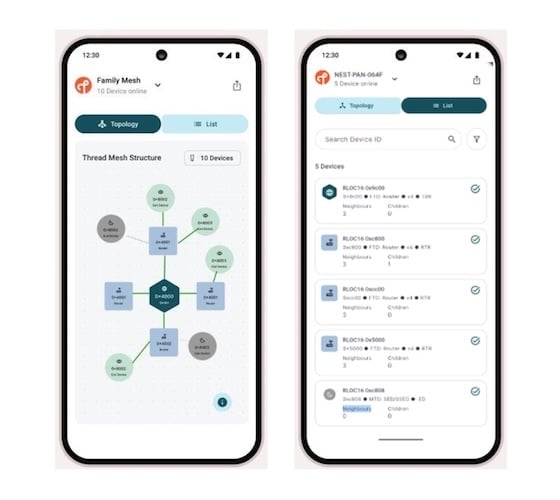
The Thread Tools app captures real-world diagnostic data from the field.
Developed in partnership with leading ecosystem members, the app removes the traditional guesswork from operating deployed mesh networks by capturing real-time, real-world diagnostic data directly from the field.
Key Benefits of the Thread Tools Ecosystem
- For Hardware Developers and OEMs: Provides streamlined access to standardized field diagnostic data and device-level insights, enabling developers to identify and patch common connectivity issues at scale.
- For Integrators and Network Operators: Implements data-driven insights to boost support efficiency and optimize device interoperability.
- For Advanced End Users: Delivers a clear picture of real-world network health, allowing users to accurately share performance metrics for faster technical resolution.
The Thread Tools utility is slated for an upcoming open-source release, allowing developers to directly audit network health and optimize hardware topology for superior field resilience.
Technical Performance Metrics at a Glance
The scope of this joint industry initiative is outlined by the foundational metrics of both standard bodies:
| Organization / Initiative | Deployment & Scalability Metrics | Core Technical Focus |
| Thread Group Protocol | 240+ member companies; 1,000+ certified consumer products. | Low-power, secure, IP-native wireless mesh networking layer. |
| Broadband Forum Standards | 150+ supplier/service provider companies; 250+ specifications. | Multi-vendor interoperability for fixed and converged broadband networks. |
| Thread Tools Application | Beta release; transitioning to open-source licensing. | Real-time field diagnostic capture and device-level performance insights. |
The Way Forward for Connected Buildings
As smart environments escalate in complexity, standalone sensor nodes are no longer sufficient; they must be backed by sophisticated edge computation and robust network visibility. By anchoring localized wireless mesh layers directly into global broadband standards, this liaison establishes the foundation for faster product time-to-market and a remarkably more resilient IoT ecosystem.
All images used courtesy of Thread Group.
Related Content