Facebook
 Google
 GitHub
 Linkedin
TI Unwraps Motor Control MCUs for Cost-Sensitive, Real-Time Designs
TI designed the new devices to provide cost-effective, high-speed sensorless control to household and industrial systems.
Texas Instruments has announced the F28E120SC and F28E120SB, the company’s most affordable additions to its C2000 real-time microcontroller portfolio.

With support for real-time, motor-control algorithms, the new MCUs may help designers to meet timing budgets at low speeds when the rotor position is most difficult to estimate.
Aiming to bring premium motor-control performance to cost-sensitive applications, the F28E12x series integrates advanced motor-control algorithms, high-performance analog blocks, and a streamlined development ecosystem at a starting price of $0.49 per 1,000 units (at the time of writing).
The F28E12x MCUs
Both the F28E120SC and F28E120SB (datasheet linked) are built around TI’s 32-bit C28x DSP, operating at 160 MHz with floating-point support. According to TI’s benchmarks, the device’s real-time signal chain performance equates to a 320-MHz Arm Cortex-M7 device. To support the compute, the F28E120SC features up to 128 KB of flash and 16 KB of SRAM, while the F28E120SB goes up to 64 KB of flash and 16 KB of SRAM. Both feature built-in, dual-zone security and a JTAG lock for secure operation.
Analog performance is a central aspect of the design. Each device integrates a 12-bit, 9.4-MSPS analog-to-digital converter with up to 17 external channels, three windowed comparators featuring 10-bit DAC references, and a programmable gain amplifier that supports multiple modes and output filtering. These elements are tightly coupled with the MCU’s eight PWM channels for tight and responsive motor drive control in single- and three-phase systems. Meanwhile, communication peripherals include SPI, I2C, UART, and dual SCI.
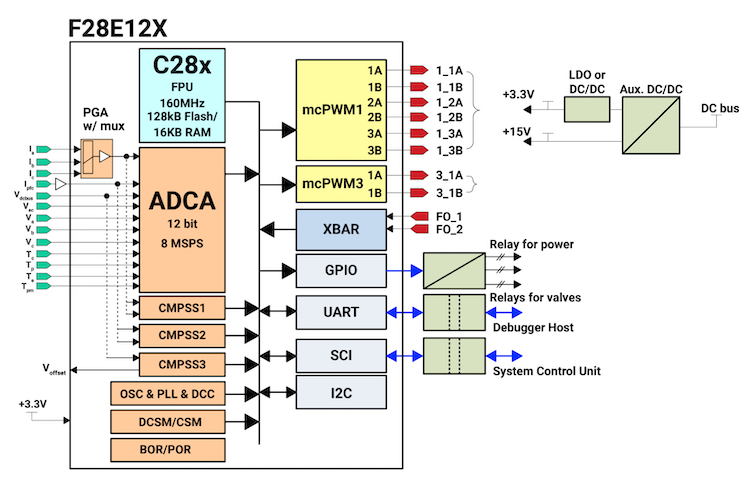
Simplified block diagram of an F28E120x MCU in a typical motor control design.
From a control standpoint, the MCUs are compatible with TI’s InstaSPIN field-oriented control software for high-speed, sensorless operation. The software allows motor speeds up to 120,000 rpm at 2-kHz electrical frequency, and a built-in vibration compensation algorithm cuts speed ripple by up to 60% for quieter operation.
To simplify designs further, the MCUs operate on a single 3.3-V supply with an internal voltage regulator supporting multiple low-power modes. Package options include 32- and 48-pin LQFP, as well as a 32-pin VQFN for space-constrained applications.
Sensorless Field-Oriented Control
Field-oriented control (FOC) is a vector-based method of controlling AC motors that decouples torque and flux components of the stator current. This approach helps motors deliver higher efficiency, smoother operation, and more precise torque response compared to scalar methods such as voltage-frequency control.
In sensorless implementations of FOC, motor position and speed are not measured with physical encoders or Hall sensors. Instead, the controller estimates rotor position from electrical signals such as back electromotive force (back-EMF) and current feedback. This eliminates additional components, reduces system cost, and improves reliability by avoiding sensor failure points.
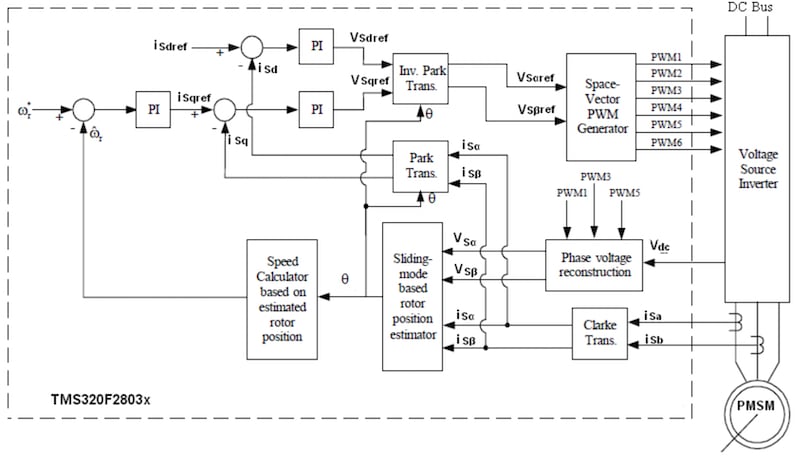
Block diagram of sensorless FOC of a PMSM.
Without sensors, FOC is only attainable through integrated ADCs with high sampling rates and processors with low latency. For instance, running motors at 120,000 rpm requires extremely fast loop execution to maintain stability while minimizing torque ripple. Advanced algorithms can confound things by incorporating vibration compensation, where control signals are dynamically adjusted to counter load imbalance and reduce acoustic noise.
Because of its minimal component count and system cost, sensorless FOC is widely used in applications such as power tools, home appliances, and electric mobility devices. By eliminating sensors, designers gain cost efficiency while still achieving a high degree of performance.
Broader Access to Precision Motor Control
With the F28E120SC and F28E120SB, TI has expanded its C2000 portfolio into the sub-$1 range without stripping away the computational and analog features needed for advanced motor control. For appliance and tool designers, this lowers the barrier to implementing sensorless FOC, high-speed operation, and active vibration reduction.
Preproduction units of the F28E12x series are now available along with evaluation hardware and reference designs.
All images used courtesy of Texas Instruments.
Related Content