Facebook
 Google
 GitHub
 Linkedin
What Does Security Look Like in a Post-Quantum World? ST Looks Ahead
ST is gearing up post-quantum cryptography solutions to protect embedded systems from future quantum attacks.
At Embedded World 2025, STMicroelectronics delivered a conference session where it introduced solutions targeted at risk prevention in a post-quantum cryptography world. Post-quantum cryptography (PQC) refers to the expected ability of quantum computers to easily crack conventional cryptographic security.
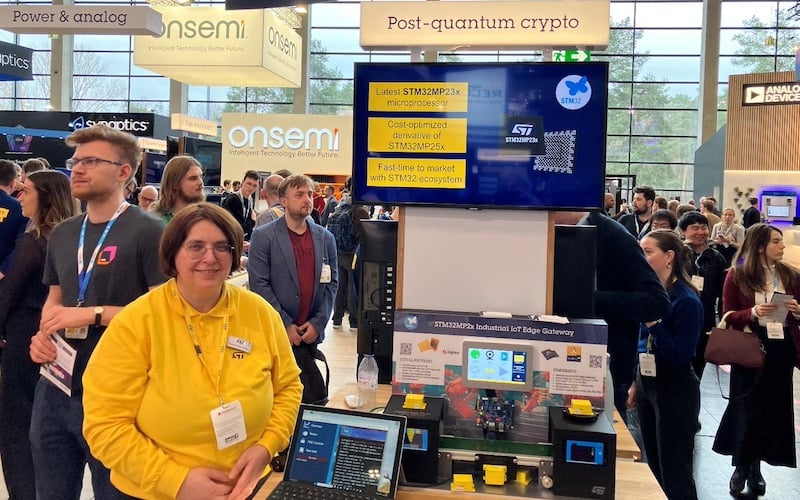
At Embedded World, ST's Marie-Christine Cayale showed the All About Circuits team the company's post-quantum crypto demo.
In the near future, today’s world’s best encryption may be vulnerable to attacks from powerful quantum computers. ST is among a group of companies already developing security solutions resistant to quantum cracking.
What Is Post-Quantum Cryptography?
Quantum computing, like so many other technologies, is a double-edged sword with opportunities for good and bad. Current cryptography, which secures financial transactions, classifies nuclear weapon launch codes, and prevents digital eavesdropping, is based on public key encryption. With public key encryption, two very large prime numbers are multiplied together, and the product is used as the encryption seed. The level of security is based on how long a conventional computer takes to determine what the prime numbers are.
Quantum computing can solve problems millions or billions of times faster than conventional computing. Once fully realized, decryption attacks that, in today’s digital world, are effectively unsolvable due to the time and resources required may be solvable in seconds or less. When that happens, the best encryption humanity has will be null and void.
ST Fortifies Its Post-Quantum Assets
Fortunately, cryptographers are not sitting back and waiting for the end to come. They are working on algorithms and joining with silicon companies to develop cryptographic systems secure against both conventional and quantum decryption attacks.
ST’s PQC solutions include cryptographic algorithms integrated into general-purpose microcontrollers (MCUs), secure MCUs, and automotive MCUs. Additionally, ST has introduced hardware cryptographic accelerators and associated software libraries.
The libraries come in the form of X-CUBE-PQC, a firmware library for use with STM32Cube, ST’s Eclipse-based development environment for writing and managing C/C++ code for STM32 microcontrollers and microprocessors.

Diagram of the X-CUBE-PQC at work. Image used courtesy of STMicroelectronics
PQC in the MCUs of Today and Tomorrow
Researchers at the National Institute of Standards and Technology (NIST) and private companies have been developing cryptography standards for the post-quantum world.
The Keccak algorithm, developed by ST researchers, is based on quantum-difficult math. NIST released key PQC standards based on Keccak in August 2024. These new NIST algorithms will eventually replace the current go-to standards, RAS and ECC. NIST's latest PQC standards, FIPS-203 (ML-KEM) for key encapsulation, FIPS 204 (ML-DSA), and FIPS 205 (SLH-DSA), can be executed on many of today’s 32-bit microcontrollers.
ST is shipping PQC-ready Arm Cortex-M and Cortex-A STM32 MCUs and MPUs that can use PQC libraries. SPC5 32-bit and Stellar 32-bit automotive MCUs come with an SHA-3 accelerator to support PQC.

ST introduced post-quantum cryptography solutions at Embedded World 2025. Image used courtesy of STMicroelectronics
Though quantum computers may be years to decades away from breaking cryptography, many embedded devices have lifecycles long enough that deployed products may someday exist in a PQC world. Although no one knows when PQC will arrive, by implementing PQC algorithms now, devices developed today will not need to be replaced when it does.
The other risk comes from what the industry refers to as “harvest now, decrypt later” (HNDL). Encryption is not just used to protect real-time assets. Many files are encrypted and then stored for later use or reference. A bad actor or adversary can steal such files even if they can’t decrypt them today. When PQC happens, they might decrypt a file and, if the data is still relevant, cause new security risks. By encrypting for PQC now, fewer of these files will be at risk from HNDL attacks.
With its Embedded World announcement, ST hopes to provide present and future risk mitigation. X-CUBE-PQC is available for download now. ST also has a number of Arm products for commercial, automotive, and high-reliability applications available for PQC development.