Facebook
 Google
 GitHub
 Linkedin
AC Electric Circuits
Autotransformers
12 questions By Tony R. Kuphaldt
-
Question 1 of 12
How much voltage is there between the following pairs of points in this circuit?

- Between C and F: VCF =
- Between A and B: VAB =
- Between D and E: VDE =
- Between D and F: VDF =
Reveal answer- Between C and F: VCF = 48 V
- Between A and B: VAB = 21.33 V
- Between D and E: VDE = 10.67 V
- Between D and F: VDF = 37.33 V
Notes:This question checks students’ ability to relate the winding ratios of a transformer to voltages in the circuit. The symbolism here is common in Europe, but not so common in the United States.
-
Question 2 of 12
How much voltage is there between the following pairs of points in this circuit?

- Between D and F: VDF =
- Between A and B: VAB =
- Between D and E: VDE =
- Between C and F: VCF =
Reveal answer- Between D and F: VDF = 16 V
- Between A and B: VAB = 9.14 V
- Between D and E: VDE = 4.57 V
- Between C and F: VCF = 20.57 V
Notes:This question checks students’ ability to relate the winding ratios of a transformer to voltages in the circuit. Note that one of the voltages actually exceeds the source voltage of 16 volts, even though this is technically a “step-down” transformer. The fact that the source voltage is not impressed upon the entire primary winding is key here.
The symbolism for this transformer is common in Europe, but not so common in the United States.
-
Question 3 of 12
How much AC voltage is there between points A and B in this circuit?
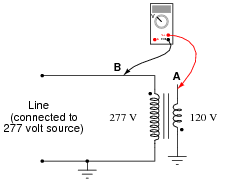
Reveal answerVAB = 397 VAC
Notes:In reality, this is nothing more than an exercise in Kirchhoff’s Voltage Law (KVL): determining the voltage between two points in a loop, knowing the voltages between other points in that same loop. Two principal challenges present themselves in this exercise: identifying the loop, and relating the dot convention to polarity markings. Different students will likely have different approaches to this problem, so it should make for an interesting discussion!