Facebook
 Google
 GitHub
 Linkedin
Basic Electricity
Basic Electromagnetism and Electromagnetic Induction
12 questions By Tony R. Kuphaldt
-
Question 10 of 12
A solenoid valve uses magnetism from an electromagnet coil to actuate a valve mechanism:
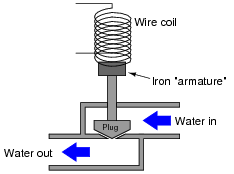
Essentially, this is an electrically-controlled on/off water valve. In the development of this valve, though, the design engineers discover that the magnetic force produced by the electromagnet coil is not strong enough to achieve reliable valve actuation every time. What can be changed in this solenoid valve design to produce a greater actuating force?
Reveal answerHere are a few ways in which the strength of the magnetic field may be increased: pass a greater electrical current through the coil, use more turns of wire in the coil, or accentuate the field strength using better or larger magnetic core materials. These are not the only ways to increase the mechanical force generated by the action of the magnetic field on the iron armature, but they are perhaps the most direct.
Follow-up question: suppose this valve did not open like it was supposed to when the solenoid coil was energized. Identify some possible reasons for this type of failure.
Notes:The fundamental question here is, “what factors influence the strength of an electromagnetically-generated magnetic field?” It is easy to research the effects of coil dimensions, core materials, current levels, etc. What students need to do in this question is apply those techniques to this real-life scenario.
Be sure to spend time on the follow-up question with your students, considering non-electrical as well as electrical fault possibilities.
-
Question 11 of 12
A coil of wire is formed of many loops. These loops, though tracing a circular path, may be thought of as being parallel to each other. We know that whenever two parallel wires carry an electric current, there will be a mechanical force generated between those two wires (as in André Marie Ampère’s famous experiment).
When electric current is passed through a coil of wire, does the inter-loop force tend to compress the coil or extend it? Explain your answer.
Reveal answerThe coil will tend to compress as current travels through its loops.
Challenge question: what will happen to a wire coil if alternating current is passed through it instead of direct current? Will the coil compress, extend, or do something entirely different?
Notes:Questions such as this require the student to visualize a “bent” version of a phenomenon defined in terms of straight wires (Ampére’s experiment). Some students, of course, will have a much more difficult time visualizing this than others. For those that struggle with this form of problem-solving, spend some discussion time on problem-solving (visualization) techniques to help those who find this difficult to do. Is there a particular drawing, sketch, or analogy that other students have found useful in their analysis of the problem?
The challenge question regarding alternating current is meant to be a “trick” question of sorts. The “unthinking” answer is that with alternating current, there will be a force that alternates direction: repulsion one half-cycle, then attraction for the next half-cycle. You may find students divided on this assessment, some thinking there will an alternating force, while others think the force will remain in the same direction at all times. There is one sure way to prove who is correct here: set up an experiment with AC power and see for yourself (straight, parallel wires will work just fine for this)!
-
Question 12 of 12
Which magnet motion past the wire will produce the greatest voltmeter indication: perpendicular, parallel, or no motion at all?

Reveal answerThe answer to this question is easy enough to determine experimentally. I’ll let you discover it for yourself rather than give you the answer here.
Hint: the voltage generated by a magnetic field with a single wire is quite weak, so I recommend using a very sensitive voltmeter and/or a powerful magnet. Also, if the meter is analog (has a moving pointer and a scale rather than a digital display), you must keep it far away from the magnet, so that the magnet’s field does not directly influence the pointer position.
Follow-up question: identify some potential problems which could arise in this experiment to prevent induction from occurring.
Notes:This is another one of those concepts that is better learned through experimentation than by direct pronouncement, especially since the experiment itself is so easy to set up.