Facebook
 Google
 GitHub
 Linkedin
Basic Electricity
Basic Electromagnetism and Electromagnetic Induction
12 questions By Tony R. Kuphaldt
-
Question 7 of 12
In 1820, the French physicist André Marie Ampère discovered that two parallel wires carrying electrical current would either be attracted to one another, or repelled by one another, depending on what directions the two currents were going. Devise an experiment to reproduce Ampère’s results, and determine which directions current must go to produce an attractive versus a repulsive force.
Reveal answerI won’t indicate the answer here, as the whole point of the question is to stimulate you to design and operate an experiment. Let the facts themselves give you the answer!
Notes:This experiment is well worth performing during discussion time with your students. There are several ways to demonstrate the effect of electromagnetism in the way that Ampère did back in 1820. It will be interesting to compare your students’ different approaches to this experiment.
One of the habits you should encourage in your students is experimentation to discover or confirm principles. While researching other peoples’ findings is a valid mode to obtaining knowledge, the rewards of primary research (i.e. direct experimentation) are greater and the results more authoritative.
Another point you might want to mention here is the problem-solving technique of altering the problem. Instead of envisioning two straight parallel wires, imagine those wires being bent so they form two parallel coils. Now the right-hand rule applies for determining magnetic polarity, and the question of attraction versus repulsion is more easily answered.
-
Question 8 of 12
A permanent magnet is a device that retains a magnetic field without need for a power source. Though many of us have experienced the effects of magnetism from a permanent magnet, very few people can describe what causes permanent magnetism. Explain the cause of permanent magnetism, in your own words.
Reveal answerMagnetism is caused by electric charges in motion. Since electrons in atoms are known to move in certain ways, they are able to produce their own magnetic fields. In some types of materials, the motions of atomic electrons are easily aligned with respect to one another, causing an overall magnetic field to be produced by the material.
Follow-up question: what does the term retentivity mean, in relation to permanent magnetism?
Notes:The answers students find to this question may be philosophically unsatisfying. It is one thing to discover that magnetism is produced by moving electric charges, but quite another to discover (much less explain) just what a magnetic field is in an ontological sense. Sure, it is easy to explain what magnetic fields do, or even how they relate to other phenomenon. But what, exactly, is a magnetic field? This question is on the same level as, “what is an electric charge?”
-
Question 9 of 12
Cranes used to move scrap iron and steel use electrically powered magnets to hold the metal pieces, rather than a scoop or some other mechanical grasping device:
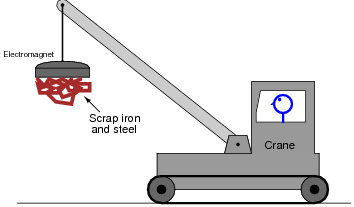
In this illustration of a crane, superimpose a drawing showing the electromagnet, electrical power supply and wiring necessary for this to work. Also include a switch so the crane operator can turn the magnet on and off. Also, draw an electrical schematic diagram of the same circuit, showing all components in the crane’s magnet circuit.
Reveal answerHere is my schematic diagram:
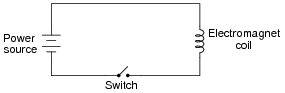
I will leave it to you to draw the illustration of this circuit on the crane. Your answer should show a wire coil embedded in the electromagnet assembly, a switch symbol near the operator, a battery symbol for the power supply, and wires carrying current to and from the electromagnet coil.
Notes:The main purpose of this question is to have the students relate the principles of electric circuits and electromagnetism to a real-life application, and to show how the wire paths in the crane do not resemble the neat, clean layout of the schematic diagram.