Facebook
 Google
 GitHub
 Linkedin
Basic Electricity
Basic Electromagnetism and Electromagnetic Induction
12 questions By Tony R. Kuphaldt
-
Question 4 of 12
What do you think might happen if someone were to gently tap on the cone of one of these speakers? What would the other speaker do? In terms of electromagnetism and electromagnetic induction, explain what is happening.
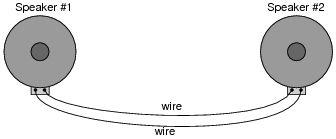
Reveal answerTry this experiment yourself, using a long pair of wires to separate the two speakers from each other by a significant distance. Listen and feel the speaker on your end while someone else taps on the other speaker, then trade roles.
Notes:Not only does this experiment illustrate the dual principles of electromagnetism and electromagnetic induction, but it also demonstrates how easy it is to set up a simple sound-powered audio telephony system.
It is highly recommended to have an identical pair of “woofer” speakers located in the classroom for this experiment, as well as a long length of twin-wire cable (an old piece of extension cord wire works well for this purpose, with alligator-clip “jumper” wires to make the connections).
-
Question 5 of 12
Draw the pattern of the magnetic field produced by electric current through a straight wire and through a wire coil:
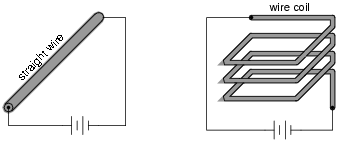
Explain your answer using either the right-hand rule (conventional flow) or the left-hand rule (electron flow).
Reveal answer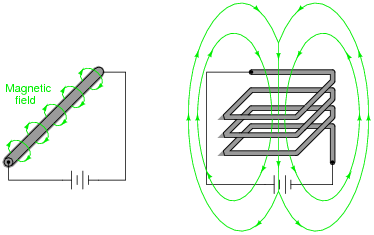
Notes:In your students’ research, they will encounter a “right-hand rule” as well as a “left-hand rule” for relating electric current with magnetic field directions. The distinction between the two rules depends on whether the text uses “conventional flow” notation or “electron flow” notation to denote the movement of electrical charge through the conductors. Sadly, this is another one of those concepts in electricity that has been made unnecessarily confusing by the prevalence of two “standard” notions for electric current.
-
Question 6 of 12
When engineers and physicists draw pictures illustrating the magnetic field produced by a straight current-carrying wire, they usually do so using this notation:
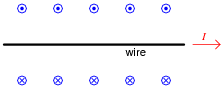
Explain what the circle-and-dot and circle-and-cross symbols mean, with reference to the right-hand rule.
Reveal answerThe circles with dots show the magnetic flux vectors coming at you from out of the paper. The circles with crosses show the magnetic flux vectors going away from you into the paper. Think of these as images of arrows with points (dots) and fletchings (crosses).
Notes:As a follow-up to this question, you might wish to draw current-carrying wires at different angles, and with current moving in different directions, as practice problems for your students to draw the corresponding arrow points and tails.