Facebook
 Google
 GitHub
 Linkedin
Blecon Debuts Software Agent Linking Zebra Devices to Bluetooth Tracking
Announced today, the new solution leverages existing hardware to expand the range of logistics tracking systems.
Today, Blecon launched a new software component that converts existing Zebra frontline devices into a distributed Bluetooth Low Energy tracking network. Called the Blecon Agent, the new solution hopes to address the persistent logistics challenge of asset visibility outside fixed facilities or where dedicated readers are impractical.
Blecon’s approach replaces purpose-built gateways with software that activates Bluetooth radios already present in Zebra mobile computers. All About Circuits interviewed Simon Ford, CEO of Blecon, to learn more about the new software agent firsthand.
Software Replaces Fixed Infrastructure
Traditional real-time location systems rely on fixed anchors installed throughout a facility to define where tracking is possible. Those anchors provide reliable coverage inside warehouses or factories that justify the infrastructure investment, but visibility typically disappears once assets leave those instrumented zones. As a result, tracking often breaks down during standard procedures like vehicle transfers or movement between sites.
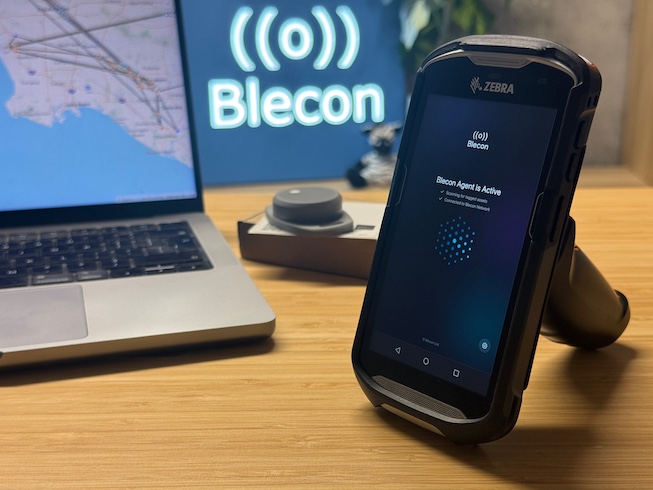
Blecon Agent running on a Zebra device
Blecon approaches the problem differently by using software to convert existing frontline devices into the tracking network itself. The Blecon Agent runs on Zebra mobile computers and continuously scans for Bluetooth Low Energy signals emitted by tracked assets. When a device detects a beacon or label, it forwards that event to enterprise backend systems along with contextual information such as time and approximate location.
Blecon is marketing the agent as an invisible background service that operates alongside existing frontline workflows. Workers can continue scanning barcodes, handling inventory, and performing daily tasks without interacting with the tracking system or altering their established processes. As devices move through facilities, the agent passively detects nearby assets via Bluetooth proximity, enabling data collection without manual input.
From a system design standpoint, the agent takes advantage of the sensing capacity that already exists on Zebra devices. Ford puts it into perspective.
“These devices are already being used by real people doing real things on the frontline… if you can amplify that device that you’ve already invested in and let it do other things too, that’s a good gearing effect in your business.”
Bluetooth scanning runs concurrently with primary device functions and, because Bluetooth Low Energy operates at milliwatt-level power consumption, these scans are compatible with existing duty cycles and battery expectations. That efficiency is supposed to preserve device uptime and avoid forcing tradeoffs between tracking coverage and worker productivity.
At the operational level, the model expands capability without redirecting labor. Each frontline worker effectively extends network coverage simply by moving through their normal routes.
Dual Support for Reusable Beacons and Disposable Labels
Another notable element of the launch is Blecon’s support for both reusable Smart Beacons and low-cost Smart Labels within the same tracking architecture. Smart Beacons are designed for returnable assets and typically operate for multiple years on coin-cell batteries. In contrast, Smart Labels address one-time or short-lifecycle shipments such as pallets or cartons and rely on printed or thin-film batteries that sustain operation for weeks or months.
Together, these two form factors address a long-standing economic divide in asset tracking. Cellular trackers provide broad geographic coverage but introduce recurring subscription costs that become prohibitive at high volumes. Passive RFID minimizes tag cost but depends on dense reader infrastructure and offers limited range.
“You might be building a pallet, you’re scanning barcodes to work out what’s on the pallet, but then you stick a Bluetooth sticker on it… and you’re actually then tracking that unit throughout”, Ford explains.

Thanks to the Blecon Agent, with a Bluetooth sticker, you can track a whole pallet throughout its travel.
Bluetooth Low Energy occupies a middle ground by providing tens of meters of range, self-powered operation, and native support in existing devices. By supporting both durable and disposable Bluetooth tags through a single software layer, Blecon hopes to let organizations track assets across different value tiers without deploying parallel systems.
Market Context and Availability
Overall, Blecon’s strategy competes most directly with cellular tracking at the high-volume end. Cellular is still valuable for high-value assets that need global reach without human proximity. But Bluetooth becomes compelling when scale and cost dominate requirements. As Ford puts it, “For a lot of people cellular trackers make no sense—because they’re too expensive. Suddenly this becomes a really good fit.”
Blecon Agent is immediately available for Zebra deployments with broader platform support spanning Android, iOS, macOS, and Windows.
All images used courtesy of Blecon.