Facebook
 Google
 GitHub
 Linkedin
Digital Circuits
Basic Logic Gates
12 questions By Tony R. Kuphaldt
-
Question 7 of 12
One way to think of the basic logic gate types (all but the XOR and XNOR gates) is to consider what single input state guarantees a certain output state. For example, we could describe the function of an OR gate as such:
Any high input guarantees a high output. Identify what type of gate is represented by each of the following phrases:
- Any high input guarantees a low output.
- Any low input guarantees a high output.
- Any low input guarantees a low output.
Reveal answer- Any high input guarantees a low output: NOR gate.
- Any low input guarantees a high output: NAND gate.
- Any low input guarantees a low output: AND gate.
Notes:This is a very useful way to think of the different logic gate types, as often you are faced with a choice of which gate type to use for a specific function in a digital circuit based on a requirement cast in these terms (“Any blank input guarantees a blank output”).
For example, we might need a gate to perform a “disable” function for a digital signal:

Considered in terms of what input state forces a low output, the choice to use an AND gate becomes obvious.
-
Question 8 of 12
One way to think of logic gate types is to consider what input states guarantee a certain output state. For example, we could describe the function of an AND gate as such:
Any low input guarantees a low output. Identify what type of gate is represented by each of the following phrases:
- Any low input guarantees a high output.
- Any high input guarantees a low output.
- Any high input guarantees a high output.
- Any difference in the inputs guarantees a high output.
- Any difference in the inputs guarantees a low output.
Also, explain how this sort of gate identification could be useful in troubleshooting logic gate circuits.
Reveal answer- Any low input guarantees a high output: NAND gate.
- Any high input guarantees a low output: NOR gate.
- Any high input guarantees a high output: OR gate.
- Any difference in the inputs guarantees a high output: XOR gate.
- Any difference in the inputs guarantees a low output: XNOR gate.
Notes:This is a very useful way to think of the different logic gate types, as often you are faced with a choice of which gate type to use for a specific function in a digital circuit based on a requirement cast in these terms (“Any blank input guarantees a blank output”).
For example, we might need a gate to perform a “disable” function for a digital signal:

Considered in terms of what input state forces a low output, the choice to use an AND gate becomes obvious.
-
Question 9 of 12
A different way to view the functions of two-input logic gates is to think of them in terms of signal controllers, where the status of one input affects how the other input’s signal passes through to the output. The generic schematic diagram for this format is as such:
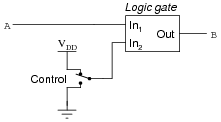
Identify the types of logic gates which do the following (there is more than one type of gate for each of the following rules!):
- B = A when Control is high
- B = A when Control is low
- B = \(\bar{A}\) when Control is high
- B = \(\bar{A}\) when Control is low
Also, explain how an understanding of this can be helpful in troubleshooting faulted logic gates.
Reveal answer- B = A when Control is high: AND gate and XNOR gate.
- B = A when Control is low: OR gate and XOR gate.
- B = \(\bar{A}\) when Control is high: NAND gate and XOR gate.
- B = \(\bar{A}\) when Control is low: NOR gate and XNOR gate.
Follow-up question: explain why XOR and XNOR gates are so useful as signal controllers.
Notes:This is a very useful way to think of the different logic gate types, as it is often required to use a gate as a controlled buffer or controlled inverter.