Facebook
 Google
 GitHub
 Linkedin
Mathematics for Electronics
Calculus for Electric Circuits
30 questions By Tony R. Kuphaldt
-
Question 13 of 30
∫f(x) dx Calculus alert!
We know that the output of an integrator circuit is proportional to the time-integral of the input voltage:
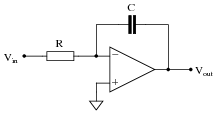
Vout ∝ ⌠ ⌡ T 0 Vin dt But how do we turn this proportionality into an exact equality, so that it accounts for the values of R and C? Although the answer to this question is easy enough to simply look up in an electronics reference book, it would be great to actually derive the exact equation from your knowledge of electronic component behaviors! Here are a couple of hints:
I = V Ri = C dv dtReveal answerVout = − 1 RC⌠ ⌡ T 0 Vin dt Follow-up question: why is there a negative sign in the equation?
Notes:The two “hint” equations given at the end of the question beg for algebraic substitution, but students must be careful which variable(s) to substitute! Both equations contain an I, and both equations also contain a V. The answer to that question can only be found by looking at the schematic diagram: do the resistor and capacitor share the same current, the same voltage, or both?
-
Question 14 of 30
∫f(x) dx Calculus alert!
If an object moves in a straight line, such as an automobile traveling down a straight road, there are three common measurements we may apply to it: position (x), velocity (v), and acceleration (a). Position, of course, is nothing more than a measure of how far the object has traveled from its starting point. Velocity is a measure of how fast its position is changing over time. Acceleration is a measure of how fast the velocity is changing over time.
These three measurements are excellent illustrations of calculus in action. Whenever we speak of “rates of change,” we are really referring to what mathematicians call derivatives. Thus, when we say that velocity (v) is a measure of how fast the object’s position (x) is changing over time, what we are really saying is that velocity is the “time-derivative” of position. Symbolically, we would express this using the following notation:
v = dx dtLikewise, if acceleration (a) is a measure of how fast the object’s velocity (v) is changing over time, we could use the same notation and say that acceleration is the time-derivative of velocity:
a = dv dtSince it took two differentiations to get from position to acceleration, we could also say that acceleration is the second time-derivative of position:
a = d2x dt2“What has this got to do with electronics,” you ask? Quite a bit! Suppose we were to measure the velocity of an automobile using a tachogenerator sensor connected to one of the wheels: the faster the wheel turns, the more DC voltage is output by the generator, so that voltage becomes a direct representation of velocity. Now we send this voltage signal to the input of a differentiator circuit, which performs the time-differentiation function on that signal. What would the output of this differentiator circuit then represent with respect to the automobile, position or acceleration? What practical use do you see for such a circuit?
Now suppose we send the same tachogenerator voltage signal (representing the automobile’s velocity) to the input of an integrator circuit, which performs the time-integration function on that signal (which is the mathematical inverse of differentiation, just as multiplication is the mathematical inverse of division). What would the output of this integrator then represent with respect to the automobile, position or acceleration? What practical use do you see for such a circuit?
Reveal answerThe differentiator’s output signal would be proportional to the automobile’s acceleration, while the integrator’s output signal would be proportional to the automobile’s position.
a ∝ dv dtOutput of differentiator x ∝ ⌠ ⌡ T 0 v dt Output of integrator Follow-up question: draw the schematic diagrams for these two circuits (differentiator and integrator).
Notes:The calculus relationships between position, velocity, and acceleration are fantastic examples of how time-differentiation and time-integration works, primarily because everyone has first-hand, tangible experience with all three. Everyone inherently understands the relationship between distance, velocity, and time, because everyone has had to travel somewhere at some point in their lives. Whenever you as an instructor can help bridge difficult conceptual leaps by appeal to common experience, do so!
-
Question 15 of 30
∫f(x) dx Calculus alert!
A familiar context in which to apply and understand basic principles of calculus is the motion of an object, in terms of position (x), velocity (v), and acceleration (a). We know that velocity is the time-derivative of position (v = [dx/dt]) and that acceleration is the time-derivative of velocity (a = [dv/dt]). Another way of saying this is that velocity is the rate of position change over time, and that acceleration is the rate of velocity change over time.
It is easy to construct circuits which input a voltage signal and output either the time-derivative or the time-integral (the opposite of the derivative) of that input signal. We call these circuits “differentiators” and “integrators,” respectively.
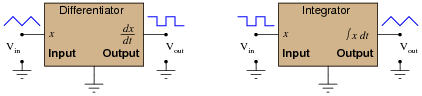
Integrator and differentiator circuits are highly useful for motion signal processing, because they allow us to take voltage signals from motion sensors and convert them into signals representing other motion variables. For each of the following cases, determine whether we would need to use an integrator circuit or a differentiator circuit to convert the first type of motion signal into the second:
- Converting velocity signal to position signal: (integrator or differentiator?)
- Converting acceleration signal to velocity signal: (integrator or differentiator?)
- Converting position signal to velocity signal: (integrator or differentiator?)
- Converting velocity signal to acceleration signal: (integrator or differentiator?)
- Converting acceleration signal to position signal: (integrator or differentiator?)
Also, draw the schematic diagrams for these two different circuits.
Reveal answer- Converting velocity signal to position signal: (integrator)
- Converting acceleration signal to velocity signal: (integrator)
- Converting position signal to velocity signal: (differentiator)
- Converting velocity signal to acceleration signal: (differentiator)
- Converting acceleration signal to position signal: (two integrators!)
I’ll let you figure out the schematic diagrams on your own!
Notes:The purpose of this question is to have students apply the concepts of time-integration and time-differentiation to the variables associated with moving objects. I like to use the context of moving objects to teach basic calculus concepts because of its everyday familiarity: anyone who has ever driven a car knows what position, velocity, and acceleration are, and the differences between them.
One way I like to think of these three variables is as a verbal sequence:

Arranged as shown, differentiation is the process of stepping to the right (measuring the rate of change of the previous variable). Integration, then, is simply the process of stepping to the left.
Ask your students to come to the front of the class and draw their integrator and differentiator circuits. Then, ask the whole class to think of some scenarios where these circuits would be used in the same manner suggested by the question: motion signal processing. Having them explain how their schematic-drawn circuits would work in such scenarios will do much to strengthen their grasp on the concept of practical integration and differentiation.