Facebook
 Google
 GitHub
 Linkedin
AC Electric Circuits
Inductive Reactance
13 questions By Tony R. Kuphaldt
-
Question 4 of 13
∫f(x) dx Calculus alert!
We know that the formula relating instantaneous voltage and current in an inductor is this:e = L di dtKnowing this, determine at what points on this sine wave plot for inductor current is the inductor voltage equal to zero, and where the voltage is at its positive and negative peaks. Then, connect these points to draw the waveform for inductor voltage:
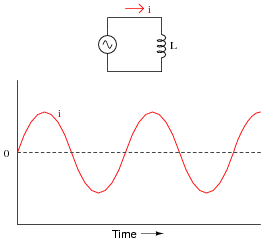
How much phase shift (in degrees) is there between the voltage and current waveforms? Which waveform is leading and which waveform is lagging?
Reveal answer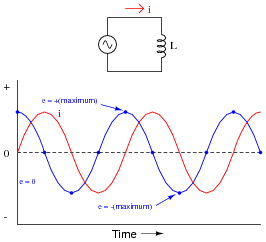
For an inductor, voltage is leading and current is lagging, by a phase shift of 90o.
Notes:This question is an excellent application of the calculus concept of the derivative: relating one function (instantaneous voltage, e) with the instantaneous rate-of-change of another function (current, [di/dt]).
-
Question 5 of 13
Does an inductor’s opposition to alternating current increase or decrease as the frequency of that current increases? Also, explain why we refer to this opposition of AC current in an inductor as reactance instead of resistance.
Reveal answerThe opposition to AC current (“reactance”) of an inductor increases as frequency increases. We refer to this opposition as “reactance” rather than “resistance” because it is non-dissipative in nature. In other words, reactance causes no power to leave the circuit.
Notes:Ask your students to define the relationship between inductor reactance and frequency as either “directly proportional” or “inversely proportional”. These are two phrases used often in science and engineering to describe whether one quantity increases or decreases as another quantity increases. Your students definitely need to be familiar with both these phrases, and be able to interpret and use them in their technical discussions.
Also, discuss the meaning of the word “non-dissipative” in this context. How could we prove that the opposition to current expressed by an inductor is non-dissipative? What would be the ultimate test of this?
-
Question 6 of 13
What will happen to the brightness of the light bulb as the iron core is moved away from the wire coil in this circuit? Explain why this happens.

Reveal answerThe light bulb will glow brighter when the iron core is moved away from the wire coil, due to the change in inductive reactance (XL).
Follow-up question: what circuit failure(s) could cause the light bulb to glow brighter than it should?
Notes:One direction you might want to lead your students in with this question is how AC power may be controlled using this principle. Controlling AC power with a variable reactance has a definite advantage over controlling AC power with a variable resistance: less wasted energy in the form of heat.