
 Facebook
 Google
 GitHub
 Linkedin
Discrete Semiconductor Devices and Circuits
Insulated Gate Field-Effect Transistors
39 questions By Tony R. Kuphaldt
-
Question 4 of 39
Some types of MOSFETs have a source-drain channel already formed with no applied gate voltage:
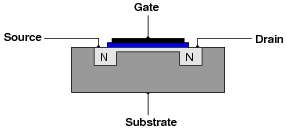
Explain what happens to source-drain conductivity with each of the following applied gate-to-substrate voltages. Modify the illustrations if necessary:
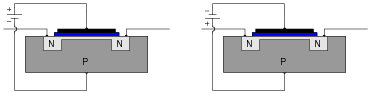
Reveal answer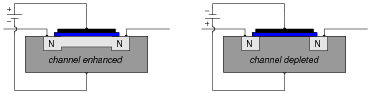
Notes:Ask your students to contrast the behavior of this type of MOSFET against the behavior of the type that requires a gate voltage to create an inversion layer.
-
Question 5 of 39
There are two general classes of MOSFETs: MOSFETs that conduct with no applied gate voltage, and MOSFETs that require a gate voltage to be applied for conduction. What are each of these MOSFET types called, and what are their respective schematic symbols?
Each of the symbols for these different types of MOSFETs hold clues to the transistor types they represent. Explain how the symbols hint at the characteristics of their respective transistor types.
Reveal answerDepletion-type (D-type) MOSFETs conduct current with no applied gate voltage. Enhancement-type (E-type) MOSFETs require a gate voltage to be applied for conduction.

Notes:The part of this question asking about clues within the transistor symbols is very important. It will be far easier for your students to remember the function of each transistor type if they are able to recognize clues in the symbolism.
-
Question 6 of 39
Identify these schematic symbols:

Reveal answer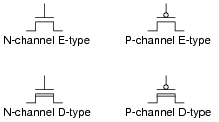
Notes:The “bubble” symbol on the gate of the P-channel devices is reminiscent of inversion bubbles used on logic gate symbols. I’m assuming that your students will not have studied logic gates at this point, so this is a foreshadowing of things to come!


