Facebook
 Google
 GitHub
 Linkedin
Synaptics Redefines Edge IoT with ‘First AI-Native Wi-Fi 7 Connectivity Solution for IoT’
Announced today at Embedded World, Synaptics claims the SYN765x as the first industry's first AI Native Wi-Fi 7 solution developed specifically for the IoT. It provides Wi-Fi 7, Bluetooth 6.0, and 802.15.4 connectivity and features a Cortex-M52 and Ethos-U55 NPU.
Today, Synaptics has formally announced the SYN765x family, a series of highly integrated devices which they’re calling the industry’s first AI-native industry's first AI Native Wi-Fi 7 solution developed specifically for the IoT. It features Wi-Fi 7, Bluetooth 6.0, and IEEE 802.15.4 connectivity.
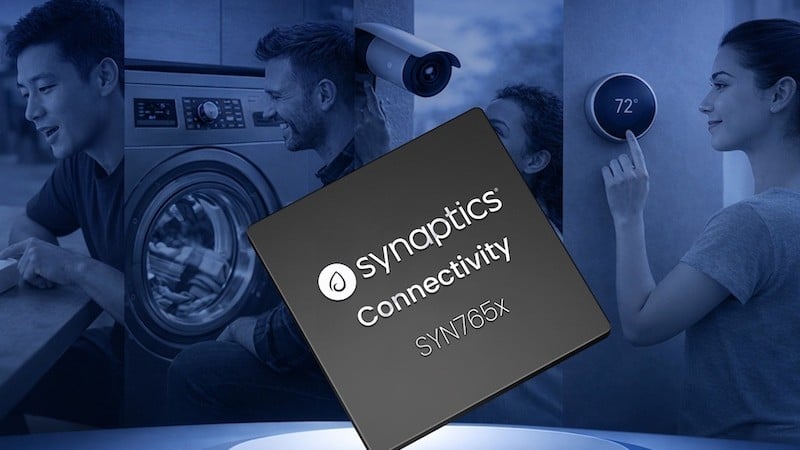
Synaptics calls SYN765x the industry's first AI Native Wi-Fi 7 solution developed specifically for the IoT.
Announced at Embedded World 2026, the SoC is meant as a solution to escalating computational and wireless demands within smart appliances and industrial IoT systems. By merging high-performance neural processing with the latest tri-band wireless standards, Synaptics hopes to provide a new design path for edge engineers.
All About Circuits spoke with Vikram Gupta, SVP & GM, Edge AI Solutions at Synaptics, to learn more about the family firsthand.
An Architecture for AI-Native Processing
AI was top of mind for Synaptics at the onset of this design. As Gupta explains, “Whatever we do for these MCUs and MPUs, we're going to have AI engines in them. We're going to architect things AI natively so that AI is front and center in terms of how we think about it from an SoC point of view, performance-wise, even security and tooling."
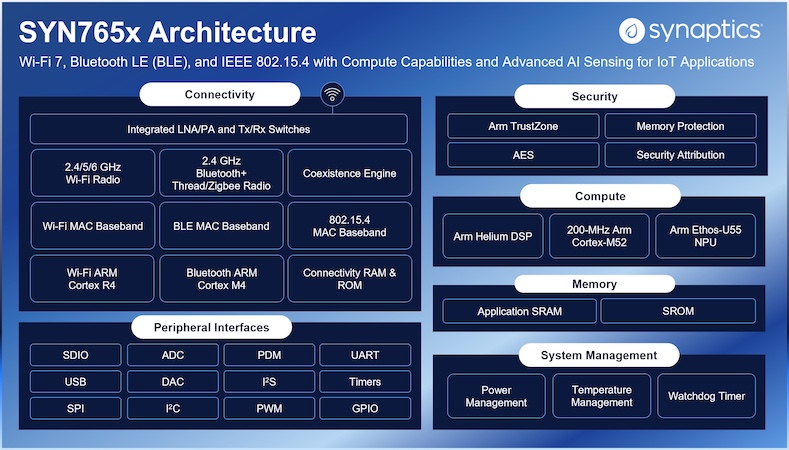
Synaptics 765x architecture
The "AI-Native" designation of the SYN765x is rooted in its heterogeneous compute architecture, which moves beyond general-purpose processing to include dedicated hardware for machine learning inference.
Specifically, the MCU’s application subsystem is a 200 MHz Arm Cortex-M52 processor. With the Helium DSP extension, it is said to provide a 30% efficiency improvement in signal processing tasks compared to the legacy Cortex-M33. The primary CPU is then paired with an Arm Ethos-U55 NPU capable of delivering 50 GOPS.
According to Synpatics, the architecture lets AI-based sensing modalities operate locally on the device without requiring cloud connectivity. As part of this, the SoC uses Channel State Information (CSI) from the Wi-Fi radio to perform contactless sensing, allowing the NPU to run algorithms for presence detection, breathing monitoring, and gesture recognition by interpreting RF signal disruptions. Furthermore, the SoC’s integrated audio processing pipeline supports sound event detection and keyword spotting.
Multi-Protocol Connectivity
The SYN765x distinguishes itself with a wireless engine that supports Wi-Fi 7, Bluetooth 6.0, and 802.15.4 protocols simultaneously. Speaking to this, Gupta tells us, “The reason we put both wireless and processors together is that we fundamentally believe that ultimately what customers will care about is like having the right solution for creating these edge AI solutions.”
To that end, the Wi-Fi 7 implementation is a tri-band 1x1 solution supporting the 2.4, 5, and 6 GHz spectrums. A technical milestone for this MCU class is the inclusion of Multi-Link Operation (MLO), which allows the hardware MAC layer to intelligently route packets across different frequency bands based on real-time congestion levels. According to Synaptics, this capability significantly reduces retransmissions and latency to deliver a sustained throughput of 20 Mbps even at ranges up to 50 meters, and reaching a maximum PHY rate of 114.7 Mbps.

The RF block diagram for Bluetooth
Complementing the Wi-Fi subsystem is a Bluetooth 6.0 radio featuring Channel Sounding technology. This system delivers precise distance measurement and phase-ranging between devices, which Synaptics positions as a cost-effective alternative to Radar or Ultra-Wideband (UWB) for asset tracking and indoor positioning.
For smart home interoperability, the integrated 802.15.4 radio supports Thread and Zigbee, facilitating seamless Matter-compliant deployments. And, to manage the potential interference of these overlapping 2.4 GHz technologies, the SoC employs proprietary Smart Co-Ex technology to optimize coexistence and concurrency between Bluetooth and Wi-Fi streams.
Reducing System Complexity
One major challenge for designers is how to balance BoM costs with the increasing complexity of IoT designs. The SYN765x hopes to resolve this issue through aggressive silicon-level integration.
Specifically, the SoC incorporates the power amplifier, low-noise amplifier, and transmit/receive switches directly onto the die for both 2.4 and 5/6 GHz bands. This high level of integration reduces the external radio bill of materials by approximately 25% and allows for a total PCB footprint of less than 30 square millimeters.
The SYN765x architecture is also said to simplify system design by offloading communication and sensing tasks from the primary application processor. For instance, in a security camera application, the SYN765x can manage front-end sensor fusion and Wi-Fi sensing while the main image processor remains in a deep-sleep state, drastically reducing standby power consumption to sub-600 µW levels.
Finally, to boost software development timelines, Synaptics provides the Astra software development environment and an MCU SDK with pre-integrated firmware for all connectivity options. With it, the SoC supports industry-standard real-time operating systems, including FreeRTOS and Zephyr, ensuring that developers can utilize existing open-source frameworks and tooling.
What’s Next?
Reflecting on the journey to this point, Gupta explains, “I think we're sort of at that moment here when, even though our legacy took us in a completely different direction, in a weird way we feel like we've been in AI for a very long time.” Following the official launch, Synaptics expects to distribute engineering samples and alpha software dev kits by late April 2026. Full production and the release of gold-standard software and reference designs are targeted for the fourth quarter of 2026.
All images used courtesy of Synaptics.