Facebook
 Google
 GitHub
 Linkedin
Discrete Semiconductor Devices and Circuits
Junction field-effect transistors (JFET)
43 questions By Tony R. Kuphaldt
-
Question 31 of 43
If a junction field-effect transistor is subjected to several different gate-to-source voltages (Vgs), and the drain-to-source voltage (Vds) “swept” through the full range for each of these gate voltage values, data for an entire “family” of characteristic curves may be obtained and graphed for the transistor:
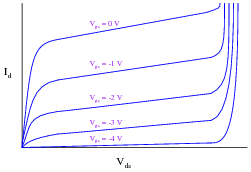
Identify the saturation, active, and breakdown regions on this graph.
What do these characteristic curves indicate about the gate voltage’s control over drain current? How are the two signals related to each other?
Reveal answerThe saturation, active, and breakdown regions on this graph are equivalent to the same regions in bipolar junction transistor characteristic curves.
The drain current regulation point is established by the gate voltage while in the “active” region.
Notes:Ask your students what the characteristic curves would look like for a perfect transistor: one that was a perfect regulator of drain current over the full range of drain-source voltage.
-
Question 32 of 43
An important JFET parameter is VGS(off). Explain what this parameter means, and why it is important to us when selecting a JFET or designing a circuit around one.
Reveal answerVGS(off) is called the cutoff voltage.
Challenge question: is VGS(off) approximately the same for all models of JFET, or does it vary from transistor to transistor? Explain your answer.
Notes:Ask your students what the “GS” subscript stands for in VGS.
-
Question 33 of 43
What does the parameter IDSS mean for a JFET? How can we use this figure, along with VGS(off), and VGS, to calculate the amount of drain current (ID) for a JFET operating in its active region? Write the equation for the relationship between these four variables.
Reveal answerIDSS is the amount of (regulated) current that will go through a JFET’s drain when the gate terminal is shorted to the source terminal.
$$I_D = I_{DSS} (1 - \sqrt{\frac{V_{GS}}{V_{GS(off)}}})^2$$
Follow-up question: how could you empirically determine the IDSS rating of a JFET? What sort of circuit would you have to set up in order to test and measure this transistor parameter?
Notes:Be sure to ask students where they found this equation! It should be available from most basic electronics textbooks. Also, discuss the experimental circuit that would have to be constructed in order to test the shorted-gate drain current of a JFET. You might want to plan on having your students build this very circuit during class time as an exercise in using JFETs.