Facebook
 Google
 GitHub
 Linkedin
DC Electric Circuits
Magnetic Units of Measurement
16 questions By Tony R. Kuphaldt
-
Question 13 of 16
Two important variables in magnetic circuit analysis are B and H. Explain what these two variables represent, in terms of the more fundamental magnetic quantities of MMF (F) and flux (Φ), and relate them, if possible, to electrical quantities. Also, determine the units of measurement for these two variables, in the CGS, SI, and English measurement systems.
Reveal answer
Field intensity (H) is also known as “magnetizing force,” and is the amount of MMF per unit length of the magnetic flux path. Flux density (B) is the amount of magnetic flux per unit area.
Notes:Although the equivalent electrical variables to field intensity and flux density are not commonly used in electronics, they do exist! Ask your students if anyone was able to determine what these variables are. Also, ask them where they were able to obtain the information on magnetic quantities and units of measurement.
You should mention to your students that the SI units are considered to be the most “modern” of those shown here, the SI system being the international standard for metric units in all applications.
-
Question 14 of 16
When a steel manufacturer publishes the magnetic characteristics of their latest alloy, they do so in the form of a “B/H” graph, where flux density (B) is plotted as a function of magnetizing force (H):
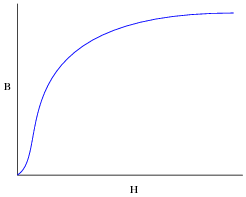
Rarely will you see a plot of flux (Φ) shown as as a function of MMF (F), even though such a plot would appear very similar to the “B/H curve” for that same material. Why is this? Why would a “B/H” curve be preferable to an engineer rather than a “Flux/MMF” curve?
Hint: if a copper manufacturer were to publish the electrical characteristics of their latest alloy, they would specify its resistivity in terms of specific resistance (ρ), rather than plain resistance (R), for the exact same reason!
Reveal answerA “B/H curve” is independent of the specimen’s physical dimensions, communicating the magnetic characteristics of the substance itself, rather than the characteristics of any one particular piece of that substance.
Notes:This concept may confuse some students, so discussion on it is helpful. Ask your students what “flux density” and “magnetizing force” really mean: they are expressions of flux and MMF per unit dimension. So, if a manufacturer states that their new steel alloy will permit a flux density of 0.6 Tesla for an applied magnetizing force of 100 amp-turns/meter, this figure holds true for any size chunk of that alloy.
To prove this concept via the rhetorical technique of reductio ad absurdum, ask your students what it would be like if copper manufacturers specified the resistivity of their copper alloys in ohms: “Alloy 123XYZ has a resistivity of 17 ohms.” Of what usefulness is this statement? What does it mean to us? How is the statement, “Alloy 123XYZ has a resistivity of 10.5 ohm-cmil per foot,” superior?
-
Question 15 of 16
Given the following equations, derive a single equation expressing permeability (μ) in terms of flux density (B) and field intensity (H, otherwise known as magnetizing force):
ℜ = F Φℜ = l μAH = F lB = Φ AReveal answerμ = B HNotes:This question is an exercise in algebraic substitution and manipulation. It might be a good idea to point out that the following equation is valid only for a “solenoid” (a coil of wire).
ℜ = l μAIn the case of an air-core solenoid, the formula is as follows:
ℜ = l μ0 AWhere,
l = linear length of coil in meters (m)
A = cross-sectional area of coil “throat” in square meters (m2)
μ0 = permeability of free space = 4 π × 10−7 (T·m/A)