Facebook
 Google
 GitHub
 Linkedin
DC Electric Circuits
Magnetic Units of Measurement
16 questions By Tony R. Kuphaldt
-
Question 10 of 16
The formula for calculating the reluctance (ℜ) of an air-core wire coil (“solenoid”) is as follows:
ℜ = l μ0 AWhere,
l = linear length of coil in meters (m)
A = cross-sectional area of coil “throat” in square meters (m2)
μ0 = permeability of free space = 4 π × 10−7 (T·m/A)
Using this formula and the Rowland’s Law formula, calculate the amount of magnetic flux (Φ) produced in the throat of an air-core solenoid with 250 turns of wire, a length of 0.2 meters, a cross-sectional area of 6.5 × 10⁻⁴ square meters, and a coil current of 5 amps:
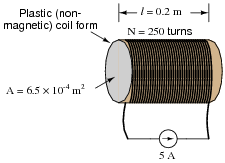
Reveal answerΦ = 5.105 μWb
Notes:With all the information given, this is nothing more than an exercise in calculation. However, it is nice for students to have the air-core solenoid reluctance formula handy for other calculations, which is the main point of this question.
-
Question 11 of 16
Electrically conductive materials may be rated according to their relative resistance by a quantity we call specific resistance (ρ). The formula relating resistance to specific resistance looks like this:
R = ρ l AWhere,
R = Electrical resistance, in ohms
ρ = Specific resistance, in ohm-cmil/ft, or some other combination of units
l = Length of conductor, in feet or cm (depending on units for ρ)
A = Cross-sectional area of conductor, in cmil or cm2 (depending on units for ρ)
Magnetic materials may also be rated according to their relative reluctance by a quantity we call permeability (μ). Write the formula relating reluctance to permeability of a magnetic substance, and note whatever differences and similarities you see between it and the specific resistance formula for electrical circuits.
Reveal answerℜ = l μANotes:Ask your students to describe the effects on magnetic reluctance resulting from increases and decreases in all three independent variables (μ, l, and A). It is important for them to qualitatively grasp this equation, just as it is important for them to qualitatively understand Ohm’s Law and the specific resistance formula.
-
Question 12 of 16
Explain the difference between relative permeability (μr) and absolute permeability (μ). How do the units of measurement differ between these two quantities?
Reveal answerμr = \(\frac{μ}{μ0}\)
Absolute permeability is measured in units of Webers per Amp-meter (Wb/Am), while relative permeability has no unit at all.
Notes:Ask your students to explain why relative permeability (μr) is unitless. Are there any other variables they’ve encountered in their science studies that are similarly unitless?
Did any of your students research the value of absolute permeability of free space (μ0)? If so, what figure did they obtain?