Facebook
 Google
 GitHub
 Linkedin
DC Electric Circuits
Capacitance
19 questions By Tony R. Kuphaldt
-
Question 1 of 19
Write an equation describing the precise mathematical relationship between electric charge (Q), capacitance (C), and voltage (V).
Reveal answerAll I’ll reveal here is that charge is directly proportional to both voltage and capacitance. This equation is an easy one to find on your own, by researching through various electronics textbooks!
Follow-up question: calculate the amount of charge stored in a 330 μF capacitor charged with a voltage of 12 volts.
Notes:This is one of those equations usually discussed somewhere in the first few months of basic electronics education, and promptly forgotten by most. It can be very useful, however, when dealing with charge pumps and other switched-capacitor circuitry.
-
Question 2 of 19
How does the rate of charge flow (current) into and out of a capacitor relate to the amount of voltage across its terminals? How does the rate of water flow into and out of a vessel relate to the amount of water stored in that vessel?
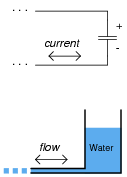
Reveal answerRather than simply give you an answer here, I’ll let you figure this out for yourself. Think very carefully about the water-in-a-vessel analogy when answering this question! Fill a glass with water, if necessary, to gain an intuitive understanding of these quantities.
Notes:The existence of such an appropriate analogy for capacitor action makes an explanation unnecessary, even if the concept takes a bit of thought to comprehend at first. It is important that students clearly distinguish the quantities of current, voltage, and charge in a capacitor circuit just as they clearly distinguish the quantities of liquid height, flow rate, and liquid volume in a hydraulic system.
-
Question 3 of 19
∫f(x) dx Calculus alert!
One of the fundamental principles of calculus is a process called integration. This principle is important to understand because it is manifested in the behavior of capacitance. Thankfully, there are more familiar physical systems which also manifest the process of integration, making it easier to comprehend.If we introduce a constant flow of water into a cylindrical tank with water, the water level inside that tank will rise at a constant rate over time:
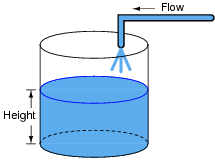
In calculus terms, we would say that the tank integrates water flow into water height. That is, one quantity (flow) dictates the rate-of-change over time of another quantity (height).
Like the water tank, electrical capacitance also exhibits the phenomenon of integration with respect to time. Which electrical quantity (voltage or current) dictates the rate-of-change over time of which other quantity (voltage or current) in a capacitance? Or, to re-phrase the question, which quantity (voltage or current), when maintained at a constant value, results in which other quantity (current or voltage) steadily ramping either up or down over time?
Reveal answerIn a capacitance, voltage is the time-integral of current. That is, the applied current “through” the capacitor dictates the rate-of-change of voltage across the capacitor over time.
Challenge question: can you think of a way we could exploit the similarity of capacitive voltage/current integration to simulate the behavior of a water tank’s filling, or any other physical process described by the same mathematical relationship?
Notes:The concept of integration doesn’t have to be overwhelmingly complex. Electrical phenomena such as capacitance and inductance may serve as excellent contexts in which students may explore and comprehend the abstract principles of calculus. The amount of time you choose to devote to a discussion of this question will depend on how mathematically adept your students are.
Hopefully, the challenge question will stir your students’ imaginations, as they realize the usefulness of electrical components as analogues for other types of physical systems.