Facebook
 Google
 GitHub
 Linkedin
NXP Makes Its CES Reveal: A Central Compute Platform for Smart Vehicles
Announced today, the new real-time, super-integration processor is the next step in NXP’s automotive processing platform.
Today at CES, NXP Semiconductors unveiled the S32N7 processor series, the next step in its S32 vehicle super-integration roadmap. Rather than targeting infotainment or high-end autonomous-driving compute, the S32N7 focuses on fundamental vehicle subsystems such as body electronics, motion and chassis control, energy management, gateway functions, and Level-2 ADAS support. NXP intends the processor to sit between high-performance ADAS/IVI computers and distributed actuators, acting as the system-level coordinator for vehicle behavior.
S32N7 is meant to tackle vehicle subsystems, including Level-2 ADAS, motion control, and body electronics.
All About Circuits had the opportunity to talk with Nicola Concer, NXP’s senior product manager of vehicle control and networking solutions, to learn about the chip firsthand.
Building on the S32N55's Super Integration
The S32N7 traces its lineage directly to the S32N55, which introduced large-scale real-time consolidation with up to 16 Arm Cortex-R52 cores, a lockstep Cortex-M7 system, communication managers, and extensive on-chip SRAM and cache resources. The S32N55 established NXP’s approach for replacing multiple domain controllers with a single SoC while preserving ASIL-D functional safety through hardware isolation and split-lock execution.
The S32N7 builds on the S32N55's wins by adding application-class processing (A78AE cores), expanded memory bandwidth, and a dedicated AI acceleration subsystem. This change helps the S32N7 move beyond consolidation alone into cross-domain intelligence, where it can locally process and act on data from multiple vehicle subsystems.
Hardware-Enforced Isolation
A main architectural element carried forward and expanded in the S32N7 is hardware-enforced, software-defined partitioning.
“Software-defined means the engineer can decide what part of the chip is assigned to which function,” Concer explained. “You define these partitions in software, but they are enforced by hardware, and each one can be booted, updated, and managed independently.”
Isolation includes compute cores, memory regions, I/O, and networking resources. Meanwhile, fault containment logic guarantees that failures remain local to the affected function rather than triggering a system-wide reset.
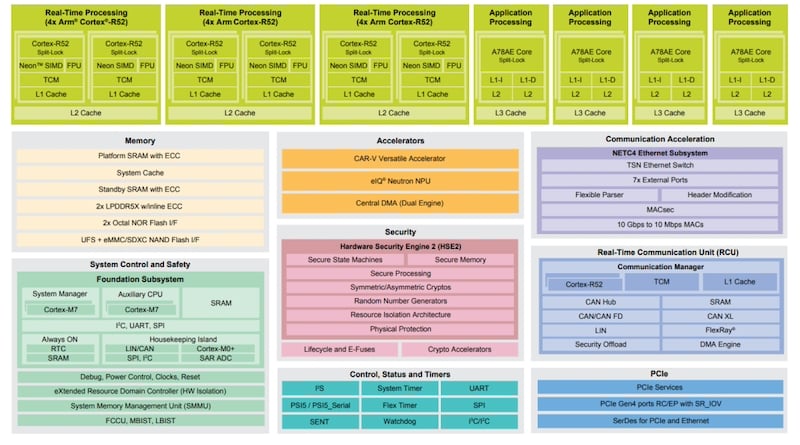
S32N7 block diagram.
With this approach, NXP helps OEMs consolidate up to eight traditionally separate vehicle domains onto a single processor while maintaining freedom from interference required for mixed-criticality systems. From an engineering perspective, the consolidation reduces ECU count, wiring harness complexity, and inter-controller communication overhead without compromising certification boundaries that previously required physical separation.
Networking and Safe High-Performance Interconnect
The S32N7 also integrates vehicle networking functions directly into the SoC. As with the S32N55, this integration includes extensive support for CAN, LIN, FlexRay, and Time-Sensitive Networking Ethernet. The S32N7, however, expands the role of networking by positioning the processor as a data-aggregation and routing hub.
A notable extension is support for a safe, constrained, high-performance, PCIe-based interconnect, which allows the S32N7 to exchange data and access selected devices with external ADAS or infotainment compute nodes without exposing unrestricted shared memory. The interconnect enables the system to share sensor data, Ethernet ports, or AI extensions across SoCs with explicit access control. In that way, the design supports modular system scaling while preserving safety and security boundaries.
Faster AI Deployment
In contrast to autonomous-driving SoCs that prioritize peak TOPS for perception workloads, NXP optimized the S32N7 for multiple concurrent AI tasks distributed across the vehicle.
“This is not about 500 TOPS to drive an autonomous car. It's about small engines that are doing a lot of different things in parallel,” Concer said. “You're serving a lot of medium- to small-AI capabilities—not driving a huge LLM. We don't want to speak English to our inventor. You want to have an intelligent inverter instead.”
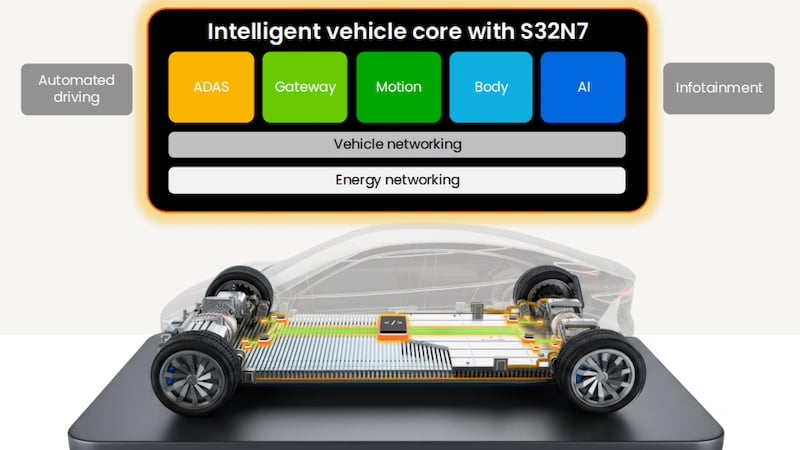
To that end, the integrated NPU is designed to run multiple medium-scale inference models in parallel, including those for use cases such as predictive maintenance and vehicle-state awareness.
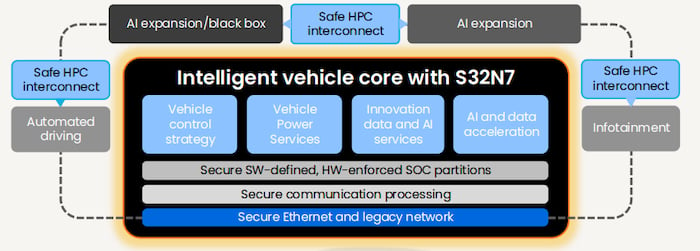
Intelligent vehicle core with the S32N7.
And because the S32N7 remains active across all vehicle power modes, AI functions can operate even when higher-power ADAS or IVI processors are off. Local inference also reduces latency and dependence on cloud connectivity, resulting in a safer, more secure system.
Unified Software Environment and Lifecycle Scaling
The S32N7 is part of a family of 32 compatible devices that share a common architecture and software environment. Functionally, that means OEMs can deploy a single software stack across multiple vehicle segments by scaling compute resources rather than redesigning applications. Engineers can use entry-level configurations to replace traditional microcontrollers, while higher-end variants add application cores, memory, and AI capacity.
“You don’t have to negotiate bandwidth with the networking team anymore. All the information is already there,” Concer said. “You have zero-copy access inside your domain to create new capabilities and add more functionality.”
NXP also claims that the unified environment simplifies over-the-air updates by allowing individual partitions to be updated independently. This effectively reduces validation scope and supports continuous feature deployment throughout the vehicle lifecycle. From a platform strategy perspective, the approach aligns directly with OEM goals: introducing software-defined functionality without repeated hardware re-architecture.
Cost, Integration, and OEM Impact
By consolidating compute, networking, and safety management into a single SoC, the S32N7 directly impacts the total cost of ownership. NXP estimates that super integration at this level can deliver up to a 20% cost reduction, accounting for hardware, integration effort, wiring, and long-term maintenance. These savings, in turn, create headroom for OEMs to add features or improve margins without increasing vehicle price.
“When you control the vehicle core and the data around it, you can innovate continuously, reduce recalls, and create new services without re-architecting the car,” Concer said.
To date, Bosch has deployed the S32N7 on its vehicle integration platform, with the collaboration yielding reference designs, safety frameworks, and integration tooling to shorten development timelines and reduce risk for early adopters.
All images used courtesy of NXP Semiconductors.
Related Content