Facebook
 Google
 GitHub
 Linkedin
DC Electric Circuits
DC Metrology
11 questions By Tony R. Kuphaldt
-
Question 1 of 11
Define the following metrological terms:
- • Uncertainty
- • Accuracy
- • Error
- • Precision
- • Traceability
Reveal answerI’ll let you research the definitions to these terms!
Notes:The words “accuracy” and “precision” are often (incorrectly) interchanged with one another. They have distinct and separate meanings, though.
Regarding the word “traceability,” you might want to elaborate on electrical metrology as a career in itself. Maintaining international measurement standards is a work-intensive endeavor, and qualified electronics people at all levels of expertise (technicians, engineers, researchers, scientists) are needed in many locations around the world to maintain the system. Though it may sound boring, metrology is essential to state-of-the art scientific research as well as modern industry.
-
Question 2 of 11
In chemistry laboratories, balance scales are used to precisely measure the mass of various substances. How, exactly, is a laboratory “balance” scale used? What component of the scale primarily determines its accuracy?
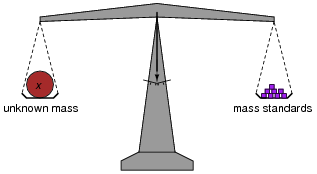
Reveal answerA “balance” scale works on the principle of masses in equilibrium: the unknown mass is countered with known quantities of mass until the scale registers a condition of balance.
Notes:The important point I wish to communicate with this question is that the scale does nothing but indicate a condition of balance (zero excess mass on either side). As such, the primary source of accuracy in this measurement system does not lie within the scale mechanism itself! This is an important quality of a measurement system: to isolate sources of inaccuracy to very specific portions of the system, where they may be tightly controlled.
-
Question 3 of 11
Explain how this electrical system functions in a similar manner to a laboratory “balance” scale:

The circle with the letter “G” in it is a symbol for a galvanometer. What practical purpose might a system like this serve?
Reveal answerThe galvanometer registers zero if and only if the two voltage sources are precisely equal.
Notes:The first question your students are likely to ask is, “What is a galvanometer?” Let them do the research on this question! The answer is easy to find.
Next, your students will have to explain how this system may be used to do something practical. Just as a laboratory balance-beam serves the purpose of measuring mass, this system also measures something. Challenge your students to draw analogies between the components of this system and the components of a laboratory balance. What essential feature must the Estandard voltage source have in order for this to be a useful measurement system?