Facebook
 Google
 GitHub
 Linkedin
Diodes Inc. Releases Multi-Phase SPI Boost Controller for Auto Lighting
Diodes Inc. says the device balances the demands of advanced headlight control units, including power density, efficiency, EMI, and functional safety.
Diodes Incorporated recently released the AL8859Q, a multi-phase SPI boost controller designed to handle the growing demands of modern automotive lighting systems.
Power stages must keep up with headlights as they evolve into integrated platforms that combine high beams, low beams, daytime running lights, turn indicators, and cornering functions. The AL8859Q addresses these requirements by operating as a constant-voltage pre-stage that supports complex, multi-channel LED architectures while maintaining high efficiency and stable performance.
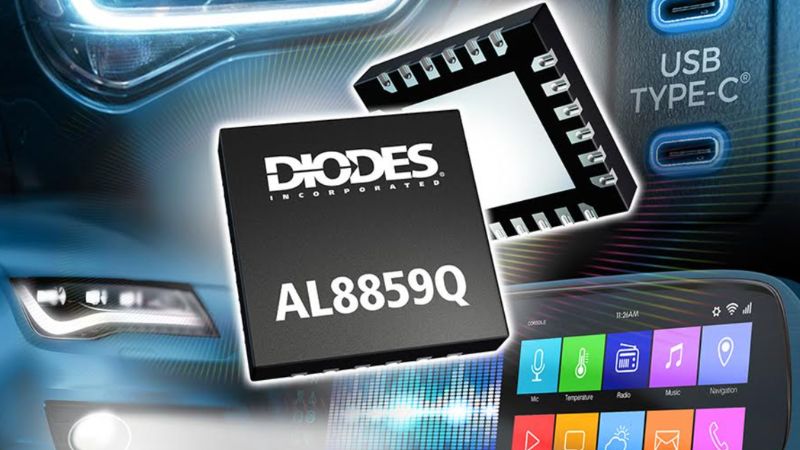
The AL8859Q's compact V-QFN packaging supports space-efficient, reliable PCB design.
Purpose Built for Advanced Headlight Control Units
Modern headlight systems are no longer single-function designs. They operate as adaptive systems that must manage multiple lighting modes simultaneously while maintaining consistent output and reliability under varying electrical conditions.
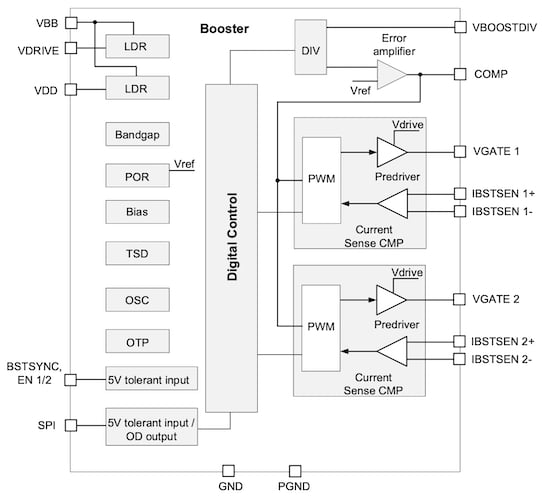
Functional block diagram of the AL8859Q.
Diodes Inc. positions the AL8859Q at this intersection. It serves as the primary boost stage, feeding downstream LED drivers to ensure stable voltage delivery across a wide range of operating conditions. It also enables a unified lighting module rather than fragmented subsystems, with support for applications such as high beams, low beams, DRL, fog lights, and even cornering lights. This consolidation matters: it reduces system complexity while improving coordination between lighting functions, which is critical in adaptive front lighting systems.
Multi-Phase Architecture Designed for High Power Density
At the core of the device is a current-mode, multi-phase boost architecture, which accounts for much of its performance advantage. The AL8859Q (datasheet linked) spreads the load across multiple phases instead of pushing everything through a single high-current stage. One device handles two phases, and additional devices can be synced to scale up to three or four. That makes it practical to reach 100 W to 400 W while keeping thermal load balanced and ripple under control.
This allows higher power with more controlled delivery. Lower ripple improves LED driver performance, and spreading the thermal load reduces stress on individual components.
Wide Input Range and Stability Under Automotive Conditions
Automotive electrical systems are inherently unstable compared to fixed industrial supplies. Voltage rails can vary widely depending on operating conditions, and transient events such as load dumps can introduce significant stress. The AL8859Q addresses this with a wide input voltage range of 4.5 V to 60 V, allowing it to operate across 5-V, 12-V, 24-V, and 48-V systems.
More importantly, the device maintains output-voltage stability during transient conditions through programmable control registers. This ensures that downstream LED drivers receive a consistent supply even during voltage disturbances.
SPI-Based Control Enables Platform-Level Flexibility
One of the defining features of the AL8859Q is its SPI-based digital interface, which allows key operating parameters to be configured through software.
Output voltage, switching frequency, current limits, and protection thresholds can all be adjusted through programmable registers. This changes how the device is used in practice. Instead of designing different hardware for each vehicle platform, manufacturers can reuse a common design and adapt behavior through software. Integrated one-time programmable memory further supports this approach by enabling production-line configuration and fail-safe operation. In certain cases, the device can operate independently without continuous MCU control, reducing system dependency and improving robustness.
This level of configurability makes the AL8859Q less of a fixed-function component and more of a flexible platform element.
Designed for Functional Safety and System Diagnostics
Automotive systems require more than performance. They require visibility and fault tolerance. The AL8859Q includes a comprehensive set of diagnostic and protection features, including thermal warning and shutdown, overvoltage and undervoltage protection, current limiting, SPI error detection, and VDRIVE monitoring.
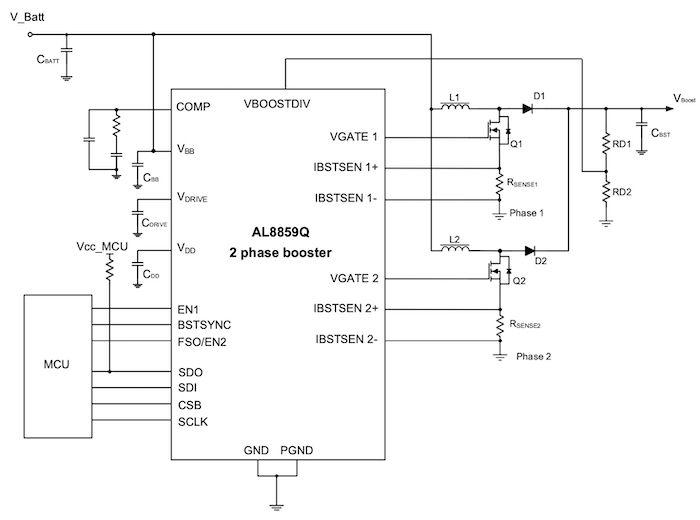
A typical multi-phase boost configuration illustrates how the controller distributes power across phases to improve efficiency and thermal balance.
These features enable continuous system status reporting and support functional-safety-capable system designs. Rather than reacting to failures after they occur, the device allows systems to detect and respond to issues in real time.
Managing EMI Without External Complexity
Electromagnetic interference remains a critical challenge in automotive electronics, particularly in high-frequency switching systems. The AL8859Q uses spread-spectrum modulation to help meet the CISPR 25 Class 5 EMI requirements. Instead of concentrating noise at a single frequency, it spreads it out, helping reduce peak emissions and cutting down on the need for large external filters. That directly affects system design, with fewer components, lower BOM cost, and less PCB space required.
Precision and Packaging for Real World Deployment
Voltage accuracy is rated at ±0.5% at 50 V, which keeps the supply stable for downstream LED drivers that rely on tight regulation for consistent brightness.
The device comes in a compact 4 mm × 4 mm wettable flank V-QFN package, making it easier to inspect solder joints and improve assembly reliability. In high-volume automotive manufacturing, that level of inspection isn’t optional; it’s required.
Front-end power stages are no longer just regulating voltage. They are expected to handle higher power, support multiple lighting functions, and integrate cleanly into system-level control. Devices like the AL8859Q are built around those requirements.
All images used courtesy of Diodes Incorporated.