Facebook
 Google
 GitHub
 Linkedin
Analog Integrated Circuits
Negative Feedback OpAmp Circuits
21 questions By Tony R. Kuphaldt
-
Question 4 of 21
How much voltage would have to be “dialed up” at the potentiometer in order to stabilize the output at exactly 0 volts, assuming the opamp has no input offset voltage?
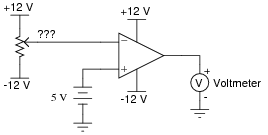
Reveal answer5 volts
Notes:This question is a basic review of an ideal differential amplifier’s function. Ask your students what voltage must be “dialed up” at the potentiometer to produce 0 volts at the output of the op-amp for several different voltages at the other input. If they don’t understand at first, they soon will after discussing these alternate scenarios.
-
Question 5 of 21
An op-amp has 3 volts applied to the inverting input and 3.002 volts applied to the non-inverting input. Its open-loop voltage gain is 220,000. Calculate the output voltage as predicted by the following formula:
Vout = AV ( Vin(+) − Vin(−) ) How much differential voltage (input) is necessary to drive the output of the op-amp to a voltage of -4.5 volts?
Reveal answerVout = 440 volts
Follow-up question: is this voltage figure realistic? Is it possible for an op-amp such as the model 741 to output 440 volts? Why or why not?
The differential input voltage necessary to drive the output of this op-amp to -4.5 volts is -20.455 μV.
Follow-up question: what does it mean for the input voltage differential to be negative 20.455 microvolts? Provide an example of two input voltages (Vin(+) and Vin(−)) that would generate this much differential voltage.
Notes:Obviously, there are limitations to the op-amp formula for calculating output voltage, given input voltages and open-loop voltage gain. Students need to realize the practical limits of an op-amp’s output voltage range, and what sets those limits.
-
Question 6 of 21
A very important concept in electronics is that of negative feedback. This is an extremely important concept to grasp, as a great many electronic systems exploit this principle for their operation and cannot be properly understood without a comprehension of it.
However important negative feedback might be, it is not the easiest concept to understand. In fact, it is quite a conceptual leap for some. The following is a list of examples - some electronic, some not - exhibiting negative feedback:
- A voltage regulating circuit
- An auto-pilot system for an aircraft or boat
- A thermostatic temperature control system (“thermostat”)
- Emitter resistor in a BJT amplifier circuit
- Lenz’s Law demonstration (magnetic damping of a moving object)
- Body temperature of a mammal
- Natural regulation of prices in a free market economy (Adam Smith’s “invisible hand”)
- A scientist learning about the behavior of a natural system through experimentation.
For each case, answer the following questions:
- What variable is being stabilized by negative feedback?
- How is the feedback taking place (step by step)?
- What would the system’s response be like if negative feedback were not present?
Reveal answerI will provide answers for only one of the examples, the voltage regulator:
- What variable is being stabilized by negative feedback?
- Output voltage.
- How is the feedback taking place (step by step)?
- When output voltage rises, the system takes action to drop more voltage internally, leaving less for the output.
- What would the system’s response be like if negative feedback were not present?
- Without negative feedback, the output voltage would rise and fall directly with the input voltage, and inversely with the load current.
Notes:It is difficult to overstate the importance of grasping negative feedback in the study of electronics. So many different types of systems depend on it for their operation that it cannot be omitted from any serious electronics curriculum. Yet I see many textbooks fail to explore this principle in adequate depth, or discuss it in a mathematical sense only where students are likely to miss the basic concept because they will be too focused on solving the equations.