Facebook
 Google
 GitHub
 Linkedin
EW ‘26 Exclusive—Nuvoton Talks MCUs: Low-Power, Edge AI, Automotive, and More
We spoke to Nuvoton’s Walter Tseng in this exclusive Embedded World 2026 interview. Our focus was all things microcontrollers, ranging from low power to Edge AI to automotive MCUs.
The landscape of embedded systems is undergoing a rapid transformation. At this year’s Embedded World 2026 trade it was great to see this transformation in action. To dig deeper, it was my pleasure to have an exclusive interview with Nuvoton Technology and learn about the company’s microcontrollers (MCUs) across a diverse spectrum of product types and applications.
For our interview at the show, I talked to Walter Tseng, Vice President of Nuvoton’s Microcontroller Business Group.
At Embedded World 2026, All About Circuits’ Jeff Child interviews Walter Tseng, Vice President of Nuvoton’s Microcontroller Business Group.
Our conversation spanned the entire breadth of Nuvoton’s MCU portfolio. We explored the challenges of balancing power and security in small-scale designs, examined the cutting-edge performance of their Edge AI solutions—including those leveraging Arm Cortex-M55 and Ethos-U55 technology—and discussed their commitment to functional safety and longevity in the demanding automotive sector.
Here’s a summary of the topics we explored:
- General insights about key microcontroller (MCU) trends at Embedded World 2026, including a major shift toward local intelligence, or "endpoint AI."
- A discussion on MCUs for small, space-constrained designs, such as Nuvoton’s 32-bit M23 base series.
- A look at high-performance and Edge AI sectors, where Nuvoton features the NuMicro M55M1 series of MCUs.
- A focus on how Nuvoton’s automotive-grade MCUs, like the M0A23 and M2A23 series, address the needs of ADAS, body control modules, and more.
- Explaining how security is multi-layered across the Nuvoton MCU portfolio, featuring products like the M2354 series which is PSA Level 3 ready and integrates Arm TrustZone.
Jeff Child, All About Circuits: Let’s start at a high-level. Before we get into the topic of microcontrollers specifically, I’d like to get your insights about trends in microcontrollers in general. Obviously, we’re here the biggest show worldwide for embedded technology: the Embedded World. It’s an event with thousands of exhibitors and tens of thousands of attendees. What are big trends in embedded technology and microcontrollers that you’re seeing here at the show today?
Walter Tseng, Nuvoton: That's a great question. Walking around Embedded World 2026, we are seeing a shift from simple connectivity to local intelligence, or what we call endpoint AI. And there is a massive industrial push to move neural network processing away from the cloud and directly onto the device to practice data privacy and low latency.
Another trend is the focus on developer tools. As system complexity grows, engineers are seeking comprehensive ecosystems that bridge the gap from initial prototype to mass production by reducing the design complexity. And finally, we see a heavy emphasis on scalability and functional safety, particularly in the automotive and industrial sectors.
Child: An interesting aspect of MCUs is that you can find them in embedded systems that are both large and small—high-performance and cost-sensitive. Let’s first talk about the small, low power MCUs. Tell me about Nuvoton’s MCUs aimed at small, space-constrained and very low power designs.
Tseng: From our perspective, the challenge for small, space-constrained design is balancing power consumption with robust security. Moving into the 32-bit space, our M23 base series—such as the M2L31, M2003, and M2U51—provide robust low-power operation and a compact format like the 3x3 mm² WLCSP and 4x4 mm² QFN33.
Taking the M2U51 as an example, the MCU delivers 36 µA per MHz. The device also provides multiple optimized low-power modes, allowing the system to reduce consumption down to 0.3 µA in Standby Power-down mode while still maintaining fast wake-up capabilities.
For display-enabled standby applications, which are increasingly influenced by energy efficiency standards such as EU Regulation 2023/826, the M2U51 demonstrates a clear advantage. Even when the LCD driver remains active, the MCU consumes only around 3 µA—approximately 40% lower than competing solutions under similar operation conditions. These products are designed not just for efficiency but also for high immunity against electrical interference.
We focus on optimizing power modes and minimizing wake-up times, which are vital for extending battery life in the field. This product portfolio ensures that even the most cost-sensitive and small-scale density designs maintain high reliability and longevity.
Furthermore, for highly cost-sensitive and compact applications like smoke detectors or thermostats, our 8-bit 8051-based series—such as ML51 and ML56—remain incredibly popular. They offer reliable performance with very low power requirements, ensuring that even the most budget-conscious and small-scale designs can maintain high reliability and longevity.
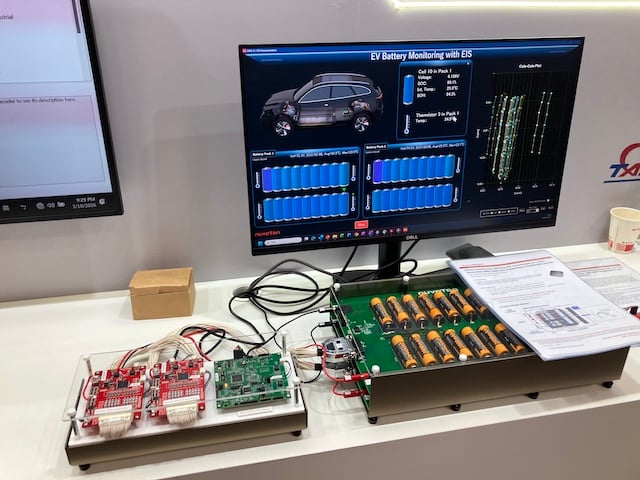
EV battery monitoring demo at Nuvoton’s Embedded World 2026 booth
Child: Now let's shift to the high-performance end of MCUs. Today’s MCUs can do a lot of processing and integrate an impressive amount of peripherals—plus an ability to do artificial intelligence (AI). I’ll want to get more into specifics about AI in my next question. But first off, what is the state of the art in terms of high-performance Nuvoton MCUs?
Tseng: Our NuMicro M55M1 series is a standout at the high-performance end, integrating the Arm Cortex-M55 CPU cores with a dedicated Ethos-U55 NPU. This combination provides the high performance and real-time inference required for advanced applications such as driver fatigue monitoring, gesture-based application, appliance control.
For applications requiring even more horsepower—such as industrial gateways or rich HMI platforms—our MA35D1 series utilizes the Cortex-A35 core running up to 800 MHz.
These high-performance platforms often feature built-in high-capability DDR memory and 2D graphics accelerators to simplify hardware design, while significantly improving the user experience. It’s about providing enough scalability to handle everything from complex ARGB gaming lighting to secure industrial communication.
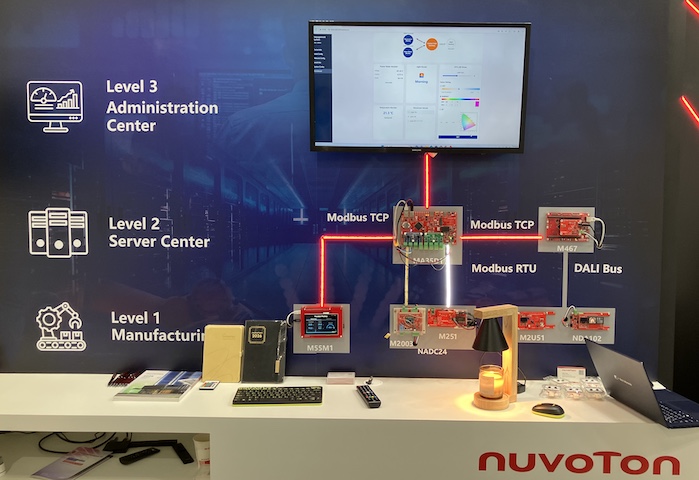
Several of Nuvoton’s MCUs on display in this booth demo of an MCU-powered industrial gateway ecosystem.
Child: In the past couple years, Edge AI has become a dynamic topic throughout the embedded industry and at shows like Embedded World. We just talked about Nuvoton’s high-performance MCUS. But now tell me what Nuvoton offers to meet the demand for Edge AI MCUs in terms of MCU products? And, as part of that, what AI tools do you offer for these designs?
Tseng: What we are seeing in the market is a massive push toward localized intelligence, which we call endpoint AI. To meet this demand, our flagship offering is the NuMicro M55M1 series. It is a powerhouse that integrates the Arm Cortex-M55 core with the Ethos-U55 NPU, especially designed for real-time on-device inference. By performing neural network processing locally on the MCU, we help developers prioritize data privacy and low latency in applications such as body pose detection and gesture recognition.
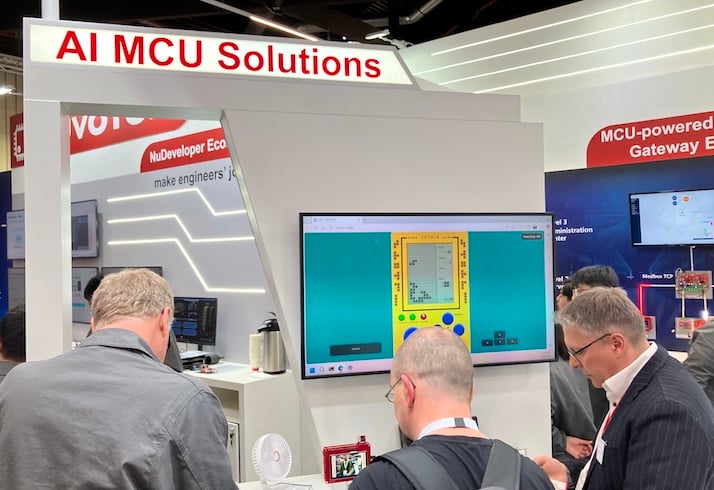
Engineers visiting Nuvoton’s Embedded World 2026 took a keen interest in the company’s AI MCUs.
Tseng (continues): From a tool perspective, we want to make the developer's job easier. We provide the NuML tool, which streamlines AI model deployment for edge devices. Our ecosystem is also compatible with TensorFlow Lite, allowing engineers to leverage existing models and transition quickly from prototyping to mass production without a massive increase in the power budget.
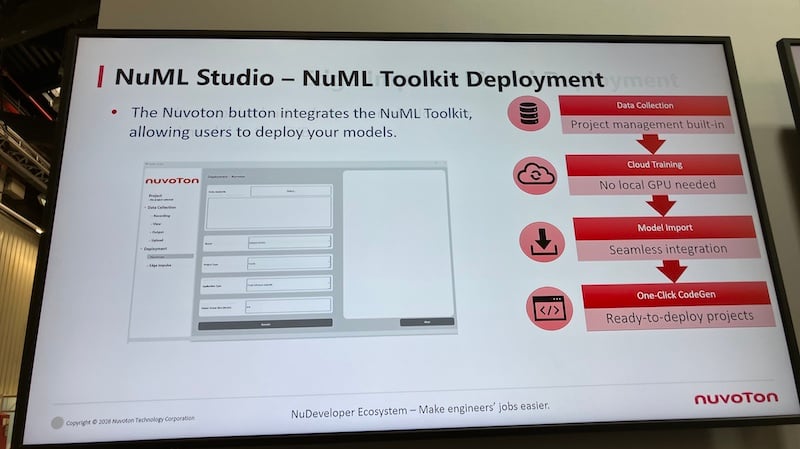
AI tools are a key part of Nuvoton’s offerings aimed at making AI-based systems easier to develop.
Child: You can find MCUs in all kinds of applications, and I know Nuvoton plays in many areas from Industrial to Communications to Consumer. But Automotive ranks as one of the most demanding and dynamic of these. Tell about Nuvoton’s latest and greatest MCU offerings that are aimed at the Automotive market.
Tseng: That's a good question. The automotive sector requires an exceptional balance of high performance and uncompromising reliability. All our automotive grade microcontrollers—such as the NuMicro M0A23 and M2A23 series—pass the AEC-Q100 automotive standard. The M0A23 MCU is a compact solution perfect for peripheral control and sensing, while the M2A23 is an upgraded version designed for intelligent driving and complex mini LED dynamic lighting control systems.
What's truly exciting is how we bring AI into the vehicle. Our M55M1 MCU supports advanced driving monitoring systems that can detect fatigue and attention levels in real time without relying on the cloud. Whether it's managing body control modules, dashboards, or ADAS, we provide a scalable base with long-term supply stability, which is vital for the automotive industry's decades-long life cycles.
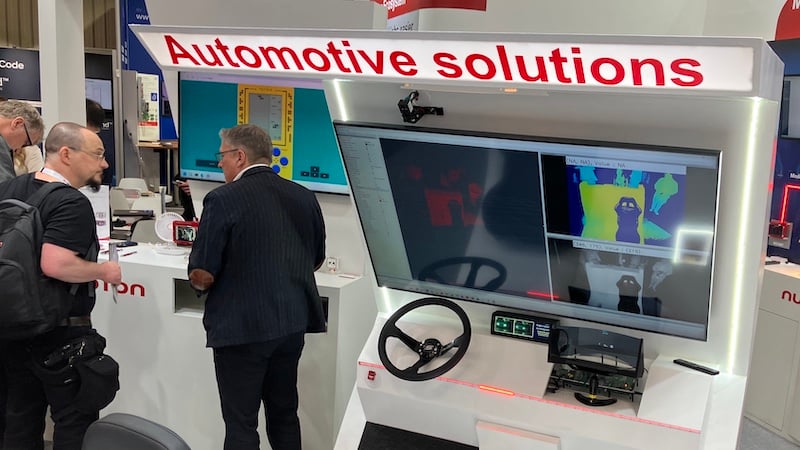
Nuvoton’s automotive MCU solutions were a popular attraction at this year’s Embedded World.
Child: Last question. Especially in connected applications like IoT and others, security is an important feature in today’s microcontrollers. Whether it’s meeting PSA Level 2 requirements or offering support for Arm Trustzone and secure boot, there are a lot of factors that go into embedded security. Talk to me about what security capabilities Nuvoton offers at the MCU-level.
Tseng: From our perspective, security is fundamental. Nuvoton has a very long heritage here---starting with our M2351 series. That MCU was the first Arm Cortex-M23 MCU to achieve the PSA Certified Level 1, Level 2, and also the PSA functional API certificate.
We have since pushed further with the M2354 series, which is the PSA Level 3 ready.
Our security architecture is multi-layered. We integrate Arm TrustZone for hardware isolation alongside secure boot, secure storage, and hardware crypto accelerators for AES, SHA, and ECC. We also address physical vulnerabilities through side-channel attack mitigation and tamper detection pins.
For higher-end applications, our MA35D1 microprocessor features Trusted Secure Island. It's an isolated security hardware unit that performs all cryptographic operations independently, ensuring that the data assets remain protected even in complex IoT environments.
All images are All About Circuits photos.
Related Content