
 Facebook
 Google
 GitHub
 Linkedin
AC Electric Circuits
Peak, Average, and RMS Measurements
10 questions By Tony R. Kuphaldt
-
Question 1 of 10
How is it possible to assign a fixed value of voltage or current (such as “120 volts”) to an AC electrical quantity that is constantly changing, crossing 0 volts, and reversing polarity?
Reveal answerWe may express quantities of AC voltage and current in terms of peak, peak-to-peak, average, or RMS.
Notes:Before you discuss “RMS” values with your students, it is important to cover the basic idea of how to assign fixed values to quantities that change over time. Since AC waveforms are cyclic (repeating), this is not as difficult to do as one might think.
-
Question 2 of 10
Suppose a DC power source with a voltage of 50 volts is connected to a 10 Ω load. How much power will this load dissipate?
Now suppose the same 10 Ω load is connected to a sinusoidal AC power source with a peak voltage of 50 volts. Will the load dissipate the same amount of power, more power, or less power? Explain your answer.
Reveal answer50 volts DC applied to a 10 Ω load will dissipate 250 watts of power. 50 volts (peak, sinusoidal) AC will deliver less than 250 watts to the same load.
Notes:There are many analogies to explain this discrepancy between the two “50 volt” sources. One is to compare the physical effort of a person pushing with a constant force of 50 pounds, versus someone who pushes intermittently with only a peak force of 50 pounds.
-
Question 3 of 10
Suppose that a variable-voltage AC source is adjusted until it dissipates the exact same amount of power in a standard load resistance as a DC voltage source with an output of 120 volts:
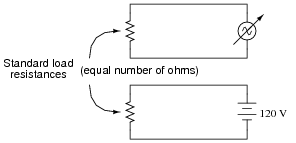
In this condition of equal power dissipation, how much voltage is the AC power supply outputting? Be as specific as you can in your answer.
Reveal answer120 volts AC RMS, by definition.
Notes:Ask your students, “how much peak voltage is the AC power source outputting? More or less than 120 volts?”
If one of your students claims to have calculated the peak voltage as 169.7 volts, ask them how they arrived at that answer. Then ask if that answer depends on the shape of the waveform (it does!). Note that the question did not specify a “sinusoidal” wave shape. Realistically, an adjustable-voltage AC power supply of substantial power output will likely be sinusoidal, being powered from utility AC power, but it could be a different wave-shape, depending on the nature of the source!






Hello, sorry but i doubt the asnwer to question #5, or at least i would ask for a better explanation.
For what i know, RMS amplitude of such a waveform is 1 x sqrt(0,5), while 0,5 seems to be average amplitude.