Facebook
 Google
 GitHub
 Linkedin
Basic Electricity
Performance-Based Assessments for Basic Electricity Competencies
29 questions By Tony R. Kuphaldt
-
Question 4 of 29

Reveal answerUse circuit simulation software to verify your predicted and measured parameter values.
Notes:Use a variable-voltage, regulated power supply to supply a suitable DC voltage for the incandescent lamp.
-
Question 5 of 29
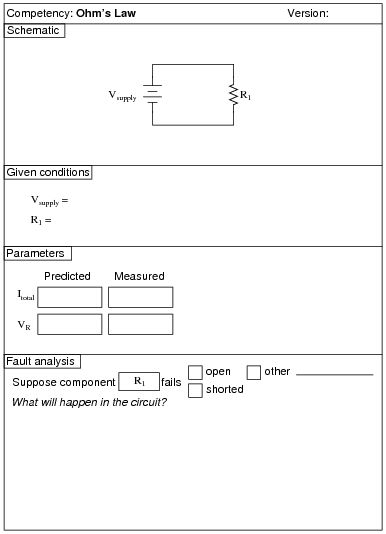
Reveal answerUse circuit simulation software to verify your predicted and measured parameter values.
Notes:Use a variable-voltage, regulated power supply to supply any amount of DC voltage below 30 volts. Specify a standard resistor value, somewhere between 1 kΩ and 100 kΩ (1k5, 2k2, 2k7, 3k3, 4k7, 5k1, 6k8, 10k, 22k, 33k, 39k 47k, 68k, etc.).
If using this question as a lab exercise rather than an assessment, I recommend specifying a voltage that is standard for batteries, so students don’t necessarily have to have an adjustable power supply available to do this lab.
For example, specify Vsupply as 6 volts and R1 as 33 kΩ. The resulting current is sufficient to provide a nice, strong needle deflection on most cheap analog ammeters, too!
-
Question 6 of 29
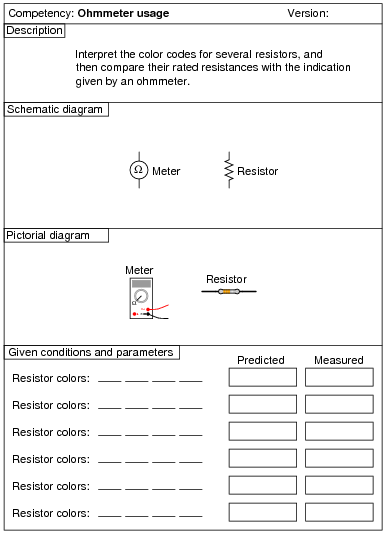
Reveal answerThe ohmmeter’s indication is the “final word” on resistance.
Notes:The purpose of this exercise is to make absolutely sure students can accurately measure resistance with a multimeter, and also that they can interpret resistor color codes. Select resistors that span a wide range, from less than 10 ohms to millions of ohms.
I recommend the following resistor color codes for students to try (all 5% tolerance):
- • Blk, Brn, Grn, Gld
- • Brn, Red, Brn, Gld
- • Blu, Gry, Blk, Gld
- • Red, Red, Org, Gld
- • Brn, Grn, Yel, Gld
- • Org, Org, Red, Gld
A good extension of this assessment is to have students demonstrate competency using both digital and analog multimeters!