Facebook
 Google
 GitHub
 Linkedin
Digital Circuits
Protective Relay Circuits
4 questions By Tony R. Kuphaldt
-
Question 1 of 4
Protective relays are special power-sensing devices whose job it is to automatically open or close circuit breakers in large electric power systems. Some protective relays are designed to be used directly with large electric motors to provide sophisticated monitoring, shut-down, and start-up control.
One of the features of these motor-oriented protective relays is start-up lockout. What this means is the relay will prevent someone from attempting too many successive re-starts of a large electric motor. If the motor is started and stopped several times over a short period of time, the relay will prevent the person from starting it again until a sufficient “rest” time has passed.
Explain why a large electric motor would need to “rest” after several successive start-up events. If electric motors are perfectly capable of running continuously at full load for years on end, why would a few start-ups be worthy of automatic lock-out?
Reveal answerI won’t give you a direct answer here, but I will provide a big hint: inrush current.
Notes:Inrush current is a factor with every motor type, AC or DC. It is easy to forget just how substantially larger a typical motor’s inrush current is compared to its normal full-load current. When students consider the magnitude of the currents involved, and also the fact that most electric motors are fan-cooled and therefore lacking in cooling during the initial moments of a start-up, the reason for automatic lock-out after several successive start-up events becomes obvious.
-
Question 2 of 4
Explain how this motor overcurrent protection circuit works:
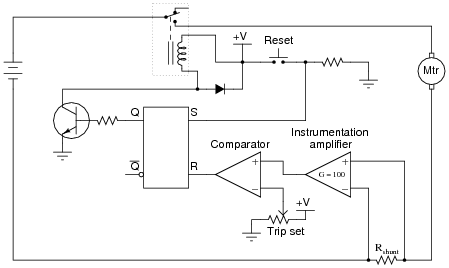
Reveal answerI’ll let you and your classmates figure out this circuit! It is fairly straightforward to analyze.
Notes:If you want to add more challenge to this question, ask your students to come up with practical component values. Of course, you will need to provide some base values such as:
- Maximum motor current (locked-rotor)
- Motor supply voltage
- Relay coil current
- Transistor β
-
Question 3 of 4
A differential relay is a common type of protective relay used in power systems. One of the more common forms is the differential current relay. A very common example of a differential current relay - so common, in fact, that nearly every house is equipped with at least one - is the GFCI, or Ground Fault Current Interrupter. Explain what a GFCI is, and then in a larger context, explain what a differential relay protects against.
Reveal answerThe function of a GFCI is very easy to research, so I’ll leave that to you. In a more general sense, a differential relay protects against conditions where two or more electrical quantities (usually current) are not in phasor balance. That is, a differential relay will trip when two or more electrical quantities do not precisely balance one another when they should.
Notes:This question affords students the opportunity to relate something they probably never have had exposure to (a differential protective relay) to something they may see every day (a GFCI-protected power receptacle). The purpose of this comparison, of course, is to give students a familiar context in which to understand something new.