Facebook
 Google
 GitHub
 Linkedin
Basic Electricity
Simple Circuits
41 questions By Tony R. Kuphaldt
-
Question 1 of 41
Shown here is the schematic symbol for a resistor:

What is the purpose of a resistor? What function does it perform? Also, draw an illustration of what a real resistor looks like.
Reveal answerThe purpose of a resistor is to provide a precise amount of electrical resistance in a circuit. Here is an illustration of a small (1/8 or 1/4 watt) resistor:

It is also good to know that the zig-zag symbol shown in the question is not the only symbol used to represent resistors. Another common resistor symbol is shown here:

Notes:Students may (properly) ask, “Why is there such a thing as a component whose sole purpose is to impede the flow of electrons?” While resistors may seem rather pointless at first, they end up being extremely valuable electrical/electronic components. If asked, you may cite several uses of resistors in circuits:
- • To limit maximum circuit current to a safe value.
- • To “split” a voltage into proportions.
- • To “scale” meter movements, for precise measurement of current and voltage.
- • To provide a non-shorting path to discharge static electricity.
-
Question 2 of 41
Resistors are sometimes represented in electrical and electronic schematic diagrams by a symbol other than this:

Draw this other symbol next to the one shown above.
Reveal answer
Notes:It might be a good idea to occasionally draw schematic diagrams for your students using the “other” resistor symbol, just so they are not taken by surprise when they see this symbol in real schematics. Just be sure to remain consistent in your symbolism within each diagram: never mix the two different symbols within the same schematic!
-
Question 3 of 41
What will this voltmeter register when connected to a battery as shown (assume a battery voltage of 6 volts)? Explain your answer.
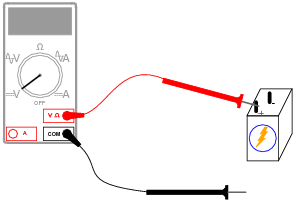
Reveal answerI could simply give you the answer, but this problem is so easy to simulate in real life that I’d rather let you try it yourself!
Follow-up question: what does this tell you about the nature of voltage, and how it is measured?
Notes:This question affords an excellent opportunity to discuss another foundational concept of electricity: that voltage is always measured between two points.